
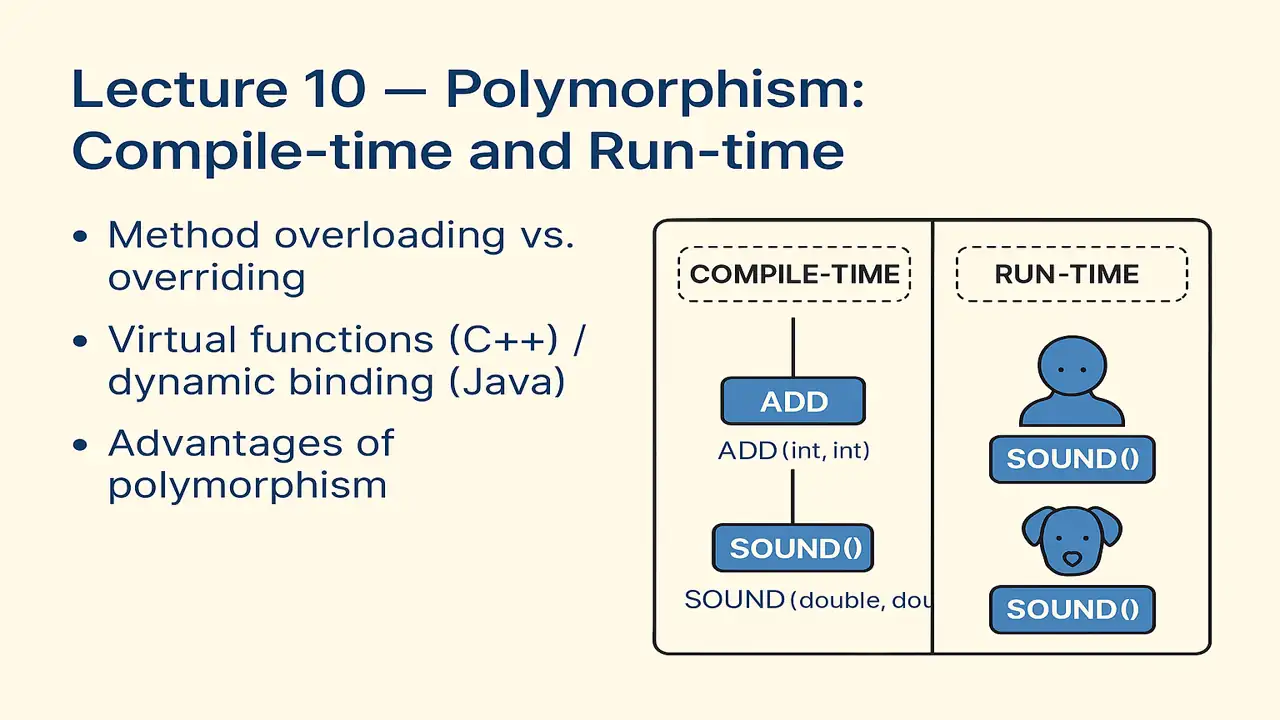
Polymorphism: Compile-time and Run-time
Learn Polymorphism in Object-Oriented Programming, including compile-time and run-time types. Understand method overloading, method overriding, virtual functions in C++, and dynamic binding in Java with practical coding examples.
What is Polymorphism?
Polymorphism comes from two Greek words:
Poly = many, Morph = forms
It means “one name, many forms.”
In Object-Oriented Programming, polymorphism allows one function, method, or operator to behave differently based on context depending on the type of object or number of arguments.
Definition:
Polymorphism is the ability of the same function or method to behave differently for different types of objects or inputs.
Lecture 9 – Inheritance in Practice
Types of Polymorphism
| Type | Description | Example |
|---|---|---|
| Compile-time (Static) | Decision made at compile time | Method Overloading |
| Run-time (Dynamic) | Decision made at runtime | Method Overriding |
Part 1: Compile-time Polymorphism (Static Binding)
Method Overloading
Method overloading means having multiple methods with the same name but different parameters (type, number, or order).
Example (C++):
#include <iostream>
using namespace std;

class Math {
public:
    int add(int a, int b) {
        return a + b;
    }

    double add(double a, double b) {
        return a + b;
    }

    int add(int a, int b, int c) {
        return a + b + c;
    }
};

int main() {
    Math m;
    cout << m.add(3, 4) << endl;        // Calls int version
    cout << m.add(2.5, 4.1) << endl;    // Calls double version
    cout << m.add(1, 2, 3) << endl;     // Calls 3-parameter version
}
Explanation:
- The compiler decides which version of
add()to call based on arguments. - This is known as compile-time binding.
Example (Java):
class MathUtils {
    int add(int a, int b) {
        return a + b;
    }

    double add(double a, double b) {
        return a + b;
    }

    int add(int a, int b, int c) {
        return a + b + c;
    }
}

public class Main {
    public static void main(String[] args) {
        MathUtils m = new MathUtils();
        System.out.println(m.add(3, 4));
        System.out.println(m.add(2.5, 4.5));
        System.out.println(m.add(1, 2, 3));
    }
}
Overloading increases flexibility and code readability.
Part 2: Run-time Polymorphism (Dynamic Binding)
Method Overriding
Method overriding occurs when a subclass provides a new implementation for a method already defined in its superclass.
Which version is executed depends on the object type at runtime.
Example (C++ with Virtual Functions):
#include <iostream>
using namespace std;

class Animal {
public:
    virtual void sound() {
        cout << "Animal makes a sound." << endl;
    }
};

class Dog : public Animal {
public:
    void sound() override {
        cout << "Dog barks." << endl;
    }
};

int main() {
    Animal* a;
    Dog d;
    a = &d;
    a->sound(); // Calls Dog's version due to virtual function
}
Explanation:
virtualtells the compiler to look for the method at runtime, not compile time.- Without
virtual, the base version would be called even when pointing to aDog.
Example (Java – Dynamic Binding):
class Animal {
    void sound() {
        System.out.println("Animal makes a sound.");
    }
}

class Dog extends Animal {
    @Override
    void sound() {
        System.out.println("Dog barks.");
    }
}

public class Main {
    public static void main(String[] args) {
        Animal a = new Dog();  // Reference of parent, object of child
        a.sound();  // Calls Dog’s version (runtime decision)
    }
}
In Java, all non-static methods are virtual by default.
So the method call depends on the actual object created, not the reference type.
Operator Overloading (C++ Only)
C++ also supports operator overloading, allowing built-in operators to behave differently for objects.
Example:
#include <iostream>
using namespace std;

class Complex {
public:
    int real, imag;

    Complex(int r, int i) : real(r), imag(i) {}

    Complex operator + (Complex c) {
        return Complex(real + c.real, imag + c.imag);
    }

    void display() {
        cout << real << " + " << imag << "i" << endl;
    }
};

int main() {
    Complex c1(2, 3), c2(4, 5);
    Complex c3 = c1 + c2;  // Uses overloaded +
    c3.display();
}
Advantages of Polymorphism
| Advantage | Description |
|---|---|
| Code Reusability | Use the same function name for different tasks. |
| Flexibility | Works with different object types dynamically. |
| Extensibility | Add new behaviors without changing existing code. |
| Maintainability | Simplifies large applications by promoting clean hierarchies. |
Summary of Lecture 10
| Concept | Type | Example |
|---|---|---|
| Method Overloading | Compile-time | add(int, int) & add(double, double) |
| Method Overriding | Run-time | sound() in Animal and Dog |
| Virtual Function | Enables runtime decision (C++) | virtual void sound() |
| Dynamic Binding | Java runtime decision | Animal a = new Dog() |
Positive Thought for Students
“Polymorphism is the art of adaptability the same name, new power. In coding and life, flexibility makes you unstoppable.”