Reproductive Biology MCQs with Answers
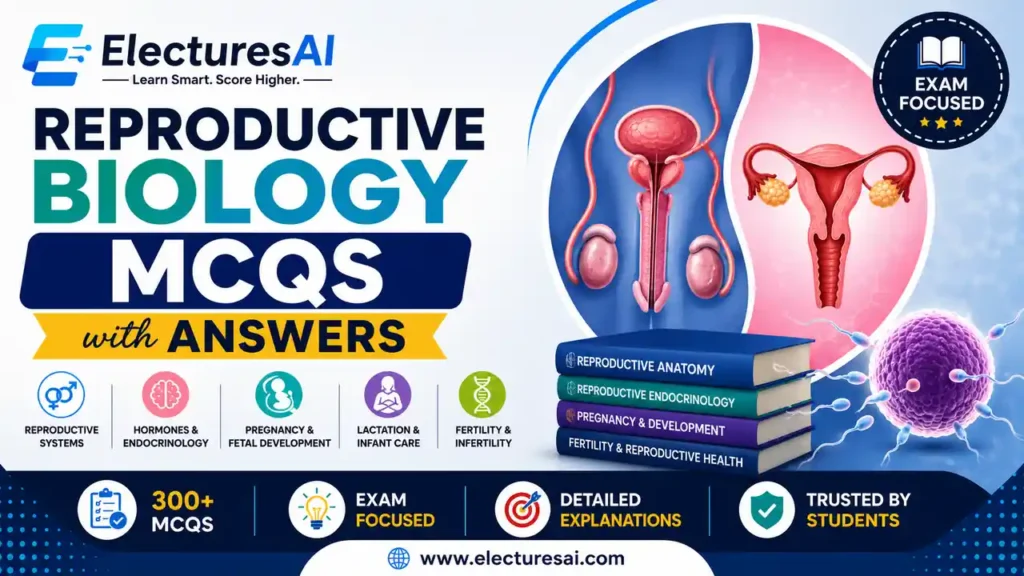
Practice Reproductive Biology MCQs with answers covering male and female reproductive systems, hormones, puberty, pregnancy, lactation, fertility, and reproductive endocrinology.

Reproductive Biology MCQs with Answers | ElecturesAI
ElecturesAI

Reproductive Biology MCQs with Answers

A complete practice file of 300 multiple-choice questions prepared from the provided course outline, with clean formatting, answer keys, and structured question schema.

Author Note

Prepared with dedication by Engr. Dr. Muhammad Tahir Dilbar to help students learn smarter, practice better, and achieve success with confidence.

Reproductive Biology Exam Preparation

This ElecturesAI resource covers reproductive biology around us, male and female reproductive systems, endocrinology, puberty, estrous and menstrual cycles, disorders of sexual development, folliculogenesis, spermatogenesis, fertilization, implantation, pregnancy, parturition, fertility regulation, reproductive aging, lactation, addiction and stress in reproduction, plus practical/histological topics.

Topics Covered

  • Reproductive Biology Overview
  • Male Reproductive System
  • Female Reproductive System
  • Reproductive Endocrinology
  • Puberty and Seasonality
  • Estrous and Menstrual Cycles
  • Sexual Development Disorders
  • Folliculogenesis
  • Spermatogenesis
  • Fertilization and Implantation
  • Pregnancy and Parturition
  • Obesity, Stress and Addiction
  • Lactation and Aging
  • Practical Histology

300 Reproductive Biology MCQs with Answers

Q1. Reproductive biology mainly deals with the study of:
  1. Digestion only
  2. Reproductive processes and organs
  3. Respiration only
  4. Excretion only
Answer: Reproductive processes and organs
Q2. The primary function of the male reproductive system is to produce:
  1. Ova
  2. Sperm
  3. Milk
  4. Placenta
Answer: Sperm
Q3. The primary function of the female reproductive system is to produce:
  1. Sperm
  2. Ova
  3. Testosterone only
  4. Semen
Answer: Ova
Q4. Which organ produces sperm in males?
  1. Ovary
  2. Testis
  3. Uterus
  4. Cervix
Answer: Testis
Q5. Which organ produces ova in females?
  1. Testis
  2. Ovary
  3. Prostate
  4. Epididymis
Answer: Ovary
Q6. The hormone mainly responsible for male secondary sexual characters is:
  1. Estrogen
  2. Testosterone
  3. Progesterone
  4. Oxytocin
Answer: Testosterone
Q7. Ovulation means:
  1. Release of an ovum
  2. Formation of semen
  3. Birth process
  4. Milk secretion
Answer: Release of an ovum
Q8. Fertilization usually involves fusion of:
  1. Two ova
  2. Sperm and ovum
  3. Two sperms
  4. Placenta and uterus
Answer: Sperm and ovum
Q9. Implantation is the attachment of embryo to the:
  1. Ovary
  2. Uterine wall
  3. Testis
  4. Vagina
Answer: Uterine wall
Q10. The pituitary hormone that stimulates follicular growth is:
  1. FSH
  2. Insulin
  3. Adrenaline
  4. Thyroxine
Answer: FSH
Q11. LH surge is most directly associated with:
  1. Ovulation
  2. Digestion
  3. Respiration
  4. Urine formation
Answer: Ovulation
Q12. The menstrual cycle occurs in:
  1. Most birds
  2. Human females and some primates
  3. Only reptiles
  4. Only insects
Answer: Human females and some primates
Q13. Estrous cycle is common in:
  1. Many non-primate mammals
  2. All plants
  3. Only humans
  4. Bacteria
Answer: Many non-primate mammals
Q14. Puberty is the stage when:
  1. Reproductive maturity begins
  2. Aging ends
  3. Digestion stops
  4. Bones disappear
Answer: Reproductive maturity begins
Q15. The epididymis is mainly involved in:
  1. Sperm maturation and storage
  2. Ovum release
  3. Milk production
  4. Placenta formation
Answer: Sperm maturation and storage
Q16. The uterus is the site of:
  1. Sperm production
  2. Embryo development
  3. Testosterone storage
  4. Semen formation
Answer: Embryo development
Q17. The placenta supports the fetus by:
  1. Gas and nutrient exchange
  2. Producing sperm
  3. Breaking bones
  4. Stopping circulation
Answer: Gas and nutrient exchange
Q18. Parturition refers to:
  1. Birth process
  2. Ovum formation
  3. Semen production
  4. Puberty onset
Answer: Birth process
Q19. Lactation means:
  1. Milk production and secretion
  2. Sperm movement
  3. Ovulation
  4. Embryo implantation
Answer: Milk production and secretion
Q20. Prolactin mainly stimulates:
  1. Milk synthesis
  2. Sperm motility
  3. Bone decay
  4. Menstruation only
Answer: Milk synthesis
Q21. Oxytocin is important for:
  1. Milk ejection and uterine contractions
  2. Sperm formation only
  3. Blood clotting only
  4. Vision
Answer: Milk ejection and uterine contractions
Q22. Folliculogenesis occurs in the:
  1. Ovary
  2. Testis
  3. Liver
  4. Kidney
Answer: Ovary
Q23. Spermatogenesis occurs in the:
  1. Seminiferous tubules
  2. Uterus
  3. Oviduct
  4. Mammary gland
Answer: Seminiferous tubules
Q24. The acrosome of sperm helps in:
  1. Penetrating the ovum
  2. Producing milk
  3. Forming placenta
  4. Digesting food
Answer: Penetrating the ovum
Q25. A zygote is formed after:
  1. Fertilization
  2. Puberty
  3. Lactation
  4. Menopause
Answer: Fertilization
Q26. The fallopian tube is also called:
  1. Oviduct
  2. Prostate
  3. Scrotum
  4. Vas deferens
Answer: Oviduct
Q27. The vas deferens transports:
  1. Sperm
  2. Ova
  3. Milk
  4. Amniotic fluid
Answer: Sperm
Q28. The prostate gland contributes to:
  1. Seminal fluid
  2. Ovum formation
  3. Placenta formation
  4. Fetal bones
Answer: Seminal fluid
Q29. The cervix is part of the:
  1. Female reproductive tract
  2. Male reproductive tract
  3. Digestive tract only
  4. Respiratory tract only
Answer: Female reproductive tract
Q30. Menopause is associated with:
  1. End of regular menstrual cycles
  2. Start of puberty
  3. Sperm production
  4. Birth only
Answer: End of regular menstrual cycles
Q31. Reproductive aging in females commonly involves decline in:
  1. Ovarian reserve
  2. Kidney number
  3. Lung size only
  4. Hair color only
Answer: Ovarian reserve
Q32. Stress can affect reproduction by altering:
  1. Hormonal balance
  2. Tooth enamel only
  3. Eye color
  4. Height instantly
Answer: Hormonal balance
Q33. Addiction may disturb reproduction through effects on:
  1. Endocrine and reproductive function
  2. Only fingerprints
  3. Only nail growth
  4. Only hearing
Answer: Endocrine and reproductive function
Q34. Seasonality of breeding is controlled partly by:
  1. Photoperiod
  2. Shoe size
  3. Blood group only
  4. Language
Answer: Photoperiod
Q35. Melatonin is linked with:
  1. Light-dark regulation of seasonal reproduction
  2. Semen storage only
  3. Ovum size only
  4. Bone digestion
Answer: Light-dark regulation of seasonal reproduction
Q36. The hypothalamus releases:
  1. GnRH
  2. Hemoglobin
  3. Bile
  4. Pepsin
Answer: GnRH
Q37. GnRH stimulates the pituitary to release:
  1. FSH and LH
  2. Bile and saliva
  3. Insulin only
  4. Adrenaline only
Answer: FSH and LH
Q38. Progesterone is mainly secreted by:
  1. Corpus luteum
  2. Epididymis
  3. Prostate
  4. Scrotum
Answer: Corpus luteum
Q39. Estrogen is mainly associated with:
  1. Female reproductive development
  2. Sperm tail formation only
  3. Blood clotting only
  4. Vision only
Answer: Female reproductive development
Q40. The corpus luteum forms after:
  1. Ovulation
  2. Implantation only
  3. Birth only
  4. Lactation only
Answer: Ovulation
Q41. Reproductive biology mainly deals with the study of: (overview)
  1. Digestion only
  2. Reproductive processes and organs
  3. Respiration only
  4. Excretion only
Answer: Reproductive processes and organs
Q42. The primary function of the male reproductive system is to produce: (male reproductive system)
  1. Ova
  2. Sperm
  3. Milk
  4. Placenta
Answer: Sperm
Q43. The primary function of the female reproductive system is to produce: (female reproductive system)
  1. Sperm
  2. Ova
  3. Testosterone only
  4. Semen
Answer: Ova
Q44. Which organ produces sperm in males in endocrinology?
  1. Ovary
  2. Testis
  3. Uterus
  4. Cervix
Answer: Testis
Q45. Which organ produces ova in females in puberty?
  1. Testis
  2. Ovary
  3. Prostate
  4. Epididymis
Answer: Ovary
Q46. The hormone mainly responsible for male secondary sexual characters is: (estrous cycle)
  1. Estrogen
  2. Testosterone
  3. Progesterone
  4. Oxytocin
Answer: Testosterone
Q47. Ovulation means: (menstrual cycle)
  1. Release of an ovum
  2. Formation of semen
  3. Birth process
  4. Milk secretion
Answer: Release of an ovum
Q48. Fertilization usually involves fusion of: (disorders of sexual development)
  1. Two ova
  2. Sperm and ovum
  3. Two sperms
  4. Placenta and uterus
Answer: Sperm and ovum
Q49. Implantation is the attachment of embryo to the: (folliculogenesis)
  1. Ovary
  2. Uterine wall
  3. Testis
  4. Vagina
Answer: Uterine wall
Q50. The pituitary hormone that stimulates follicular growth is: (spermatogenesis)
  1. FSH
  2. Insulin
  3. Adrenaline
  4. Thyroxine
Answer: FSH
Q51. LH surge is most directly associated with: (fertilization)
  1. Ovulation
  2. Digestion
  3. Respiration
  4. Urine formation
Answer: Ovulation
Q52. The menstrual cycle occurs in: (implantation)
  1. Most birds
  2. Human females and some primates
  3. Only reptiles
  4. Only insects
Answer: Human females and some primates
Q53. Estrous cycle is common in: (pregnancy)
  1. Many non-primate mammals
  2. All plants
  3. Only humans
  4. Bacteria
Answer: Many non-primate mammals
Q54. Puberty is the stage when: (parturition)
  1. Reproductive maturity begins
  2. Aging ends
  3. Digestion stops
  4. Bones disappear
Answer: Reproductive maturity begins
Q55. The epididymis is mainly involved in: (fertility regulation)
  1. Sperm maturation and storage
  2. Ovum release
  3. Milk production
  4. Placenta formation
Answer: Sperm maturation and storage
Q56. The uterus is the site of: (reproductive aging)
  1. Sperm production
  2. Embryo development
  3. Testosterone storage
  4. Semen formation
Answer: Embryo development
Q57. The placenta supports the fetus by: (lactation)
  1. Gas and nutrient exchange
  2. Producing sperm
  3. Breaking bones
  4. Stopping circulation
Answer: Gas and nutrient exchange
Q58. Parturition refers to: (addictions and reproduction)
  1. Birth process
  2. Ovum formation
  3. Semen production
  4. Puberty onset
Answer: Birth process
Q59. Lactation means: (stress in reproduction)
  1. Milk production and secretion
  2. Sperm movement
  3. Ovulation
  4. Embryo implantation
Answer: Milk production and secretion
Q60. Prolactin mainly stimulates: (histology practicals)
  1. Milk synthesis
  2. Sperm motility
  3. Bone decay
  4. Menstruation only
Answer: Milk synthesis
Q61. Oxytocin is important for: (overview)
  1. Milk ejection and uterine contractions
  2. Sperm formation only
  3. Blood clotting only
  4. Vision
Answer: Milk ejection and uterine contractions
Q62. Folliculogenesis occurs in the: (male reproductive system)
  1. Ovary
  2. Testis
  3. Liver
  4. Kidney
Answer: Ovary
Q63. Spermatogenesis occurs in the: (female reproductive system)
  1. Seminiferous tubules
  2. Uterus
  3. Oviduct
  4. Mammary gland
Answer: Seminiferous tubules
Q64. The acrosome of sperm helps in: (endocrinology)
  1. Penetrating the ovum
  2. Producing milk
  3. Forming placenta
  4. Digesting food
Answer: Penetrating the ovum
Q65. A zygote is formed after: (puberty)
  1. Fertilization
  2. Puberty
  3. Lactation
  4. Menopause
Answer: Fertilization
Q66. The fallopian tube is also called: (estrous cycle)
  1. Oviduct
  2. Prostate
  3. Scrotum
  4. Vas deferens
Answer: Oviduct
Q67. The vas deferens transports: (menstrual cycle)
  1. Sperm
  2. Ova
  3. Milk
  4. Amniotic fluid
Answer: Sperm
Q68. The prostate gland contributes to: (disorders of sexual development)
  1. Seminal fluid
  2. Ovum formation
  3. Placenta formation
  4. Fetal bones
Answer: Seminal fluid
Q69. The cervix is part of the: (folliculogenesis)
  1. Female reproductive tract
  2. Male reproductive tract
  3. Digestive tract only
  4. Respiratory tract only
Answer: Female reproductive tract
Q70. Menopause is associated with: (spermatogenesis)
  1. End of regular menstrual cycles
  2. Start of puberty
  3. Sperm production
  4. Birth only
Answer: End of regular menstrual cycles
Q71. Reproductive aging in females commonly involves decline in: (fertilization)
  1. Ovarian reserve
  2. Kidney number
  3. Lung size only
  4. Hair color only
Answer: Ovarian reserve
Q72. Stress can affect reproduction by altering: (implantation)
  1. Hormonal balance
  2. Tooth enamel only
  3. Eye color
  4. Height instantly
Answer: Hormonal balance
Q73. Addiction may disturb reproduction through effects on: (pregnancy)
  1. Endocrine and reproductive function
  2. Only fingerprints
  3. Only nail growth
  4. Only hearing
Answer: Endocrine and reproductive function
Q74. Seasonality of breeding is controlled partly by: (parturition)
  1. Photoperiod
  2. Shoe size
  3. Blood group only
  4. Language
Answer: Photoperiod
Q75. Melatonin is linked with: (fertility regulation)
  1. Light-dark regulation of seasonal reproduction
  2. Semen storage only
  3. Ovum size only
  4. Bone digestion
Answer: Light-dark regulation of seasonal reproduction
Q76. The hypothalamus releases: (reproductive aging)
  1. GnRH
  2. Hemoglobin
  3. Bile
  4. Pepsin
Answer: GnRH
Q77. GnRH stimulates the pituitary to release: (lactation)
  1. FSH and LH
  2. Bile and saliva
  3. Insulin only
  4. Adrenaline only
Answer: FSH and LH
Q78. Progesterone is mainly secreted by: (addictions and reproduction)
  1. Corpus luteum
  2. Epididymis
  3. Prostate
  4. Scrotum
Answer: Corpus luteum
Q79. Estrogen is mainly associated with: (stress in reproduction)
  1. Female reproductive development
  2. Sperm tail formation only
  3. Blood clotting only
  4. Vision only
Answer: Female reproductive development
Q80. The corpus luteum forms after: (histology practicals)
  1. Ovulation
  2. Implantation only
  3. Birth only
  4. Lactation only
Answer: Ovulation
Q81. Reproductive biology mainly deals with the study of: (overview)
  1. Digestion only
  2. Reproductive processes and organs
  3. Respiration only
  4. Excretion only
Answer: Reproductive processes and organs
Q82. The primary function of the male reproductive system is to produce: (male reproductive system)
  1. Ova
  2. Sperm
  3. Milk
  4. Placenta
Answer: Sperm
Q83. The primary function of the female reproductive system is to produce: (female reproductive system)
  1. Sperm
  2. Ova
  3. Testosterone only
  4. Semen
Answer: Ova
Q84. Which organ produces sperm in males in endocrinology?
  1. Ovary
  2. Testis
  3. Uterus
  4. Cervix
Answer: Testis
Q85. Which organ produces ova in females in puberty?
  1. Testis
  2. Ovary
  3. Prostate
  4. Epididymis
Answer: Ovary
Q86. The hormone mainly responsible for male secondary sexual characters is: (estrous cycle)
  1. Estrogen
  2. Testosterone
  3. Progesterone
  4. Oxytocin
Answer: Testosterone
Q87. Ovulation means: (menstrual cycle)
  1. Release of an ovum
  2. Formation of semen
  3. Birth process
  4. Milk secretion
Answer: Release of an ovum
Q88. Fertilization usually involves fusion of: (disorders of sexual development)
  1. Two ova
  2. Sperm and ovum
  3. Two sperms
  4. Placenta and uterus
Answer: Sperm and ovum
Q89. Implantation is the attachment of embryo to the: (folliculogenesis)
  1. Ovary
  2. Uterine wall
  3. Testis
  4. Vagina
Answer: Uterine wall
Q90. The pituitary hormone that stimulates follicular growth is: (spermatogenesis)
  1. FSH
  2. Insulin
  3. Adrenaline
  4. Thyroxine
Answer: FSH
Q91. LH surge is most directly associated with: (fertilization)
  1. Ovulation
  2. Digestion
  3. Respiration
  4. Urine formation
Answer: Ovulation
Q92. The menstrual cycle occurs in: (implantation)
  1. Most birds
  2. Human females and some primates
  3. Only reptiles
  4. Only insects
Answer: Human females and some primates
Q93. Estrous cycle is common in: (pregnancy)
  1. Many non-primate mammals
  2. All plants
  3. Only humans
  4. Bacteria
Answer: Many non-primate mammals
Q94. Puberty is the stage when: (parturition)
  1. Reproductive maturity begins
  2. Aging ends
  3. Digestion stops
  4. Bones disappear
Answer: Reproductive maturity begins
Q95. The epididymis is mainly involved in: (fertility regulation)
  1. Sperm maturation and storage
  2. Ovum release
  3. Milk production
  4. Placenta formation
Answer: Sperm maturation and storage
Q96. The uterus is the site of: (reproductive aging)
  1. Sperm production
  2. Embryo development
  3. Testosterone storage
  4. Semen formation
Answer: Embryo development
Q97. The placenta supports the fetus by: (lactation)
  1. Gas and nutrient exchange
  2. Producing sperm
  3. Breaking bones
  4. Stopping circulation
Answer: Gas and nutrient exchange
Q98. Parturition refers to: (addictions and reproduction)
  1. Birth process
  2. Ovum formation
  3. Semen production
  4. Puberty onset
Answer: Birth process
Q99. Lactation means: (stress in reproduction)
  1. Milk production and secretion
  2. Sperm movement
  3. Ovulation
  4. Embryo implantation
Answer: Milk production and secretion
Q100. Prolactin mainly stimulates: (histology practicals)
  1. Milk synthesis
  2. Sperm motility
  3. Bone decay
  4. Menstruation only
Answer: Milk synthesis
Q101. Oxytocin is important for: (overview)
  1. Milk ejection and uterine contractions
  2. Sperm formation only
  3. Blood clotting only
  4. Vision
Answer: Milk ejection and uterine contractions
Q102. Folliculogenesis occurs in the: (male reproductive system)
  1. Ovary
  2. Testis
  3. Liver
  4. Kidney
Answer: Ovary
Q103. Spermatogenesis occurs in the: (female reproductive system)
  1. Seminiferous tubules
  2. Uterus
  3. Oviduct
  4. Mammary gland
Answer: Seminiferous tubules
Q104. The acrosome of sperm helps in: (endocrinology)
  1. Penetrating the ovum
  2. Producing milk
  3. Forming placenta
  4. Digesting food
Answer: Penetrating the ovum
Q105. A zygote is formed after: (puberty)
  1. Fertilization
  2. Puberty
  3. Lactation
  4. Menopause
Answer: Fertilization
Q106. The fallopian tube is also called: (estrous cycle)
  1. Oviduct
  2. Prostate
  3. Scrotum
  4. Vas deferens
Answer: Oviduct
Q107. The vas deferens transports: (menstrual cycle)
  1. Sperm
  2. Ova
  3. Milk
  4. Amniotic fluid
Answer: Sperm
Q108. The prostate gland contributes to: (disorders of sexual development)
  1. Seminal fluid
  2. Ovum formation
  3. Placenta formation
  4. Fetal bones
Answer: Seminal fluid
Q109. The cervix is part of the: (folliculogenesis)
  1. Female reproductive tract
  2. Male reproductive tract
  3. Digestive tract only
  4. Respiratory tract only
Answer: Female reproductive tract
Q110. Menopause is associated with: (spermatogenesis)
  1. End of regular menstrual cycles
  2. Start of puberty
  3. Sperm production
  4. Birth only
Answer: End of regular menstrual cycles
Q111. Reproductive aging in females commonly involves decline in: (fertilization)
  1. Ovarian reserve
  2. Kidney number
  3. Lung size only
  4. Hair color only
Answer: Ovarian reserve
Q112. Stress can affect reproduction by altering: (implantation)
  1. Hormonal balance
  2. Tooth enamel only
  3. Eye color
  4. Height instantly
Answer: Hormonal balance
Q113. Addiction may disturb reproduction through effects on: (pregnancy)
  1. Endocrine and reproductive function
  2. Only fingerprints
  3. Only nail growth
  4. Only hearing
Answer: Endocrine and reproductive function
Q114. Seasonality of breeding is controlled partly by: (parturition)
  1. Photoperiod
  2. Shoe size
  3. Blood group only
  4. Language
Answer: Photoperiod
Q115. Melatonin is linked with: (fertility regulation)
  1. Light-dark regulation of seasonal reproduction
  2. Semen storage only
  3. Ovum size only
  4. Bone digestion
Answer: Light-dark regulation of seasonal reproduction
Q116. The hypothalamus releases: (reproductive aging)
  1. GnRH
  2. Hemoglobin
  3. Bile
  4. Pepsin
Answer: GnRH
Q117. GnRH stimulates the pituitary to release: (lactation)
  1. FSH and LH
  2. Bile and saliva
  3. Insulin only
  4. Adrenaline only
Answer: FSH and LH
Q118. Progesterone is mainly secreted by: (addictions and reproduction)
  1. Corpus luteum
  2. Epididymis
  3. Prostate
  4. Scrotum
Answer: Corpus luteum
Q119. Estrogen is mainly associated with: (stress in reproduction)
  1. Female reproductive development
  2. Sperm tail formation only
  3. Blood clotting only
  4. Vision only
Answer: Female reproductive development
Q120. The corpus luteum forms after: (histology practicals)
  1. Ovulation
  2. Implantation only
  3. Birth only
  4. Lactation only
Answer: Ovulation
Q121. Reproductive biology mainly deals with the study of: (overview)
  1. Digestion only
  2. Reproductive processes and organs
  3. Respiration only
  4. Excretion only
Answer: Reproductive processes and organs
Q122. The primary function of the male reproductive system is to produce: (male reproductive system)
  1. Ova
  2. Sperm
  3. Milk
  4. Placenta
Answer: Sperm
Q123. The primary function of the female reproductive system is to produce: (female reproductive system)
  1. Sperm
  2. Ova
  3. Testosterone only
  4. Semen
Answer: Ova
Q124. Which organ produces sperm in males in endocrinology?
  1. Ovary
  2. Testis
  3. Uterus
  4. Cervix
Answer: Testis
Q125. Which organ produces ova in females in puberty?
  1. Testis
  2. Ovary
  3. Prostate
  4. Epididymis
Answer: Ovary
Q126. The hormone mainly responsible for male secondary sexual characters is: (estrous cycle)
  1. Estrogen
  2. Testosterone
  3. Progesterone
  4. Oxytocin
Answer: Testosterone
Q127. Ovulation means: (menstrual cycle)
  1. Release of an ovum
  2. Formation of semen
  3. Birth process
  4. Milk secretion
Answer: Release of an ovum
Q128. Fertilization usually involves fusion of: (disorders of sexual development)
  1. Two ova
  2. Sperm and ovum
  3. Two sperms
  4. Placenta and uterus
Answer: Sperm and ovum
Q129. Implantation is the attachment of embryo to the: (folliculogenesis)
  1. Ovary
  2. Uterine wall
  3. Testis
  4. Vagina
Answer: Uterine wall
Q130. The pituitary hormone that stimulates follicular growth is: (spermatogenesis)
  1. FSH
  2. Insulin
  3. Adrenaline
  4. Thyroxine
Answer: FSH
Q131. LH surge is most directly associated with: (fertilization)
  1. Ovulation
  2. Digestion
  3. Respiration
  4. Urine formation
Answer: Ovulation
Q132. The menstrual cycle occurs in: (implantation)
  1. Most birds
  2. Human females and some primates
  3. Only reptiles
  4. Only insects
Answer: Human females and some primates
Q133. Estrous cycle is common in: (pregnancy)
  1. Many non-primate mammals
  2. All plants
  3. Only humans
  4. Bacteria
Answer: Many non-primate mammals
Q134. Puberty is the stage when: (parturition)
  1. Reproductive maturity begins
  2. Aging ends
  3. Digestion stops
  4. Bones disappear
Answer: Reproductive maturity begins
Q135. The epididymis is mainly involved in: (fertility regulation)
  1. Sperm maturation and storage
  2. Ovum release
  3. Milk production
  4. Placenta formation
Answer: Sperm maturation and storage
Q136. The uterus is the site of: (reproductive aging)
  1. Sperm production
  2. Embryo development
  3. Testosterone storage
  4. Semen formation
Answer: Embryo development
Q137. The placenta supports the fetus by: (lactation)
  1. Gas and nutrient exchange
  2. Producing sperm
  3. Breaking bones
  4. Stopping circulation
Answer: Gas and nutrient exchange
Q138. Parturition refers to: (addictions and reproduction)
  1. Birth process
  2. Ovum formation
  3. Semen production
  4. Puberty onset
Answer: Birth process
Q139. Lactation means: (stress in reproduction)
  1. Milk production and secretion
  2. Sperm movement
  3. Ovulation
  4. Embryo implantation
Answer: Milk production and secretion
Q140. Prolactin mainly stimulates: (histology practicals)
  1. Milk synthesis
  2. Sperm motility
  3. Bone decay
  4. Menstruation only
Answer: Milk synthesis
Q141. Oxytocin is important for: (overview)
  1. Milk ejection and uterine contractions
  2. Sperm formation only
  3. Blood clotting only
  4. Vision
Answer: Milk ejection and uterine contractions
Q142. Folliculogenesis occurs in the: (male reproductive system)
  1. Ovary
  2. Testis
  3. Liver
  4. Kidney
Answer: Ovary
Q143. Spermatogenesis occurs in the: (female reproductive system)
  1. Seminiferous tubules
  2. Uterus
  3. Oviduct
  4. Mammary gland
Answer: Seminiferous tubules
Q144. The acrosome of sperm helps in: (endocrinology)
  1. Penetrating the ovum
  2. Producing milk
  3. Forming placenta
  4. Digesting food
Answer: Penetrating the ovum
Q145. A zygote is formed after: (puberty)
  1. Fertilization
  2. Puberty
  3. Lactation
  4. Menopause
Answer: Fertilization
Q146. The fallopian tube is also called: (estrous cycle)
  1. Oviduct
  2. Prostate
  3. Scrotum
  4. Vas deferens
Answer: Oviduct
Q147. The vas deferens transports: (menstrual cycle)
  1. Sperm
  2. Ova
  3. Milk
  4. Amniotic fluid
Answer: Sperm
Q148. The prostate gland contributes to: (disorders of sexual development)
  1. Seminal fluid
  2. Ovum formation
  3. Placenta formation
  4. Fetal bones
Answer: Seminal fluid
Q149. The cervix is part of the: (folliculogenesis)
  1. Female reproductive tract
  2. Male reproductive tract
  3. Digestive tract only
  4. Respiratory tract only
Answer: Female reproductive tract
Q150. Menopause is associated with: (spermatogenesis)
  1. End of regular menstrual cycles
  2. Start of puberty
  3. Sperm production
  4. Birth only
Answer: End of regular menstrual cycles
Q151. Reproductive aging in females commonly involves decline in: (fertilization)
  1. Ovarian reserve
  2. Kidney number
  3. Lung size only
  4. Hair color only
Answer: Ovarian reserve
Q152. Stress can affect reproduction by altering: (implantation)
  1. Hormonal balance
  2. Tooth enamel only
  3. Eye color
  4. Height instantly
Answer: Hormonal balance
Q153. Addiction may disturb reproduction through effects on: (pregnancy)
  1. Endocrine and reproductive function
  2. Only fingerprints
  3. Only nail growth
  4. Only hearing
Answer: Endocrine and reproductive function
Q154. Seasonality of breeding is controlled partly by: (parturition)
  1. Photoperiod
  2. Shoe size
  3. Blood group only
  4. Language
Answer: Photoperiod
Q155. Melatonin is linked with: (fertility regulation)
  1. Light-dark regulation of seasonal reproduction
  2. Semen storage only
  3. Ovum size only
  4. Bone digestion
Answer: Light-dark regulation of seasonal reproduction
Q156. The hypothalamus releases: (reproductive aging)
  1. GnRH
  2. Hemoglobin
  3. Bile
  4. Pepsin
Answer: GnRH
Q157. GnRH stimulates the pituitary to release: (lactation)
  1. FSH and LH
  2. Bile and saliva
  3. Insulin only
  4. Adrenaline only
Answer: FSH and LH
Q158. Progesterone is mainly secreted by: (addictions and reproduction)
  1. Corpus luteum
  2. Epididymis
  3. Prostate
  4. Scrotum
Answer: Corpus luteum
Q159. Estrogen is mainly associated with: (stress in reproduction)
  1. Female reproductive development
  2. Sperm tail formation only
  3. Blood clotting only
  4. Vision only
Answer: Female reproductive development
Q160. The corpus luteum forms after: (histology practicals)
  1. Ovulation
  2. Implantation only
  3. Birth only
  4. Lactation only
Answer: Ovulation
Q161. Reproductive biology mainly deals with the study of: (overview)
  1. Digestion only
  2. Reproductive processes and organs
  3. Respiration only
  4. Excretion only
Answer: Reproductive processes and organs
Q162. The primary function of the male reproductive system is to produce: (male reproductive system)
  1. Ova
  2. Sperm
  3. Milk
  4. Placenta
Answer: Sperm
Q163. The primary function of the female reproductive system is to produce: (female reproductive system)
  1. Sperm
  2. Ova
  3. Testosterone only
  4. Semen
Answer: Ova
Q164. Which organ produces sperm in males in endocrinology?
  1. Ovary
  2. Testis
  3. Uterus
  4. Cervix
Answer: Testis
Q165. Which organ produces ova in females in puberty?
  1. Testis
  2. Ovary
  3. Prostate
  4. Epididymis
Answer: Ovary
Q166. The hormone mainly responsible for male secondary sexual characters is: (estrous cycle)
  1. Estrogen
  2. Testosterone
  3. Progesterone
  4. Oxytocin
Answer: Testosterone
Q167. Ovulation means: (menstrual cycle)
  1. Release of an ovum
  2. Formation of semen
  3. Birth process
  4. Milk secretion
Answer: Release of an ovum
Q168. Fertilization usually involves fusion of: (disorders of sexual development)
  1. Two ova
  2. Sperm and ovum
  3. Two sperms
  4. Placenta and uterus
Answer: Sperm and ovum
Q169. Implantation is the attachment of embryo to the: (folliculogenesis)
  1. Ovary
  2. Uterine wall
  3. Testis
  4. Vagina
Answer: Uterine wall
Q170. The pituitary hormone that stimulates follicular growth is: (spermatogenesis)
  1. FSH
  2. Insulin
  3. Adrenaline
  4. Thyroxine
Answer: FSH
Q171. LH surge is most directly associated with: (fertilization)
  1. Ovulation
  2. Digestion
  3. Respiration
  4. Urine formation
Answer: Ovulation
Q172. The menstrual cycle occurs in: (implantation)
  1. Most birds
  2. Human females and some primates
  3. Only reptiles
  4. Only insects
Answer: Human females and some primates
Q173. Estrous cycle is common in: (pregnancy)
  1. Many non-primate mammals
  2. All plants
  3. Only humans
  4. Bacteria
Answer: Many non-primate mammals
Q174. Puberty is the stage when: (parturition)
  1. Reproductive maturity begins
  2. Aging ends
  3. Digestion stops
  4. Bones disappear
Answer: Reproductive maturity begins
Q175. The epididymis is mainly involved in: (fertility regulation)
  1. Sperm maturation and storage
  2. Ovum release
  3. Milk production
  4. Placenta formation
Answer: Sperm maturation and storage
Q176. The uterus is the site of: (reproductive aging)
  1. Sperm production
  2. Embryo development
  3. Testosterone storage
  4. Semen formation
Answer: Embryo development
Q177. The placenta supports the fetus by: (lactation)
  1. Gas and nutrient exchange
  2. Producing sperm
  3. Breaking bones
  4. Stopping circulation
Answer: Gas and nutrient exchange
Q178. Parturition refers to: (addictions and reproduction)
  1. Birth process
  2. Ovum formation
  3. Semen production
  4. Puberty onset
Answer: Birth process
Q179. Lactation means: (stress in reproduction)
  1. Milk production and secretion
  2. Sperm movement
  3. Ovulation
  4. Embryo implantation
Answer: Milk production and secretion
Q180. Prolactin mainly stimulates: (histology practicals)
  1. Milk synthesis
  2. Sperm motility
  3. Bone decay
  4. Menstruation only
Answer: Milk synthesis
Q181. Oxytocin is important for: (overview)
  1. Milk ejection and uterine contractions
  2. Sperm formation only
  3. Blood clotting only
  4. Vision
Answer: Milk ejection and uterine contractions
Q182. Folliculogenesis occurs in the: (male reproductive system)
  1. Ovary
  2. Testis
  3. Liver
  4. Kidney
Answer: Ovary
Q183. Spermatogenesis occurs in the: (female reproductive system)
  1. Seminiferous tubules
  2. Uterus
  3. Oviduct
  4. Mammary gland
Answer: Seminiferous tubules
Q184. The acrosome of sperm helps in: (endocrinology)
  1. Penetrating the ovum
  2. Producing milk
  3. Forming placenta
  4. Digesting food
Answer: Penetrating the ovum
Q185. A zygote is formed after: (puberty)
  1. Fertilization
  2. Puberty
  3. Lactation
  4. Menopause
Answer: Fertilization
Q186. The fallopian tube is also called: (estrous cycle)
  1. Oviduct
  2. Prostate
  3. Scrotum
  4. Vas deferens
Answer: Oviduct
Q187. The vas deferens transports: (menstrual cycle)
  1. Sperm
  2. Ova
  3. Milk
  4. Amniotic fluid
Answer: Sperm
Q188. The prostate gland contributes to: (disorders of sexual development)
  1. Seminal fluid
  2. Ovum formation
  3. Placenta formation
  4. Fetal bones
Answer: Seminal fluid
Q189. The cervix is part of the: (folliculogenesis)
  1. Female reproductive tract
  2. Male reproductive tract
  3. Digestive tract only
  4. Respiratory tract only
Answer: Female reproductive tract
Q190. Menopause is associated with: (spermatogenesis)
  1. End of regular menstrual cycles
  2. Start of puberty
  3. Sperm production
  4. Birth only
Answer: End of regular menstrual cycles
Q191. Reproductive aging in females commonly involves decline in: (fertilization)
  1. Ovarian reserve
  2. Kidney number
  3. Lung size only
  4. Hair color only
Answer: Ovarian reserve
Q192. Stress can affect reproduction by altering: (implantation)
  1. Hormonal balance
  2. Tooth enamel only
  3. Eye color
  4. Height instantly
Answer: Hormonal balance
Q193. Addiction may disturb reproduction through effects on: (pregnancy)
  1. Endocrine and reproductive function
  2. Only fingerprints
  3. Only nail growth
  4. Only hearing
Answer: Endocrine and reproductive function
Q194. Seasonality of breeding is controlled partly by: (parturition)
  1. Photoperiod
  2. Shoe size
  3. Blood group only
  4. Language
Answer: Photoperiod
Q195. Melatonin is linked with: (fertility regulation)
  1. Light-dark regulation of seasonal reproduction
  2. Semen storage only
  3. Ovum size only
  4. Bone digestion
Answer: Light-dark regulation of seasonal reproduction
Q196. The hypothalamus releases: (reproductive aging)
  1. GnRH
  2. Hemoglobin
  3. Bile
  4. Pepsin
Answer: GnRH
Q197. GnRH stimulates the pituitary to release: (lactation)
  1. FSH and LH
  2. Bile and saliva
  3. Insulin only
  4. Adrenaline only
Answer: FSH and LH
Q198. Progesterone is mainly secreted by: (addictions and reproduction)
  1. Corpus luteum
  2. Epididymis
  3. Prostate
  4. Scrotum
Answer: Corpus luteum
Q199. Estrogen is mainly associated with: (stress in reproduction)
  1. Female reproductive development
  2. Sperm tail formation only
  3. Blood clotting only
  4. Vision only
Answer: Female reproductive development
Q200. The corpus luteum forms after: (histology practicals)
  1. Ovulation
  2. Implantation only
  3. Birth only
  4. Lactation only
Answer: Ovulation
Q201. Reproductive biology mainly deals with the study of: (overview)
  1. Digestion only
  2. Reproductive processes and organs
  3. Respiration only
  4. Excretion only
Answer: Reproductive processes and organs
Q202. The primary function of the male reproductive system is to produce: (male reproductive system)
  1. Ova
  2. Sperm
  3. Milk
  4. Placenta
Answer: Sperm
Q203. The primary function of the female reproductive system is to produce: (female reproductive system)
  1. Sperm
  2. Ova
  3. Testosterone only
  4. Semen
Answer: Ova
Q204. Which organ produces sperm in males in endocrinology?
  1. Ovary
  2. Testis
  3. Uterus
  4. Cervix
Answer: Testis
Q205. Which organ produces ova in females in puberty?
  1. Testis
  2. Ovary
  3. Prostate
  4. Epididymis
Answer: Ovary
Q206. The hormone mainly responsible for male secondary sexual characters is: (estrous cycle)
  1. Estrogen
  2. Testosterone
  3. Progesterone
  4. Oxytocin
Answer: Testosterone
Q207. Ovulation means: (menstrual cycle)
  1. Release of an ovum
  2. Formation of semen
  3. Birth process
  4. Milk secretion
Answer: Release of an ovum
Q208. Fertilization usually involves fusion of: (disorders of sexual development)
  1. Two ova
  2. Sperm and ovum
  3. Two sperms
  4. Placenta and uterus
Answer: Sperm and ovum
Q209. Implantation is the attachment of embryo to the: (folliculogenesis)
  1. Ovary
  2. Uterine wall
  3. Testis
  4. Vagina
Answer: Uterine wall
Q210. The pituitary hormone that stimulates follicular growth is: (spermatogenesis)
  1. FSH
  2. Insulin
  3. Adrenaline
  4. Thyroxine
Answer: FSH
Q211. LH surge is most directly associated with: (fertilization)
  1. Ovulation
  2. Digestion
  3. Respiration
  4. Urine formation
Answer: Ovulation
Q212. The menstrual cycle occurs in: (implantation)
  1. Most birds
  2. Human females and some primates
  3. Only reptiles
  4. Only insects
Answer: Human females and some primates
Q213. Estrous cycle is common in: (pregnancy)
  1. Many non-primate mammals
  2. All plants
  3. Only humans
  4. Bacteria
Answer: Many non-primate mammals
Q214. Puberty is the stage when: (parturition)
  1. Reproductive maturity begins
  2. Aging ends
  3. Digestion stops
  4. Bones disappear
Answer: Reproductive maturity begins
Q215. The epididymis is mainly involved in: (fertility regulation)
  1. Sperm maturation and storage
  2. Ovum release
  3. Milk production
  4. Placenta formation
Answer: Sperm maturation and storage
Q216. The uterus is the site of: (reproductive aging)
  1. Sperm production
  2. Embryo development
  3. Testosterone storage
  4. Semen formation
Answer: Embryo development
Q217. The placenta supports the fetus by: (lactation)
  1. Gas and nutrient exchange
  2. Producing sperm
  3. Breaking bones
  4. Stopping circulation
Answer: Gas and nutrient exchange
Q218. Parturition refers to: (addictions and reproduction)
  1. Birth process
  2. Ovum formation
  3. Semen production
  4. Puberty onset
Answer: Birth process
Q219. Lactation means: (stress in reproduction)
  1. Milk production and secretion
  2. Sperm movement
  3. Ovulation
  4. Embryo implantation
Answer: Milk production and secretion
Q220. Prolactin mainly stimulates: (histology practicals)
  1. Milk synthesis
  2. Sperm motility
  3. Bone decay
  4. Menstruation only
Answer: Milk synthesis
Q221. Oxytocin is important for: (overview)
  1. Milk ejection and uterine contractions
  2. Sperm formation only
  3. Blood clotting only
  4. Vision
Answer: Milk ejection and uterine contractions
Q222. Folliculogenesis occurs in the: (male reproductive system)
  1. Ovary
  2. Testis
  3. Liver
  4. Kidney
Answer: Ovary
Q223. Spermatogenesis occurs in the: (female reproductive system)
  1. Seminiferous tubules
  2. Uterus
  3. Oviduct
  4. Mammary gland
Answer: Seminiferous tubules
Q224. The acrosome of sperm helps in: (endocrinology)
  1. Penetrating the ovum
  2. Producing milk
  3. Forming placenta
  4. Digesting food
Answer: Penetrating the ovum
Q225. A zygote is formed after: (puberty)
  1. Fertilization
  2. Puberty
  3. Lactation
  4. Menopause
Answer: Fertilization
Q226. The fallopian tube is also called: (estrous cycle)
  1. Oviduct
  2. Prostate
  3. Scrotum
  4. Vas deferens
Answer: Oviduct
Q227. The vas deferens transports: (menstrual cycle)
  1. Sperm
  2. Ova
  3. Milk
  4. Amniotic fluid
Answer: Sperm
Q228. The prostate gland contributes to: (disorders of sexual development)
  1. Seminal fluid
  2. Ovum formation
  3. Placenta formation
  4. Fetal bones
Answer: Seminal fluid
Q229. The cervix is part of the: (folliculogenesis)
  1. Female reproductive tract
  2. Male reproductive tract
  3. Digestive tract only
  4. Respiratory tract only
Answer: Female reproductive tract
Q230. Menopause is associated with: (spermatogenesis)
  1. End of regular menstrual cycles
  2. Start of puberty
  3. Sperm production
  4. Birth only
Answer: End of regular menstrual cycles
Q231. Reproductive aging in females commonly involves decline in: (fertilization)
  1. Ovarian reserve
  2. Kidney number
  3. Lung size only
  4. Hair color only
Answer: Ovarian reserve
Q232. Stress can affect reproduction by altering: (implantation)
  1. Hormonal balance
  2. Tooth enamel only
  3. Eye color
  4. Height instantly
Answer: Hormonal balance
Q233. Addiction may disturb reproduction through effects on: (pregnancy)
  1. Endocrine and reproductive function
  2. Only fingerprints
  3. Only nail growth
  4. Only hearing
Answer: Endocrine and reproductive function
Q234. Seasonality of breeding is controlled partly by: (parturition)
  1. Photoperiod
  2. Shoe size
  3. Blood group only
  4. Language
Answer: Photoperiod
Q235. Melatonin is linked with: (fertility regulation)
  1. Light-dark regulation of seasonal reproduction
  2. Semen storage only
  3. Ovum size only
  4. Bone digestion
Answer: Light-dark regulation of seasonal reproduction
Q236. The hypothalamus releases: (reproductive aging)
  1. GnRH
  2. Hemoglobin
  3. Bile
  4. Pepsin
Answer: GnRH
Q237. GnRH stimulates the pituitary to release: (lactation)
  1. FSH and LH
  2. Bile and saliva
  3. Insulin only
  4. Adrenaline only
Answer: FSH and LH
Q238. Progesterone is mainly secreted by: (addictions and reproduction)
  1. Corpus luteum
  2. Epididymis
  3. Prostate
  4. Scrotum
Answer: Corpus luteum
Q239. Estrogen is mainly associated with: (stress in reproduction)
  1. Female reproductive development
  2. Sperm tail formation only
  3. Blood clotting only
  4. Vision only
Answer: Female reproductive development
Q240. The corpus luteum forms after: (histology practicals)
  1. Ovulation
  2. Implantation only
  3. Birth only
  4. Lactation only
Answer: Ovulation
Q241. Reproductive biology mainly deals with the study of: (overview)
  1. Digestion only
  2. Reproductive processes and organs
  3. Respiration only
  4. Excretion only
Answer: Reproductive processes and organs
Q242. The primary function of the male reproductive system is to produce: (male reproductive system)
  1. Ova
  2. Sperm
  3. Milk
  4. Placenta
Answer: Sperm
Q243. The primary function of the female reproductive system is to produce: (female reproductive system)
  1. Sperm
  2. Ova
  3. Testosterone only
  4. Semen
Answer: Ova
Q244. Which organ produces sperm in males in endocrinology?
  1. Ovary
  2. Testis
  3. Uterus
  4. Cervix
Answer: Testis
Q245. Which organ produces ova in females in puberty?
  1. Testis
  2. Ovary
  3. Prostate
  4. Epididymis
Answer: Ovary
Q246. The hormone mainly responsible for male secondary sexual characters is: (estrous cycle)
  1. Estrogen
  2. Testosterone
  3. Progesterone
  4. Oxytocin
Answer: Testosterone
Q247. Ovulation means: (menstrual cycle)
  1. Release of an ovum
  2. Formation of semen
  3. Birth process
  4. Milk secretion
Answer: Release of an ovum
Q248. Fertilization usually involves fusion of: (disorders of sexual development)
  1. Two ova
  2. Sperm and ovum
  3. Two sperms
  4. Placenta and uterus
Answer: Sperm and ovum
Q249. Implantation is the attachment of embryo to the: (folliculogenesis)
  1. Ovary
  2. Uterine wall
  3. Testis
  4. Vagina
Answer: Uterine wall
Q250. The pituitary hormone that stimulates follicular growth is: (spermatogenesis)
  1. FSH
  2. Insulin
  3. Adrenaline
  4. Thyroxine
Answer: FSH
Q251. LH surge is most directly associated with: (fertilization)
  1. Ovulation
  2. Digestion
  3. Respiration
  4. Urine formation
Answer: Ovulation
Q252. The menstrual cycle occurs in: (implantation)
  1. Most birds
  2. Human females and some primates
  3. Only reptiles
  4. Only insects
Answer: Human females and some primates
Q253. Estrous cycle is common in: (pregnancy)
  1. Many non-primate mammals
  2. All plants
  3. Only humans
  4. Bacteria
Answer: Many non-primate mammals
Q254. Puberty is the stage when: (parturition)
  1. Reproductive maturity begins
  2. Aging ends
  3. Digestion stops
  4. Bones disappear
Answer: Reproductive maturity begins
Q255. The epididymis is mainly involved in: (fertility regulation)
  1. Sperm maturation and storage
  2. Ovum release
  3. Milk production
  4. Placenta formation
Answer: Sperm maturation and storage
Q256. The uterus is the site of: (reproductive aging)
  1. Sperm production
  2. Embryo development
  3. Testosterone storage
  4. Semen formation
Answer: Embryo development
Q257. The placenta supports the fetus by: (lactation)
  1. Gas and nutrient exchange
  2. Producing sperm
  3. Breaking bones
  4. Stopping circulation
Answer: Gas and nutrient exchange
Q258. Parturition refers to: (addictions and reproduction)
  1. Birth process
  2. Ovum formation
  3. Semen production
  4. Puberty onset
Answer: Birth process
Q259. Lactation means: (stress in reproduction)
  1. Milk production and secretion
  2. Sperm movement
  3. Ovulation
  4. Embryo implantation
Answer: Milk production and secretion
Q260. Prolactin mainly stimulates: (histology practicals)
  1. Milk synthesis
  2. Sperm motility
  3. Bone decay
  4. Menstruation only
Answer: Milk synthesis
Q261. Oxytocin is important for: (overview)
  1. Milk ejection and uterine contractions
  2. Sperm formation only
  3. Blood clotting only
  4. Vision
Answer: Milk ejection and uterine contractions
Q262. Folliculogenesis occurs in the: (male reproductive system)
  1. Ovary
  2. Testis
  3. Liver
  4. Kidney
Answer: Ovary
Q263. Spermatogenesis occurs in the: (female reproductive system)
  1. Seminiferous tubules
  2. Uterus
  3. Oviduct
  4. Mammary gland
Answer: Seminiferous tubules
Q264. The acrosome of sperm helps in: (endocrinology)
  1. Penetrating the ovum
  2. Producing milk
  3. Forming placenta
  4. Digesting food
Answer: Penetrating the ovum
Q265. A zygote is formed after: (puberty)
  1. Fertilization
  2. Puberty
  3. Lactation
  4. Menopause
Answer: Fertilization
Q266. The fallopian tube is also called: (estrous cycle)
  1. Oviduct
  2. Prostate
  3. Scrotum
  4. Vas deferens
Answer: Oviduct
Q267. The vas deferens transports: (menstrual cycle)
  1. Sperm
  2. Ova
  3. Milk
  4. Amniotic fluid
Answer: Sperm
Q268. The prostate gland contributes to: (disorders of sexual development)
  1. Seminal fluid
  2. Ovum formation
  3. Placenta formation
  4. Fetal bones
Answer: Seminal fluid
Q269. The cervix is part of the: (folliculogenesis)
  1. Female reproductive tract
  2. Male reproductive tract
  3. Digestive tract only
  4. Respiratory tract only
Answer: Female reproductive tract
Q270. Menopause is associated with: (spermatogenesis)
  1. End of regular menstrual cycles
  2. Start of puberty
  3. Sperm production
  4. Birth only
Answer: End of regular menstrual cycles
Q271. Reproductive aging in females commonly involves decline in: (fertilization)
  1. Ovarian reserve
  2. Kidney number
  3. Lung size only
  4. Hair color only
Answer: Ovarian reserve
Q272. Stress can affect reproduction by altering: (implantation)
  1. Hormonal balance
  2. Tooth enamel only
  3. Eye color
  4. Height instantly
Answer: Hormonal balance
Q273. Addiction may disturb reproduction through effects on: (pregnancy)
  1. Endocrine and reproductive function
  2. Only fingerprints
  3. Only nail growth
  4. Only hearing
Answer: Endocrine and reproductive function
Q274. Seasonality of breeding is controlled partly by: (parturition)
  1. Photoperiod
  2. Shoe size
  3. Blood group only
  4. Language
Answer: Photoperiod
Q275. Melatonin is linked with: (fertility regulation)
  1. Light-dark regulation of seasonal reproduction
  2. Semen storage only
  3. Ovum size only
  4. Bone digestion
Answer: Light-dark regulation of seasonal reproduction
Q276. The hypothalamus releases: (reproductive aging)
  1. GnRH
  2. Hemoglobin
  3. Bile
  4. Pepsin
Answer: GnRH
Q277. GnRH stimulates the pituitary to release: (lactation)
  1. FSH and LH
  2. Bile and saliva
  3. Insulin only
  4. Adrenaline only
Answer: FSH and LH
Q278. Progesterone is mainly secreted by: (addictions and reproduction)
  1. Corpus luteum
  2. Epididymis
  3. Prostate
  4. Scrotum
Answer: Corpus luteum
Q279. Estrogen is mainly associated with: (stress in reproduction)
  1. Female reproductive development
  2. Sperm tail formation only
  3. Blood clotting only
  4. Vision only
Answer: Female reproductive development
Q280. The corpus luteum forms after: (histology practicals)
  1. Ovulation
  2. Implantation only
  3. Birth only
  4. Lactation only
Answer: Ovulation
Q281. Reproductive biology mainly deals with the study of: (overview)
  1. Digestion only
  2. Reproductive processes and organs
  3. Respiration only
  4. Excretion only
Answer: Reproductive processes and organs
Q282. The primary function of the male reproductive system is to produce: (male reproductive system)
  1. Ova
  2. Sperm
  3. Milk
  4. Placenta
Answer: Sperm
Q283. The primary function of the female reproductive system is to produce: (female reproductive system)
  1. Sperm
  2. Ova
  3. Testosterone only
  4. Semen
Answer: Ova
Q284. Which organ produces sperm in males in endocrinology?
  1. Ovary
  2. Testis
  3. Uterus
  4. Cervix
Answer: Testis
Q285. Which organ produces ova in females in puberty?
  1. Testis
  2. Ovary
  3. Prostate
  4. Epididymis
Answer: Ovary
Q286. The hormone mainly responsible for male secondary sexual characters is: (estrous cycle)
  1. Estrogen
  2. Testosterone
  3. Progesterone
  4. Oxytocin
Answer: Testosterone
Q287. Ovulation means: (menstrual cycle)
  1. Release of an ovum
  2. Formation of semen
  3. Birth process
  4. Milk secretion
Answer: Release of an ovum
Q288. Fertilization usually involves fusion of: (disorders of sexual development)
  1. Two ova
  2. Sperm and ovum
  3. Two sperms
  4. Placenta and uterus
Answer: Sperm and ovum
Q289. Implantation is the attachment of embryo to the: (folliculogenesis)
  1. Ovary
  2. Uterine wall
  3. Testis
  4. Vagina
Answer: Uterine wall
Q290. The pituitary hormone that stimulates follicular growth is: (spermatogenesis)
  1. FSH
  2. Insulin
  3. Adrenaline
  4. Thyroxine
Answer: FSH
Q291. LH surge is most directly associated with: (fertilization)
  1. Ovulation
  2. Digestion
  3. Respiration
  4. Urine formation
Answer: Ovulation
Q292. The menstrual cycle occurs in: (implantation)
  1. Most birds
  2. Human females and some primates
  3. Only reptiles
  4. Only insects
Answer: Human females and some primates
Q293. Estrous cycle is common in: (pregnancy)
  1. Many non-primate mammals
  2. All plants
  3. Only humans
  4. Bacteria
Answer: Many non-primate mammals
Q294. Puberty is the stage when: (parturition)
  1. Reproductive maturity begins
  2. Aging ends
  3. Digestion stops
  4. Bones disappear
Answer: Reproductive maturity begins
Q295. The epididymis is mainly involved in: (fertility regulation)
  1. Sperm maturation and storage
  2. Ovum release
  3. Milk production
  4. Placenta formation
Answer: Sperm maturation and storage
Q296. The uterus is the site of: (reproductive aging)
  1. Sperm production
  2. Embryo development
  3. Testosterone storage
  4. Semen formation
Answer: Embryo development
Q297. The placenta supports the fetus by: (lactation)
  1. Gas and nutrient exchange
  2. Producing sperm
  3. Breaking bones
  4. Stopping circulation
Answer: Gas and nutrient exchange
Q298. Parturition refers to: (addictions and reproduction)
  1. Birth process
  2. Ovum formation
  3. Semen production
  4. Puberty onset
Answer: Birth process
Q299. Lactation means: (stress in reproduction)
  1. Milk production and secretion
  2. Sperm movement
  3. Ovulation
  4. Embryo implantation
Answer: Milk production and secretion
Q300. Prolactin mainly stimulates: (histology practicals)
  1. Milk synthesis
  2. Sperm motility
  3. Bone decay
  4. Menstruation only
Answer: Milk synthesis

How to Use This MCQ File

Read each question first, select your answer, then compare it with the green answer box. Repeat the important reproductive biology topics until your accuracy improves.

Contact ElecturesAI

For notes, MCQs, and academic help, contact ElecturesAI.

WhatsApp Channel: Join Channel

WhatsApp: +971562492274

Email: Electuresai@gmail.com

WhatsApp Contact
© 2026 ElecturesAI. All rights reserved.

Academic Reading and Writing MCQs with Answers

2 Comments

    • 📚 Boost Your Learning with Quality Educational Content!

      Are you looking for well-structured notes, clear lectures, and exam-ready questions with answers — all in proper English?
      Join our WhatsApp channel and stay ahead in your studies! 🚀
      ✔️ Easy-to-understand notes
      ✔️ Concept-based lectures
      ✔️ Important MCQs & solved questions
      ✔️ Regular updates for exam preparation

      👉 Follow now and never miss an important update:
      https://whatsapp.com/channel/0029VbCBele72WU5CJvllA0p

      📢 Don’t just study… study smart!

Leave a Reply

Your email address will not be published. Required fields are marked *