
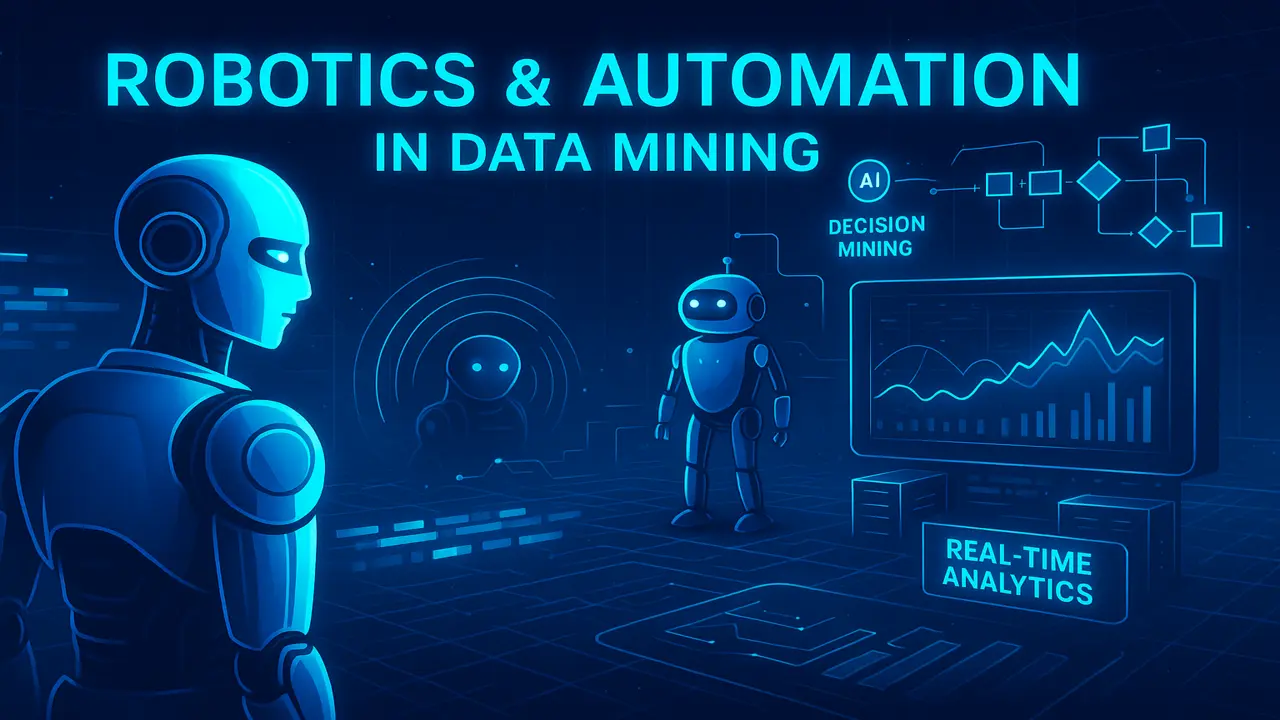
Lecture 16 explores how robotics and automation use Data Mining for perception, navigation, motion planning, intelligent decision-making, sensor analysis, and Industry 4.0 applications. Includes ML, SLAM, RPA, and dataset references.
Robotics has evolved from mechanical systems performing basic movements into intelligent, autonomous agents capable of perceiving their surroundings, making decisions, learning from data, and adapting in real-time. Modern robotics relies heavily on Data Mining to interpret sensor data, analyze environments, optimize motion, and automate complex industrial tasks.
This lecture provides a comprehensive understanding of how data mining integrates with robotics, enabling real-time intelligence, decision-making, and automation across industries.
Introduction to Robotics & Data Mining
Why Robotics Needs Data Mining
Robots gather huge amounts of data from:
- Cameras
- LIDAR
- GPS
- IMU sensors
- Microphones
- Temperature, pressure, and proximity sensors
Data Mining helps robots to:
- Understand environments
- Detect obstacles
- Recognize objects
- Predict future states
- Optimize motion
- Make decisions autonomously
Evolution of Intelligent Automation
Robots evolved from:
- Rule-based automation
- Programmable arms
- Sensor-driven robots
- Machine-learning robots
- Deep-learning autonomous agents
- Self-learning robots (reinforcement learning)
Modern robots mine data continuously to improve performance.
Robotic System Architecture
A robot typically includes three layers:
1. Perception Layer
Processes sensor inputs:
- Images
- Depth maps
- Audio
- Motion data
2. Planning Layer
Decides actions:
- Which path to take
- What sequence of tasks to perform
- How to avoid obstacles
3. Control Layer
Executes movement:
- Motor control
- Speed adjustments
- Balancing
Data mining improves all three layers.
Sensor Data & Perception Models
Camera & Vision Sensors
Robots use:
- RGB cameras
- Stereo cameras
- Event-based cameras
Vision data helps in:
- Object detection
- Scene understanding
- Visual SLAM
LIDAR & Depth Sensors
Sensors like:
- Velodyne LIDAR
- Intel RealSense
- Kinect
Used for:
- 3D mapping
- Obstacle avoidance
- Autonomous navigation
IMU, GPS & Proprioception Sensors
Track:
- Orientation
- Velocity
- Acceleration
- Joint angles
Data Mining for Robot Perception
Image Mining
Includes:
- Edge detection
- Pattern recognition
- CNN-based classification
- Semantic segmentation
Point-Cloud Processing
Helps with:
- 3D reconstruction
- Terrain analysis
- Object localization
Algorithms:
- Voxelization
- Plane detection
- Clustering
Multimodal Sensor Fusion
Combining:
- LIDAR + Camera
- Audio + Vision
- IMU + GPS
Fusion increases accuracy and robustness.
Feature Extraction & Representation
CNN Feature Extraction
Deep CNNs extract:
- Edges
- Shapes
- Object parts
- High-level concepts
Used in:
- Industrial robots
- Self-driving cars
- Service robots
Time-Series Features for Motion
Robot motion generates temporal patterns.
Feature extraction includes:
- Velocity curves
- Acceleration patterns
- Joint trajectory analysis
Knowledge Graphs for Robotics
Knowledge graphs store relationships between objects and actions.
Example:
Cup → can_be_grasped
Door → can_be_opened
Robotics + Machine Learning
Supervised Learning in Robotics
Used for:
- Object classification
- Face recognition
- Pose estimation
Unsupervised Learning for Clustering Behaviors
Used for:
- Grouping object shapes
- Identifying similar navigation patterns
- Behavior segmentation
Reinforcement Learning for Action Selection
RL agents learn optimal actions through reward signals.
Applications:
- Robotic arms
- Drones
- Autonomous driving
Data Mining for Autonomous Navigation
Autonomous navigation requires:
- Map understanding
- Path planning
- Real-time adjustments
SLAM (Simultaneous Localization & Mapping)
SLAM achieves:
- Robot localizing itself
- Building a map of surroundings
Methods:
- EKF-SLAM
- GMapping
- ORB-SLAM
Path Planning Algorithms
Common algorithms:
- A*
- Dijkstra
- RRT (Rapidly-Exploring Random Trees)
- DQN-based RL planners
Obstacle Detection
Robots use sensor data to avoid:
- Walls
- People
- Dynamic obstacles
Techniques:
- LIDAR clustering
- Optical flow
- Neural detectors
Automation Pipelines & Industry 4.0
Smart Manufacturing Systems
Robots mine data for:
- Quality control
- Process optimization
- Safety monitoring
Predictive Maintenance
Robots analyze:
- Vibration data
- Temperature data
- Wear and tear patterns
Predict when machines will fail before they break.
Robotic Process Automation (RPA)
Software robots extract patterns from:
- Logs
- Emails
- Spreadsheets
- Business workflows
Then automate repetitive tasks.
Real-Time Analytics for Autonomous Robots
Edge Computing
Robots perform computations locally to reduce delay.
Benefits:
- Faster response
- No internet required
Fog Computing
Intermediate layer between cloud and edge for:
- Resource optimization
- Local processing
Low-Latency Decision Models
Critical for:
- Self-driving cars
- Flying drones
- Humanoid robots
Robotics Data Labeling & Datasets
Dataset Examples
- COCO (object detection)
- KITTI (autonomous driving)
- Open Images (general vision)
- ScanNet (indoor 3D scenes)
Synthetic Data in Robotics
Tools:
- NVIDIA Isaac Sim
- Unity ML-Agents
- Blender synthetic generation
Synthetic data:
- Reduces labeling cost
- Improves model robustness
Case Studies
Self-Driving Cars
Data mining helps in:
- Lane detection
- Pedestrian detection
- Traffic prediction
Companies:
- Tesla
- Waymo
- Cruise
Warehouse Automation
Robots perform:
- Picking & placing
- Routing
- Inventory mining
Used by:
- Amazon Robotics
- DHL
- Alibaba
Drone Intelligence
Drones perform:
- Inspection
- Delivery
- Mapping
- Surveillance
Data mining helps interpret:
- GPS signals
- Camera feeds
- LIDAR scans
Summary
Lecture 16 explored how robotics integrates with Data Mining to create intelligent, autonomous systems capable of perception, planning, and real-time decision-making. Students now understand sensor data processing, SLAM, path planning, reinforcement learning in robotics, RPA, and Industry 4.0 automation pipelines. This lecture completes the practical + conceptual understanding of AI-driven automation.
People also ask:
It helps interpret sensor data, detect patterns, and make decisions.
Cameras, LIDAR, IMU, GPS, and proximity sensors.
Simultaneous Localization and Mapping robots build a map while finding their own position.
For perception, action selection, navigation, and automation.
Manufacturing, healthcare, logistics, defense, retail, and agriculture.