

Sets in Mathematics explain how objects are grouped and related. Learn definitions, notations, types, and real-life examples with easy explanations.
Understanding Sets in Mathematics
A set is one of the most fundamental concepts in mathematics. It refers to a well-defined collection of distinct objects, considered as a single unit. These objects are called elements or members of the set. Sets are used to group numbers, symbols, or even real-world items for logical reasoning and data organization.
For example:
A = {1, 2, 3, 4, 5} is a set of natural numbers less than 6.
B = {red, blue, green} is a set of colors.
The study of sets forms the basis for modern mathematics, logic, and computer science.
Representation of Sets
There are two common methods to represent a set:
Roster (Tabular) Form
In this method, all elements are listed inside curly brackets { }, separated by commas.
Example:A = {2, 4, 6, 8, 10} represents even numbers less than 11.
Set-builder Form
In this form, a condition defines the elements of the set.
Example:A = {x | x is an even number less than 11}
Here, the vertical bar “|” means “such that.”
Types of Sets
Sets can be classified into several types depending on their elements:
Empty or Null Set (∅)
A set that contains no elements.
Example: A = {x | x < 0, x ∈ Natural numbers} → ∅
Finite Set
A set with a countable number of elements.
Example: A = {1, 3, 5, 7, 9}
Infinite Set
A set that has an uncountable number of elements.
Example: B = {x | x ∈ Natural numbers}
Equal Sets
Two sets are equal if they have exactly the same elements.
Example: A = {2, 4, 6} and B = {6, 4, 2} → A = B
Equivalent Sets
Sets having the same number of elements.
Example: A = {1, 2, 3} and B = {a, b, c}
Subset (⊆)
A set A is a subset of B if every element of A is also in B.
Example: A = {1, 2} is a subset of B = {1, 2, 3}.
Power Set (P)
The set of all subsets of a given set.
Example:
If A = {1, 2}, thenP(A) = {∅, {1}, {2}, {1,2}}
Universal Set (U)
A set that contains all the objects under consideration.
Example:
If U represents all natural numbers up to 10, thenU = {1,2,3,4,5,6,7,8,9,10}.
Set Operations
Sets can be combined and compared using specific operations:
Union (A ∪ B)
Elements belonging to either A or B.
Example:A = {1,2,3} and B = {3,4,5}
→ A ∪ B = {1,2,3,4,5}
Intersection (A ∩ B)
Elements common to both A and B.
Example:A ∩ B = {3}
Difference (A – B)
Elements in A but not in B.
Example:A – B = {1,2}
Complement (A′)
All elements in the universal set U that are not in A.
Example:
If U = {1,2,3,4,5} and A = {2,4}, then A′ = {1,3,5}.
Venn Diagrams
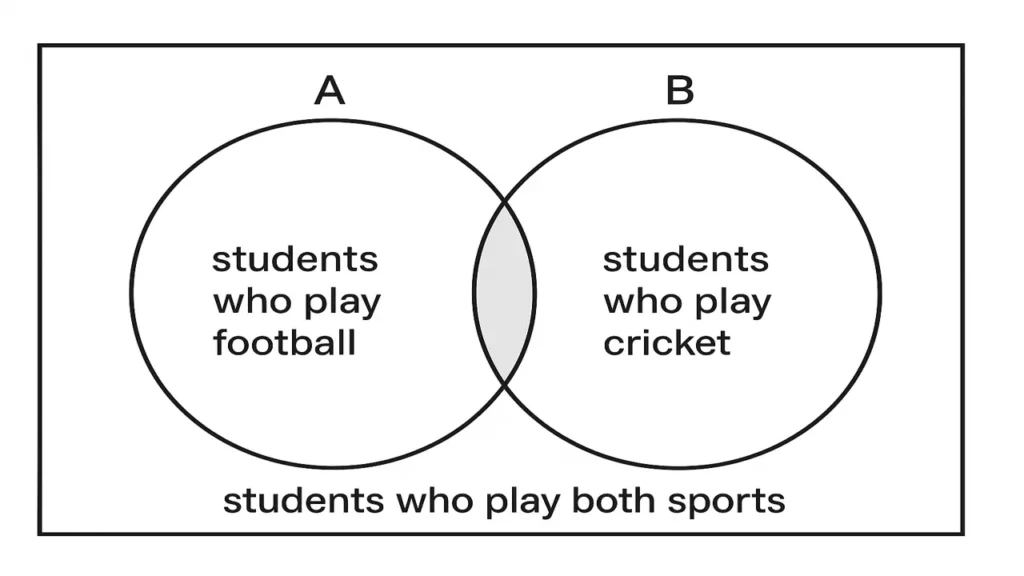
Venn diagrams are visual tools used to represent sets and their relationships. Each set is shown as a circle within a rectangle representing the universal set. Overlapping areas show intersections, while separate regions show differences.
For example:
If A = students who play football and B = students who play cricket,
then A ∩ B = students who play both sports.
Real-Life Applications of Sets
- Data Classification: Grouping data (e.g., students by grades or blood type).
- Database Design: Used in SQL and data relationships.
- Logic and Programming: If–else conditions and Boolean algebra are based on set theory.
- Probability: Events in probability are treated as sets of outcomes.
Sets are not just theoretical they shape every logical system in computing and mathematics.
Important Symbols in Set Theory
| Symbol | Meaning | Example |
|---|---|---|
| ∈ | Element of | 3 ∈ {1,2,3} |
| ∉ | Not an element of | 5 ∉ {1,2,3} |
| ⊆ | Subset | {1,2} ⊆ {1,2,3} |
| ⊂ | Proper subset | {1,2} ⊂ {1,2,3} |
| ∪ | Union | A ∪ B |
| ∩ | Intersection | A ∩ B |
| ∅ | Empty set | {} |
| U | Universal set | All elements considered |
| P(A) | Power set | All subsets of A |
Summary
| Concept | Meaning | Example |
|---|---|---|
| Set | Collection of distinct objects | {1,2,3} |
| Subset | Elements of one set belong to another | {1,2} ⊆ {1,2,3} |
| Union | Combination of all elements | A ∪ B |
| Intersection | Common elements | A ∩ B |
| Difference | Elements in one set but not another | A – B |
| Complement | Elements not in the set | A′ |
The approach followed at E Lectures reflects both academic depth and easy-to-understand explanations.
People also ask:
A set is a group of unique objects or numbers considered as one collection.
A finite set has a limited number of elements, while an infinite set has elements without end.
It contains all elements under study for a specific problem.
They form the foundation of logic, database design, and programming structures.