

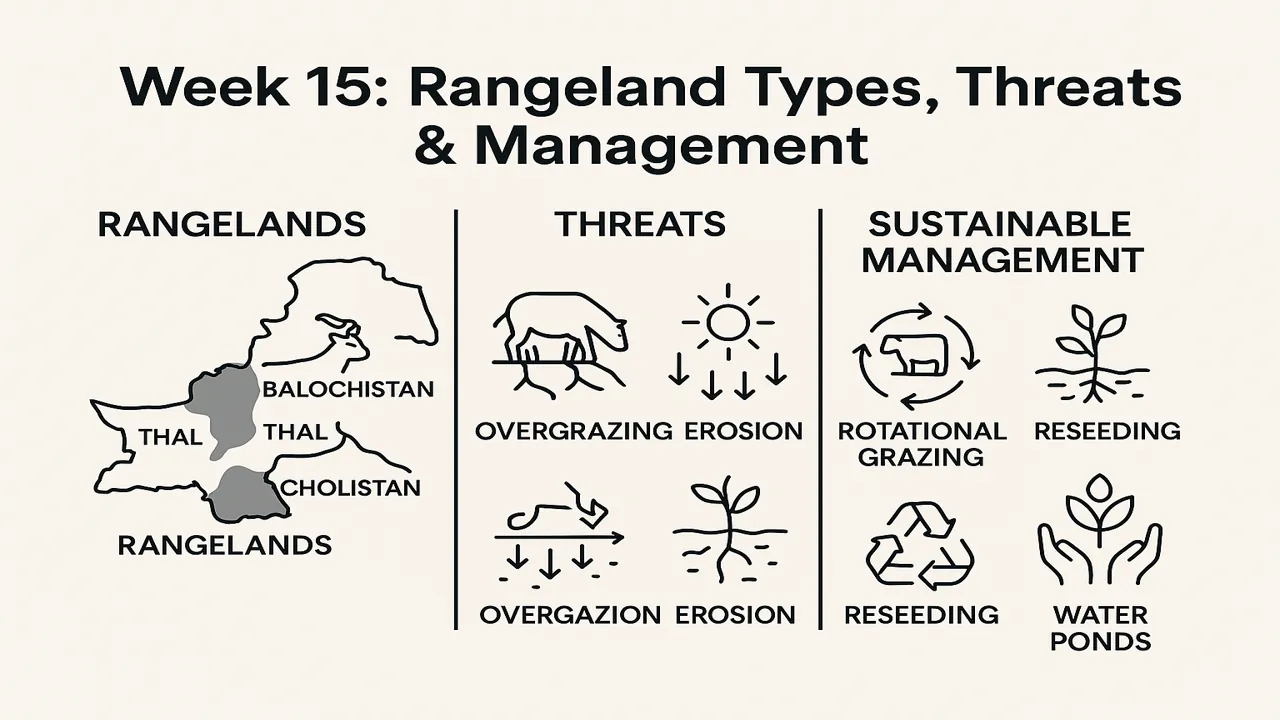
The types of rangelands in Pakistan, their ecological importance, major threats, and sustainable management strategies for a greener future.
Introduction to Rangelands
Rangelands are vast natural ecosystems dominated by grasses, shrubs, and herbs used for livestock grazing and wildlife habitats. In Pakistan, they cover about 60% of the total land area and are the main resource for rural livelihoods, especially in Balochistan, Sindh, and Punjab deserts.
Types of Rangelands in Pakistan
| Type | Location | Key Features | Vegetation Examples |
|---|---|---|---|
| Mountain Rangelands | Northern areas, KPK, Gilgit-Baltistan | High elevation pastures, cold & dry | Artemisia, Juniperus, Ephedra |
| Plateau Rangelands | Balochistan Plateau | Arid to semi-arid, rocky soils | Haloxylon, Salsola, Cymbopogon |
| Desert Rangelands | Thar, Cholistan, Thal | Sandy soils, drought-tolerant species | Cenchrus, Calligonum, Panicum |
| Foothill Rangelands | Potohar, Suleiman, and Salt Range | Moderate rainfall, mixed grass-shrub vegetation | Acacia, Cymbopogon, Saccharum |
| Coastal Rangelands | Makran and Karachi coasts | Saline soils, wind erosion | Atriplex, Suaeda, Halophytes |
Ecological and Economic Importance
- Livestock Grazing: Major feed source for goats, camels, and sheep.
- Biodiversity Reservoir: Home to herbs, insects, birds, and reptiles.
- Watershed Protection: Prevents floods and soil erosion.
- Carbon Storage: Acts as carbon sink and mitigates climate change.
- Medicinal Plants: Source of native species used in herbal medicine.
Major Threats to Rangelands
- Overgrazing: Exceeding the natural carrying capacity.
- Deforestation & Fuelwood Cutting: Shrub removal leads to erosion.
- Drought & Climate Change: Reduced rainfall lowers productivity.
- Unplanned Cultivation: Conversion to cropland disturbs ecosystems.
- Urban Expansion & Mining: Loss of grazing lands.
Impact:
- Decline in vegetation cover.
- Soil compaction and reduced fertility.
- Loss of wildlife and native grass species.
Week 14 – Sustainable Rangeland Management in Pakistan: Challenges & Solutions
Sustainable Management Practices
a) Rotational Grazing
Divide rangelands into paddocks and allow rest periods for recovery.
b) Reseeding and Rehabilitation
Use native grasses such as Cenchrus ciliaris and Panicum antidotale.
c) Water Conservation
Construct small dams, contour bunds, and ponds to retain moisture.
d) Community-Based Management
Empower local herders to implement rules on grazing schedules.
e) Policy and Research
- Integrate with Pakistan’s National Rangeland Policy (NRP).
- Establish monitoring units for soil, vegetation, and livestock.
Case Study: Balochistan Rangelands
Balochistan has vast but fragile rangelands, where nomadic tribes depend entirely on livestock.
Problems: Overgrazing, prolonged droughts, and lack of management.
Solutions:
- Controlled grazing by seasonal rotation.
- Artificial reseeding of perennial grasses.
- Rainwater harvesting structures for dry-season use.
Restoration Benefits
- Improved livestock yield and health.
- Enhanced soil moisture retention.
- Increased vegetation diversity and carbon sequestration.
- Strengthened local economies through sustainable herding.
The approach followed at E Lectures reflects both academic depth and easy-to-understand explanations.
People also ask:
Balochistan, with nearly 85% of its area under rangelands.
Cenchrus, Calligonum, and Panicum grasses dominate these arid areas.
By applying rotational grazing, rest periods, and community regulation.
They absorb atmospheric carbon and reduce desertification.
It’s the process of planting native grass species to restore degraded lands.


