

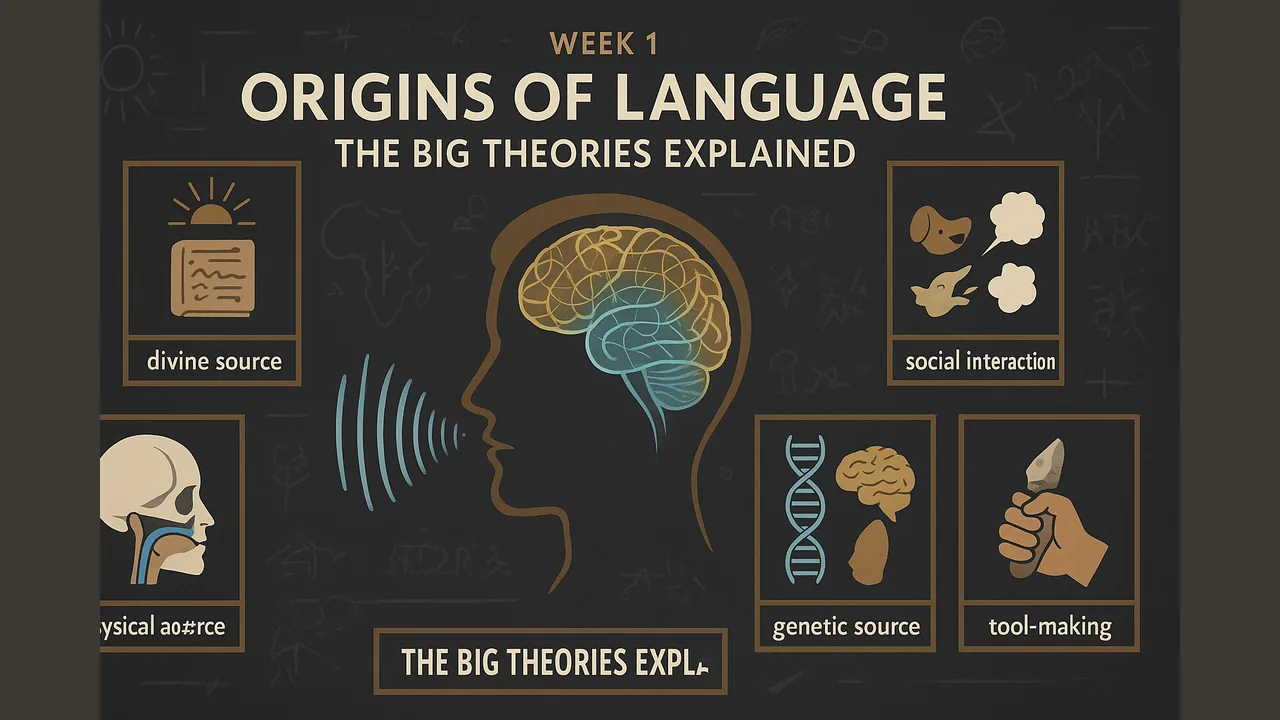
Where did language come from? Scholars have offered bold answers for centuries. Some say language was a divine gift. Others see it as a natural human evolution.
In this Week 1 article, you will learn five core theories: divine source, natural sound, social interaction, physical adaptation, and the genetic source. Each section gives simple definitions, classroom-ready examples, strengths, and limits. By the end, you will know what each theory claims and why no single theory wins alone.
Language as a Divine Gift
Idea in one line: Language was given by a deity or higher power.
Explanation:
Many cultures tell stories in which gods give speech to humans. These accounts stress that language is special and set apart from animal communication. If speech is sacred, then its rules may be fixed and stable.
Strengths:
- Explains the uniqueness and complexity of human language.
- Matches many historical myths and religious texts.
Limits:
- Cannot be tested by scientific methods.
- Does not explain how individual languages change over time.
Keep learning and keep growing, here is the very next part for your languages guide:
Week 2 — Speech vs Writing
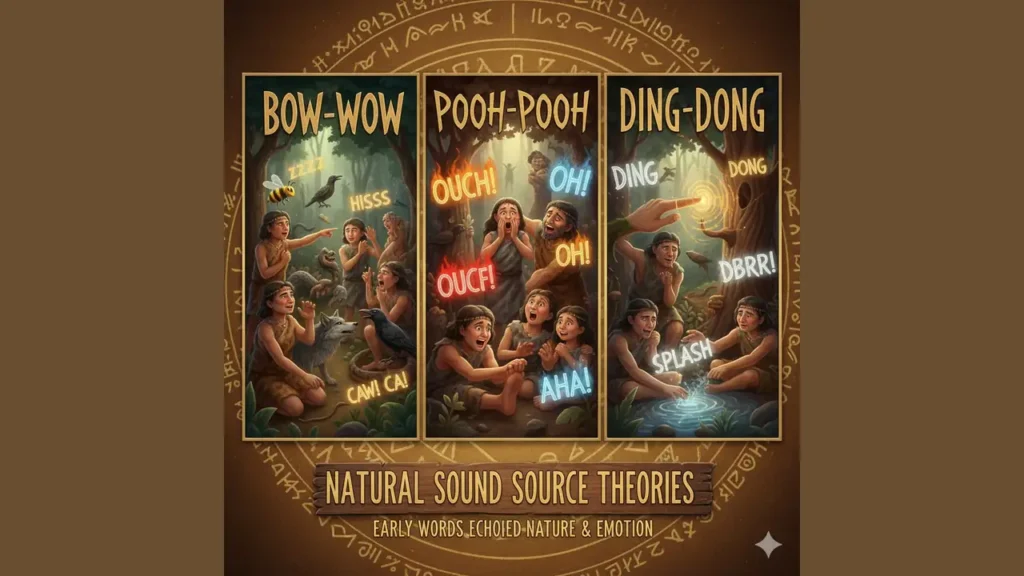
Natural Sound Source Theories
Idea in one line: Early words echoed sounds in the environment or human emotions.
Explanation:
- Bow-wow: words imitated sounds from nature (e.g., buzz, hiss).
- Pooh-pooh: words began as instinctive cries of pain, joy, or surprise.
- Ding-dong: sounds matched the “essence” of objects.
Strengths:
- Onomatopoeic words exist in many languages.
- Emotional interjections are near-universal.
Limits:
- Only a tiny part of vocabulary is onomatopoeic.
- Interjections do not explain grammar or complex syntax.
In the Data Science stream you’ll find lectures tailored to real-world data problems, backed by our digital learning platform.
Social Interaction Source
Idea in one line: Language grew from rhythmic sounds used during group work and social bonding.
Explanation:
Humans work together. Early communities likely used chants and calls to time movement, signal danger, and share plans. Over time, these sounds gained structure and meaning. Language thus formed inside interaction.
Strengths:
- Explains why turn-taking and rhythm matter in conversation.
- Connects language to cooperation and culture.
Limits:
- Hard to show how chants became full grammar.
- Does not explain the biological capacity for syntax.
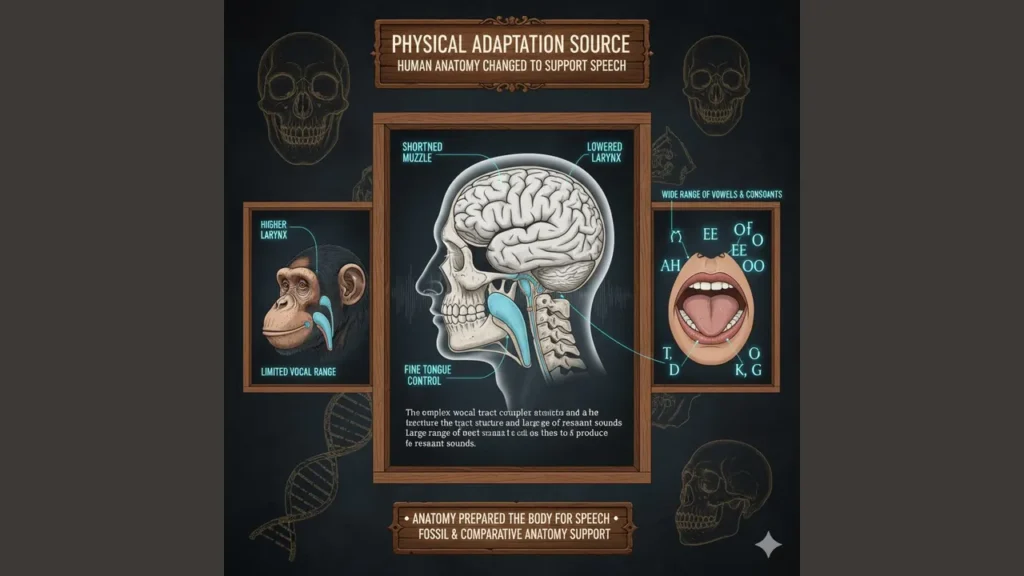
Physical Adaptation Source
Idea in one line: Human anatomy changed to support speech.
Explanation:
Humans have a lowered larynx, a shortened muzzle, fine tongue control, and precise lip and jaw movement. These changes allow a wide range of vowels and consonants. Anatomy prepared the body for speech.
Strengths:
- Supported by fossil and comparative anatomy studies.
- Explains why human speech sounds differ from animal calls.
Limits:
- A vocal tract alone does not create grammar or meaning.
- Does not explain the origin of semantic concepts.
The Genetic Source
Idea in one line: Humans evolved a biological language faculty—a brain-based capacity for language.
Explanation:
Children learn any language rapidly with limited input. Many researchers propose an innate Language Acquisition Device or universal biases that help build grammar. Genes influence brain growth, neural timing, and auditory processing. Language is thus a human species trait.
Strengths:
- Matches rapid child language development.
- Explains cross-linguistic similarities.
Limits:
- Specific genes for grammar remain debated.
- Culture and input still play major roles.
Stay connected with E Lectures AI, a space where notes from nearly every subject taught across universities in Pakistan come together in one place.
People also ask:
There is no single winner. Research favors multi-factor accounts that blend anatomy, cognition, and social life.
Animals communicate, but human language has open vocabulary and complex grammar. That combination is uniquely human.
No. It supports it partly, but most vocabulary is not sound-imitative.
Children learn fast and reach similar milestones across cultures, hinting at an in-built bias for grammar.
