

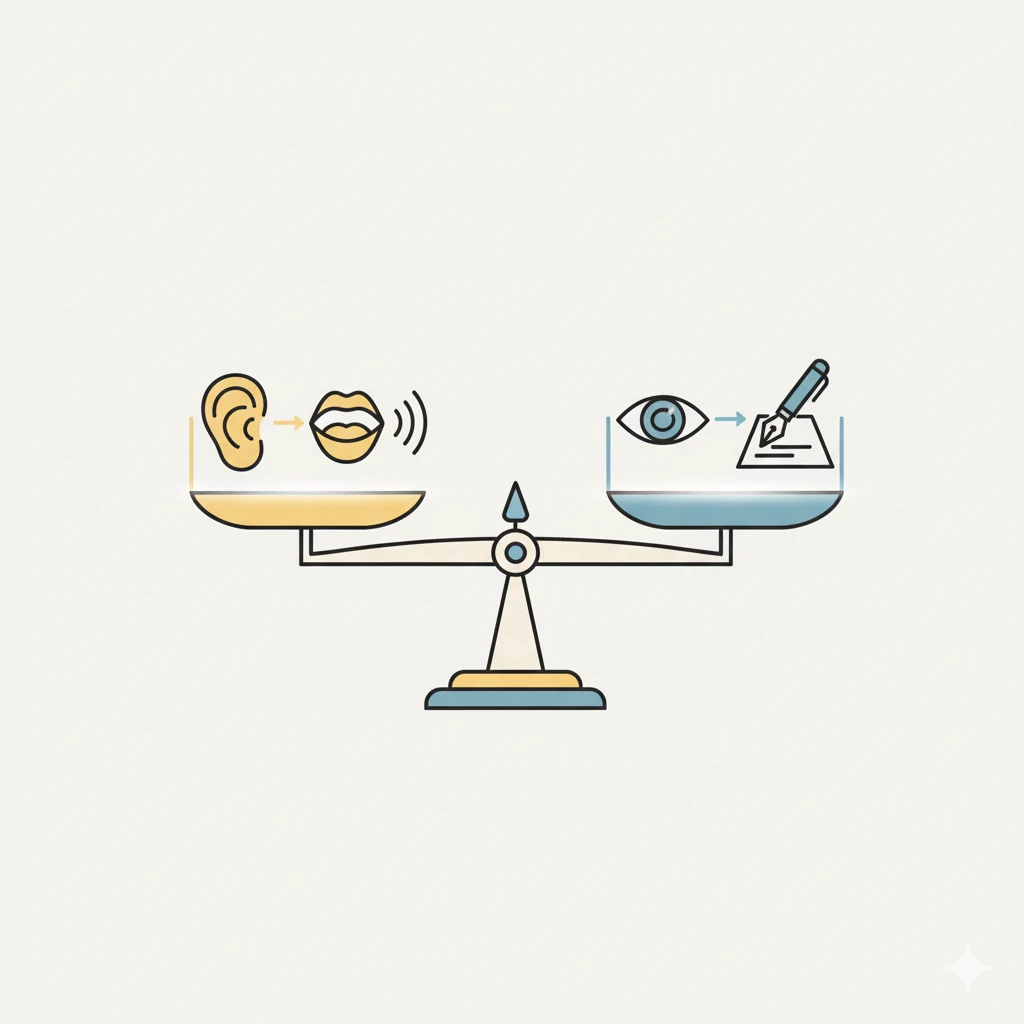
Speech and writing are two faces of one system: language. Speech is sound in real time. Writing is a visual record. This Week 2 guide explains the primacy of speech and clarifies how speech and writing differ and overlap. You will get clean definitions, examples, and quick classroom tasks.
Primacy of Speech (the core idea)
Claim: Speech is primary; writing is a later technology that represents speech.
Why linguists say this
- Evolutionary timing:
Humans spoke long before the first scripts appeared. - Acquisition:
Children learn to speak without instruction; reading and writing need teaching. - Universality:
Every known community has speech; many never developed writing. - Interactivity:
Speech includes turn-taking, feedback, gaze, gesture, and prosody (rhythm, stress, intonation). - Representation:
Most writing systems encode speech sounds or syllables; even logographic systems mix phonetic cues.
Counterpoint (balanced view): Writing enables storage, standardization, and complex analysis. It shapes science, law, and education. Speech is primary in origin and learning; writing is primary for memory and institutions.

Speech vs Writing: Clear Comparison
| Dimension | Speech | Writing |
|---|---|---|
| Channel | Audio; ephemeral | Visual; lasting |
| Production | Fast, spontaneous | Slower, planned |
| Feedback | Immediate; interactive | Delayed; one-way |
| Prosody | Present (pitch, stress) | Indirect (punctuation, layout) |
| Context | Shared, situational | Must supply context in text |
| Density | Looser, repeats, fillers | Denser, edited, compact |
| Standardization | Dialectal, variable | More standardized |
| Errors | Repairs in real time | Edited before/after |
| Audience | Known, co-present | Often distant, unknown |
| Aids | Gesture, gaze, posture | Headings, paragraphs, punctuation |
Takeaway: Neither mode is “better.” They serve different goals.
How Writing Represents Speech
- Graphemes ↔ phonemes/syllables: alphabets and syllabaries map sound to symbols.
- Punctuation as surrogate prosody: commas for pauses; question marks for rising pitch.
- Paragraphing and layout: visual signals for topic shifts and turns.
- Emoji and chat cues: modern writing adds paralinguistic hints once carried by tone or face.
Overlaps and Blurred Lines (digital age)
- Texting and chat feel like written conversation.
- Voice notes are recorded speech that can be transcribed.
- AI speech-to-text and text-to-speech bridge both modes.
- Academic writing sometimes imitates spoken rhythm to engage readers.
The approach followed at E Lectures reflects both academic depth and easy-to-understand explanations.
Key Terms
- Prosody: the music of speech stress, rhythm, and intonation.
- Orthography: the rules of a writing system.
- Turn-taking: orderly exchange of speaking roles.
- Paralinguistic features: non-verbal cues like gesture or emoji.
People also ask:
Not exactly. Writing represents speech but has its own norms, density, and structure.
No. It means speech came first biologically and historically. Writing is crucial for knowledge and institutions.
It requires mapping visual symbols to sounds and words; this mapping is cultural, not innate.
Yes through punctuation, layout, word choice, and visual cues like emoji.