What makes a paragraph strong?
Lecture 3 – Words, Sentences, and Paragraphs: Building Blocks of Effective English Writing
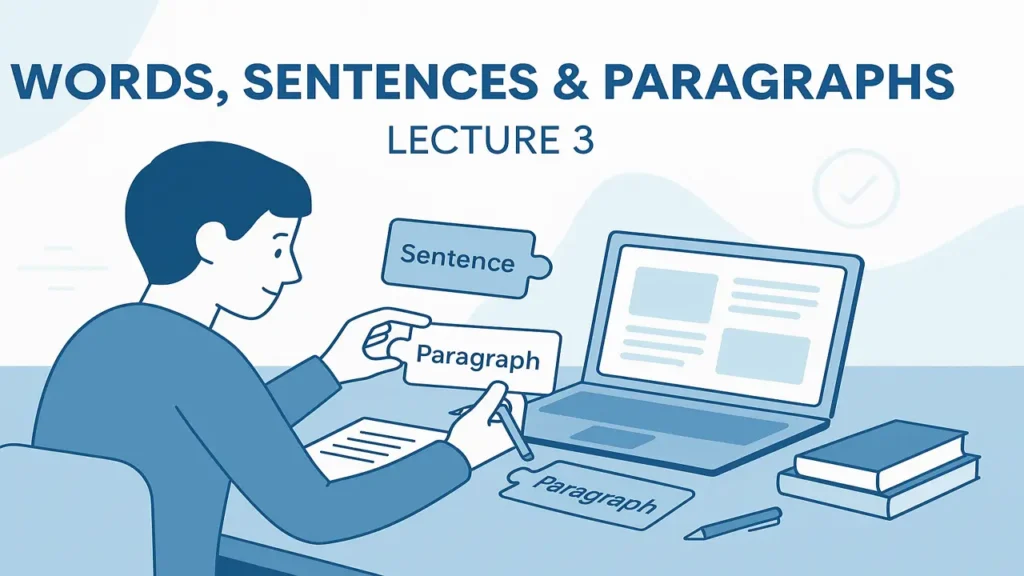
How to construct clear words, meaningful sentences, and unified paragraphs. This lecture explains vocabulary choice, sentence structure, paragraph unity, topic sentences, and transitions to improve your academic and professional writing.
Words, Sentences, and Paragraphs
Good writing is like building a solid structure. You begin with strong small blocks words connect them into meaningful sentences, and arrange those sentences into unified paragraphs. If even one block is weak, the entire structure becomes shaky.
Lecture 3 explores how these three components work together to form clear, effective, and powerful writing. By mastering them, students improve not only their academic assignments but also workplace communication, reports, essays, and presentations.
1. Words: Choosing the Right Vocabulary
Every sentence begins with words. Good writers choose words that fit their purpose, match their audience, and make meaning clear.
1.1. Characteristics of Effective Word Choice
Accuracy the word must express the exact meaning
Simplicity avoid overly complex vocabulary
Appropriateness match the tone (formal/informal)
Variety avoid repeating the same words unnecessarily
Precision choose specific and concrete words
Examples:
- “Use” is better than “utilize.”
- “Improve” is better than “ameliorate.”
- “Students struggle with grammar” is better than “Students face various difficulties in the grammar domain.”
Your goal is to make readers understand easily not to impress them with difficult vocabulary.
1.2. Avoiding Problematic Word Choices
Vague Words
Words like things, stuff, several, good, bad, nice do not convey clear meaning.
Slang and Informal Expressions
Words like btw, wanna, kinda, cool, awesome are not suitable for academic writing.
Overly Technical Jargon
If the audience is general, avoid niche scientific or business terminology unless explained.
2. Sentences: Forming Complete Thoughts
A sentence expresses a complete idea. It must have a subject and a verb, and it should be structured logically.
2.1. Types of Sentences
A good paragraph uses a mix of sentence types for rhythm and readability.
1. Simple Sentence
Contains one main idea.
“The class started.”
2. Compound Sentence
Joins two ideas with and, but, or, so.
“The class started, and the teacher entered.”
3. Complex Sentence
Includes an independent idea + a dependent clause.
“When the class started, the teacher entered.”
4. Compound-Complex Sentence
Combination of all structures.
“When the class started, the teacher entered, and everyone became quiet.”
Purdue OWL – Paragraph Structure
2.2. Characteristics of Good Sentences
Clarity
Avoid confusing or overly long sentences.
Correctness
Use proper grammar and punctuation.
Unity
One main idea per sentence.
Logical Flow
Ideas should follow a natural order.
2.3. Common Sentence Problems
Run-on Sentences
“When we reached class it was locked we had to wait outside which was irritating because the weather was hot.”
Too long and confusing.
Corrected:
“When we reached class, it was locked. We waited outside in the hot weather.”
Sentence Fragments
“In the classroom after the bell rang.”
Not a complete idea.
Corrected:
“We entered the classroom after the bell rang.”
Wordiness
“It is necessary that we should try to understand the importance of time.”
Corrected:
“We must understand the importance of time.”
Lecture 2 – Principles of Good English Writing
3. Paragraphs: The Heart of Expository Writing
A strong paragraph is the core of clear writing. Each paragraph should focus on one idea, explained fully and logically.
3.1. Structure of a Good Paragraph
A strong paragraph has three essential parts:
1. Topic Sentence
Introduces the main idea.
“Time management improves students’ academic performance.”
2. Supporting Sentences
Explain, give reasons, provide evidence, or examples.
“When students plan their tasks, they complete work on time…”
3. Concluding Sentence
Summarizes or finalizes the idea.
“Therefore, time management is essential for better results.”
3.2. Qualities of a Strong Paragraph
Unity
All sentences must relate to the topic sentence.
Coherence
Ideas should flow smoothly using transition words.
Adequate Development
Provide enough detail examples, facts, explanations.
3.3. Example of a Complete Paragraph
Topic Sentence:
“Reading regularly helps students become better writers.”
Supporting Details:
“Regular reading exposes students to new vocabulary and sentence structures. It helps them observe how professional writers develop ideas and organize content. Students also learn grammar naturally by seeing correct usage in context.”
Concluding Sentence:
“For these reasons, reading plays a major role in improving writing skills.”
This paragraph is unified, coherent, and fully developed.
4. Using Transitions to Connect Ideas
Transitions are the glue of writing. They connect sentences and paragraphs smoothly.
Types of Transition Words
Adding Information:
also, moreover, furthermore, in addition
Comparing Ideas:
similarly, likewise
Contrasting Ideas:
however, on the other hand, although
Showing Cause and Effect:
therefore, consequently, as a result
Showing Sequence:
first, next, finally
Transitions improve readability and make writing smoother.
5. Paragraph Types in Academic Writing
1. Descriptive Paragraph
Explains characteristics or features.
2. Expository Paragraph
Explains a process or concept.
3. Persuasive Paragraph
Convinces the reader.
4. Narrative Paragraph
Tells a story or sequence of events.
Lecture 3 focuses on expository paragraphs.
6. Common Paragraph Mistakes
Including multiple ideas in one paragraph
Weak or missing topic sentence
Lack of transitions
Too short or too long
Off-topic information
These mistakes break unity and coherence.
7. Practical Tips to Improve Writing
- Read high-quality articles daily
- Practice rewriting confusing text
- Look for grammar mistakes using tools
- Summarize paragraphs in your own words
- Write paragraphs with clear topic sentences
- Ask someone to review your writing
Improvement comes with practice.
SUMMARY
Lecture 3 explains the foundational building blocks of effective English writing: words, sentences, and paragraphs. Students learn how to choose accurate vocabulary, construct clear sentences, and write unified paragraphs with topic sentences and transitions. These skills are essential for academic, professional, and everyday communication.
People also ask:
Unity, coherence, and enough supporting details.
Use simple, precise, familiar vocabulary that fits your purpose.
Long enough to express the idea clearly usually 10–20 words.
It tells the reader what the paragraph is about.
Use transition words and vary sentence length.