

Artificial Intelligence – 500 MCQs
Answers are hidden by default. Students can read the question first and then click to reveal the answer.
Showing 500 questions
Question 1
Introduction to Artificial Intelligence
Artificial Intelligence is a branch of:
Correct Answer: B) Computer Science
Question 2
Introduction to Artificial Intelligence
The term 'Artificial Intelligence' was first introduced at:
Correct Answer: B) Dartmouth Conference 1956
Question 3
Introduction to Artificial Intelligence
Alan Turing proposed the concept of machine intelligence in:
Correct Answer: C) 1950
Question 4
Introduction to Artificial Intelligence
AI systems differ from traditional programs because AI:
Correct Answer: B) Can learn from data
Question 5
Introduction to Artificial Intelligence
Which of the following is a goal of AI?
Correct Answer: C) Enabling machines to simulate human intelligence
Question 6
Introduction to Artificial Intelligence
Which is NOT an application of AI?
Correct Answer: C) Calculator
Question 7
Introduction to Artificial Intelligence
The Turing Test was proposed by:
Correct Answer: C) Alan Turing
Question 8
Introduction to Artificial Intelligence
The Turing Test evaluates a machine's ability to:
Correct Answer: B) Imitate human conversation
Question 9
Introduction to Artificial Intelligence
In traditional programming, the output is determined by:
Correct Answer: C) Predefined rules
Question 10
Introduction to Artificial Intelligence
Which AI milestone involved defeating a world chess champion?
Correct Answer: B) IBM Deep Blue
Question 11
Introduction to Artificial Intelligence
Which AI milestone involved defeating a world Go champion?
Correct Answer: B) Google AlphaGo
Question 12
Introduction to Artificial Intelligence
AI systems can:
Correct Answer: C) Analyze large data and identify patterns
Question 13
Introduction to Artificial Intelligence
The Dartmouth Conference is known for:
Correct Answer: B) Officially introducing the term AI
Question 14
Introduction to Artificial Intelligence
Machine Learning became popular in which decade?
Correct Answer: C) 1980s
Question 15
Introduction to Artificial Intelligence
Deep Learning is a part of:
Correct Answer: C) Artificial Intelligence
Question 16
Introduction to Artificial Intelligence
Which is a key property of AI systems?
Correct Answer: C) Ability to adapt to new inputs SECTION 2: Key Components of AI (Q21–Q35)
Question 17
Key Components of AI
Spam detection using AI learns from:
Correct Answer: B) Thousands of email examples
Question 18
Key Components of AI
Computer Vision allows machines to:
Correct Answer: C) Interpret images and videos
Question 19
Key Components of AI
Natural Language Processing (NLP) deals with:
Correct Answer: B) Human language understanding
Question 20
Key Components of AI
Robotics integrates AI with:
Correct Answer: C) Mechanical/physical systems
Question 21
Key Components of AI
Which component of AI enables systems to learn without being explicitly programmed?
Correct Answer: B) Machine Learning
Question 22
Key Components of AI
An intelligent agent perceives its environment through:
Correct Answer: C) Sensors
Question 23
Key Components of AI
An intelligent agent takes actions through:
Correct Answer: B) Actuators
Question 24
Key Components of AI
Knowledge representation stores information as:
Correct Answer: B) Logical rules and knowledge bases
Question 25
Key Components of AI
Which reasoning type derives specific conclusions from general rules?
Correct Answer: C) Deductive
Question 26
Key Components of AI
BFS stands for:
Correct Answer: B) Breadth First Search
Question 27
Key Components of AI
DFS stands for:
Correct Answer: B) Depth First Search
Question 28
Key Components of AI
A* is a type of:
Correct Answer: C) Informed search algorithm
Question 29
Key Components of AI
Facial recognition is an application of:
Correct Answer: C) Computer Vision
Question 30
Key Components of AI
Which component bridges communication between humans and machines?
Correct Answer: C) NLP
Question 31
Key Components of AI
Types of Machine Learning include:
Correct Answer: A) Supervised, Unsupervised, Reinforcement
Question 32
Key Components of AI
Medical image diagnosis uses:
Correct Answer: B) Computer Vision
Question 33
Key Components of AI
Semantic networks are used in:
Correct Answer: B) Knowledge representation
Question 34
Intelligent Agents
Probabilistic reasoning is used when:
Correct Answer: B) Dealing with uncertainty
Question 35
Intelligent Agents
Which search algorithm uses f(n) = g(n) + h(n)?
Correct Answer: C) A*
Question 36
Intelligent Agents
An intelligent agent is:
Correct Answer: B) An autonomous system that perceives and acts
Question 37
Intelligent Agents
The basic cycle of an intelligent agent is:
Correct Answer: C) Perception-Decision-Action
Question 38
Intelligent Agents
Simple reflex agents act based on:
Correct Answer: C) Current percept only
Question 39
Intelligent Agents
Model-based agents differ from simple reflex agents because they:
Correct Answer: B) Maintain an internal state/model
Question 40
Intelligent Agents
Goal-based agents use:
Correct Answer: C) Planning to achieve goals
Question 41
Intelligent Agents
A utility-based agent aims to:
Correct Answer: B) Maximize utility function
Question 42
Intelligent Agents
Learning agents improve by:
Correct Answer: B) Learning from experience and feedback
Question 43
Intelligent Agents
A thermostat is an example of:
Correct Answer: C) Simple reflex agent
Question 44
Intelligent Agents
Google Maps route planning is an example of:
Correct Answer: B) Goal-based agent
Question 45
Intelligent Agents
Netflix recommendation system is an example of:
Correct Answer: C) Learning agent
Question 46
Intelligent Agents
A rational agent selects actions that:
Correct Answer: B) Maximize expected performance
Question 47
Intelligent Agents
Rationality does NOT mean:
Correct Answer: C) Always being perfect
Question 48
Intelligent Agents
PEAS stands for:
Correct Answer: B) Performance, Environment, Actuators, Sensors
Question 49
Intelligent Agents
In PEAS for a self-driving car, Actuators include:
Correct Answer: C) Steering and brakes
Question 50
Knowledge-Based Systems & ELIZA
Performance measure for a spam filter is:
Correct Answer: B) High detection accuracy, low false positives
Question 51
Knowledge-Based Systems & ELIZA
Sensors of a self-driving car include:
Correct Answer: B) Cameras, radar, GPS, LiDAR
Question 52
Knowledge-Based Systems & ELIZA
Which agent type is best for uncertain environments with trade-offs?
Correct Answer: C) Utility-based agent
Question 53
Knowledge-Based Systems & ELIZA
The environment of a spam filter is:
Correct Answer: B) Incoming emails
Question 54
Knowledge-Based Systems & ELIZA
Which is NOT a type of intelligent agent?
Correct Answer: C) Compiler-based agent
Question 55
Knowledge-Based Systems & ELIZA
Actuators help an intelligent agent to:
Correct Answer: C) Execute actions in environment
Question 56
Knowledge-Based Systems & ELIZA
A Knowledge-Based System uses:
Correct Answer: B) Stored knowledge and logical reasoning
Question 57
Knowledge-Based Systems & ELIZA
The inference engine in a KBS is responsible for:
Correct Answer: B) Applying logic to derive conclusions
Question 58
Knowledge-Based Systems & ELIZA
Forward chaining starts from:
Correct Answer: C) Known facts
Question 59
Knowledge-Based Systems & ELIZA
Backward chaining starts from:
Correct Answer: B) Goal
Question 60
Knowledge-Based Systems & ELIZA
ELIZA was developed by:
Correct Answer: C) Joseph Weizenbaum
Question 61
Knowledge-Based Systems & ELIZA
ELIZA was developed in the:
Correct Answer: B) 1960s
Question 62
Knowledge-Based Systems & ELIZA
ELIZA simulated a:
Correct Answer: C) Psychotherapist
Question 63
Knowledge-Based Systems & ELIZA
ELIZA used which technique?
Correct Answer: C) Pattern matching
Question 64
Knowledge-Based Systems & ELIZA
ELIZA demonstrated:
Correct Answer: B) That AI can simulate conversation
Question 65
Knowledge-Based Systems & ELIZA
The knowledge base in a KBS stores:
Correct Answer: B) Facts and rules
Question 66
Knowledge-Based Systems & ELIZA
An expert system is a type of:
Correct Answer: B) Knowledge-Based System
Question 67
Knowledge Representation & Logic
Working memory in a KBS stores:
Correct Answer: B) Current input data for processing
Question 68
Knowledge Representation & Logic
IF fever AND cough implies possible flu is an example of:
Correct Answer: B) A knowledge base rule
Question 69
Knowledge Representation & Logic
KBS systems were popular mainly in:
Correct Answer: B) 1970s-1980s
Question 70
Knowledge Representation & Logic
The explanation system in KBS is used to:
Correct Answer: B) Explain why a conclusion was reached
Question 71
Knowledge Representation & Logic
Knowledge Representation in AI is used to:
Correct Answer: B) Store structured information for reasoning
Question 72
Knowledge Representation & Logic
A proposition is a statement that is:
Correct Answer: C) Either true or false
Question 73
Knowledge Representation & Logic
Propositional Logic deals with:
Correct Answer: B) Simple true/false statements
Question 74
Knowledge Representation & Logic
The symbol AND (conjunction) represents:
Correct Answer: C) AND
Question 75
Knowledge Representation & Logic
The symbol OR (disjunction) represents:
Correct Answer: B) OR
Question 76
Knowledge Representation & Logic
The symbol NOT (negation) represents:
Correct Answer: C) NOT
Question 77
Knowledge Representation & Logic
P IMPLIES Q means:
Correct Answer: C) If P then Q
Question 78
Knowledge Representation & Logic
Predicate Logic is also called:
Correct Answer: B) First-Order Logic
Question 79
Knowledge Representation & Logic
The universal quantifier (for all) means:
Correct Answer: B) For all
Question 80
Knowledge Representation & Logic
The existential quantifier (there exists) means:
Correct Answer: C) There exists
Question 81
Knowledge Representation & Logic
ForAll x (Human(x) implies Mortal(x)) is an example of:
Correct Answer: B) Predicate Logic
Question 82
Knowledge Representation & Logic
Which logic cannot represent relationships between objects?
Correct Answer: C) Propositional Logic
Question 83
Knowledge Representation & Logic
Predicate Logic is more expressive because it allows:
Correct Answer: B) Objects, variables, relationships, quantifiers
Question 84
Knowledge Representation & Logic
Modus Ponens is an example of:
Correct Answer: B) Inference rule
Question 85
Knowledge Representation & Logic
If P implies Q and P is true, then Q is:
Correct Answer: C) True
Question 86
Knowledge Representation & Logic
Deductive reasoning guarantees:
Correct Answer: B) Logically certain conclusions
Question 87
Knowledge Representation & Logic
Inductive reasoning is:
Correct Answer: B) Probabilistic
Question 88
Knowledge Representation & Logic
Which reasoning moves from specific to general?
Correct Answer: C) Inductive
Question 89
Knowledge Representation & Logic
Forward chaining is also called:
Correct Answer: B) Data-driven
Question 90
Knowledge Representation & Logic
Backward chaining is commonly used in:
Correct Answer: B) Prolog and medical diagnosis
Question 91
Knowledge Representation & Logic
Inference mechanisms help AI systems to:
Correct Answer: B) Derive new knowledge
Question 92
Knowledge Representation & Logic
Constants in Predicate Logic represent: SECTION 6: Uninformed Search — BFS, DFS, DLS, IDS (Q96–Q130)
Correct Answer: B) Specific objects like Ali or Car1
Question 93
Uninformed Search — BFS, DFS, DLS, IDS
Which reasoning is used mainly in Machine Learning?
Correct Answer: B) Inductive
Question 94
Uninformed Search — BFS, DFS, DLS, IDS
Inferential adequacy means:
Correct Answer: B) Ability to derive new knowledge
Question 95
Uninformed Search — BFS, DFS, DLS, IDS
Ontologies in AI are used for:
Correct Answer: B) Representing structured domain knowledge
Question 96
Uninformed Search — BFS, DFS, DLS, IDS
Uninformed search is also called:
Correct Answer: B) Blind search
Question 97
Uninformed Search — BFS, DFS, DLS, IDS
BFS explores nodes:
Correct Answer: C) Level by level
Question 98
Uninformed Search — BFS, DFS, DLS, IDS
BFS uses which data structure?
Correct Answer: B) Queue
Question 99
Uninformed Search — BFS, DFS, DLS, IDS
DFS uses which data structure?
Correct Answer: B) Stack
Question 100
Uninformed Search — BFS, DFS, DLS, IDS
Queue follows:
Correct Answer: B) FIFO
Question 101
Uninformed Search — BFS, DFS, DLS, IDS
Stack follows:
Correct Answer: B) LIFO
Question 102
Uninformed Search — BFS, DFS, DLS, IDS
BFS is complete meaning:
Correct Answer: A) It always finds goal if it exists
Question 103
Uninformed Search — BFS, DFS, DLS, IDS
BFS is optimal when:
Correct Answer: A) All step costs are equal
Question 104
Uninformed Search — BFS, DFS, DLS, IDS
Time complexity of BFS is:
Correct Answer: C) O(b^d)
Question 105
Uninformed Search — BFS, DFS, DLS, IDS
Space complexity of BFS is:
Correct Answer: B) O(b^d)
Question 106
Uninformed Search — BFS, DFS, DLS, IDS
In BFS, 'b' represents:
Correct Answer: B) Branching factor
Question 107
Uninformed Search — BFS, DFS, DLS, IDS
In BFS, 'd' represents:
Correct Answer: C) Depth of goal node
Question 108
Uninformed Search — BFS, DFS, DLS, IDS
DFS explores:
Correct Answer: C) Deepest nodes first
Question 109
Uninformed Search — BFS, DFS, DLS, IDS
DFS is complete?
Correct Answer: C) No
Question 110
Uninformed Search — BFS, DFS, DLS, IDS
DFS is optimal?
Correct Answer: C) No
Question 111
Uninformed Search — BFS, DFS, DLS, IDS
Time complexity of DFS is:
Correct Answer: B) O(b^m)
Question 112
Uninformed Search — BFS, DFS, DLS, IDS
In DFS, 'm' represents:
Correct Answer: B) Maximum depth
Question 113
Uninformed Search — BFS, DFS, DLS, IDS
DFS may get stuck in:
Correct Answer: C) Infinite paths
Question 114
Uninformed Search — BFS, DFS, DLS, IDS
DLS stands for:
Correct Answer: B) Depth Limited Search
Question 115
Uninformed Search — BFS, DFS, DLS, IDS
DLS is a modified version of:
Correct Answer: B) DFS
Question 116
Uninformed Search — BFS, DFS, DLS, IDS
DLS prevents:
Correct Answer: B) Infinite search paths
Question 117
Uninformed Search — BFS, DFS, DLS, IDS
IDS stands for:
Correct Answer: B) Iterative Deepening Search
Question 118
Uninformed Search — BFS, DFS, DLS, IDS
IDS combines:
Correct Answer: A) BFS and DFS
Question 119
Uninformed Search — BFS, DFS, DLS, IDS
IDS gradually increases:
Correct Answer: C) Depth limit
Question 120
Uninformed Search — BFS, DFS, DLS, IDS
IDS is complete?
Correct Answer: C) Yes
Question 121
Uninformed Search — BFS, DFS, DLS, IDS
IDS is optimal when:
Correct Answer: B) Step costs are equal
Question 122
Uninformed Search — BFS, DFS, DLS, IDS
Space complexity of IDS is:
Correct Answer: C) O(bd)
Question 123
Uninformed Search — BFS, DFS, DLS, IDS
Which algorithm uses least memory?
Correct Answer: B) DFS
Question 124
Uninformed Search — BFS, DFS, DLS, IDS
A state space represents:
Correct Answer: B) All possible states of a problem
Question 125
Uninformed Search — BFS, DFS, DLS, IDS
The initial state in a search problem is:
Correct Answer: B) The starting configuration
Question 126
Uninformed Search — BFS, DFS, DLS, IDS
Goal test in a search problem: SECTION 7: Informed Search — Heuristics, Greedy, A* (Q131–Q155)
Correct Answer: B) Checks if goal is reached
Question 127
Informed Search — Heuristics, Greedy, A*
Path cost in search represents:
Correct Answer: C) Cost to reach goal state
Question 128
Informed Search — Heuristics, Greedy, A*
Which algorithm guarantees shortest path with equal costs?
Correct Answer: C) BFS
Question 129
Informed Search — Heuristics, Greedy, A*
Backtracking in DFS means:
Correct Answer: B) Going to a previous state when stuck
Question 130
Informed Search — Heuristics, Greedy, A*
State space is usually represented as:
Correct Answer: B) A tree or graph
Question 131
Informed Search — Heuristics, Greedy, A*
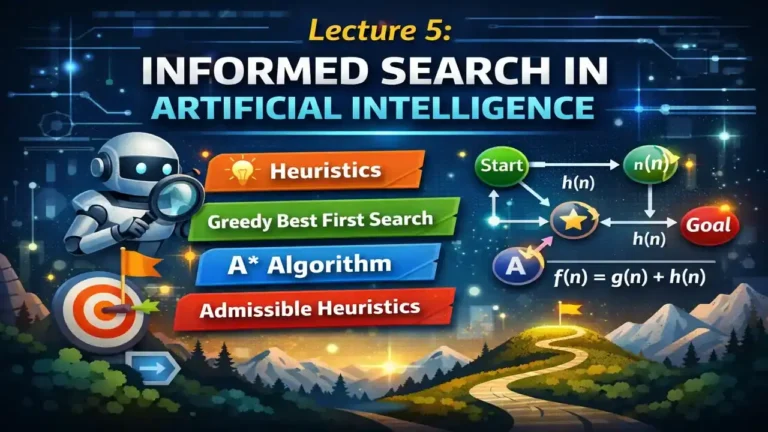
Informed search is also known as:
Correct Answer: B) Heuristic search
Question 132
Informed Search — Heuristics, Greedy, A*
A heuristic function is represented as:
Correct Answer: C) h(n)
Question 133
Informed Search — Heuristics, Greedy, A*
h(n) estimates:
Correct Answer: C) Distance from node to goal
Question 134
Informed Search — Heuristics, Greedy, A*
Greedy Best First Search selects:
Correct Answer: B) Node with lowest h(n)
Question 135
Informed Search — Heuristics, Greedy, A*
Evaluation function of Greedy Best First Search is:
Correct Answer: C) f(n) = h(n)
Question 136
Informed Search — Heuristics, Greedy, A*
A* algorithm evaluation function is:
Correct Answer: C) f(n) = g(n) + h(n)
Question 137
Informed Search — Heuristics, Greedy, A*
In A*, g(n) represents:
Correct Answer: B) Cost from start to current node
Question 138
Informed Search — Heuristics, Greedy, A*
In A*, h(n) represents:
Correct Answer: C) Heuristic estimate to goal
Question 139
Informed Search — Heuristics, Greedy, A*
A* is optimal when the heuristic is:
Correct Answer: B) Admissible
Question 140
Informed Search — Heuristics, Greedy, A*
An admissible heuristic:
Correct Answer: B) Never overestimates the true cost
Question 141
Informed Search — Heuristics, Greedy, A*
Formally, admissible means h(n):
Correct Answer: B) <= h*(n)
Question 142
Informed Search — Heuristics, Greedy, A*
Manhattan Distance is used in:
Correct Answer: B) Grid-based problems like 8-puzzle
Question 143
Informed Search — Heuristics, Greedy, A*
Manhattan Distance formula is:
Correct Answer: B) |x1-x2| + |y1-y2|
Question 144
Informed Search — Heuristics, Greedy, A*
Euclidean Distance is used in:
Correct Answer: C) Continuous movement like robotics
Question 145
Informed Search — Heuristics, Greedy, A*
Straight-line distance is admissible because:
Correct Answer: B) Actual road distance cannot be less than straight-line
Question 146
Informed Search — Heuristics, Greedy, A*
A* algorithm is used in:
Correct Answer: C) GPS navigation and pathfinding
Question 147
Informed Search — Heuristics, Greedy, A*
Greedy search may get stuck in:
Correct Answer: B) Local minima
Question 148
Informed Search — Heuristics, Greedy, A*
A consistent heuristic satisfies:
Correct Answer: B) h(n) <= c(n,n') + h(n')
Question 149
Informed Search — Heuristics, Greedy, A*
All consistent heuristics are:
Correct Answer: B) Admissible
Question 150
Informed Search — Heuristics, Greedy, A*
A* uses a priority queue ordered by:
Correct Answer: C) f(n) = g(n) + h(n)
Question 151
Informed Search — Heuristics, Greedy, A*
Which algorithm is NOT an informed search?
Correct Answer: C) BFS SECTION 8: Local Search — Hill Climbing, SA, Genetic Algorithms (Q156–Q180)
Question 152
Local Search — Hill Climbing, SA, Genetic Algorithms
Greedy Best First Search is:
Correct Answer: C) Fast but not always optimal
Question 153
Local Search — Hill Climbing, SA, Genetic Algorithms
A* combines advantages of:
Correct Answer: B) Uniform Cost Search and Greedy Search
Question 154
Local Search — Hill Climbing, SA, Genetic Algorithms
Video game pathfinding uses:
Correct Answer: C) Informed search like A*
Question 155
Local Search — Hill Climbing, SA, Genetic Algorithms
A good heuristic should:
Correct Answer: C) Provide accurate estimates and easy to compute
Question 156
Local Search — Hill Climbing, SA, Genetic Algorithms
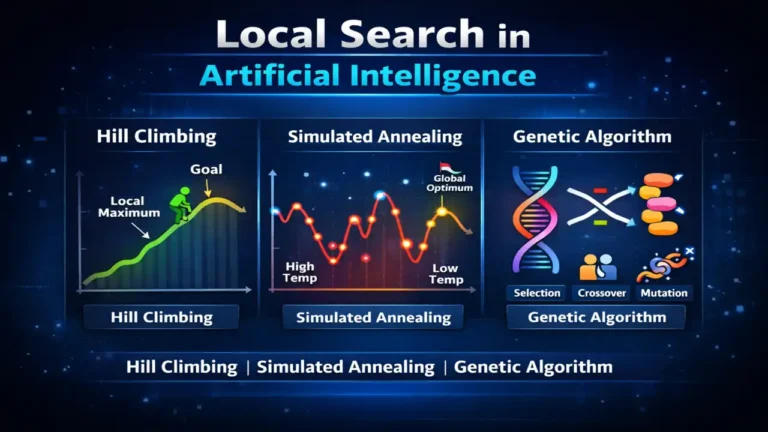
Local search focuses on:
Correct Answer: B) Improving a single current solution
Question 157
Local Search — Hill Climbing, SA, Genetic Algorithms
Hill Climbing is a:
Correct Answer: B) Greedy local search algorithm
Question 158
Local Search — Hill Climbing, SA, Genetic Algorithms
Hill Climbing selects:
Correct Answer: C) Best neighboring state
Question 159
Local Search — Hill Climbing, SA, Genetic Algorithms
Main drawback of Hill Climbing:
Correct Answer: C) Gets stuck in local maxima
Question 160
Local Search — Hill Climbing, SA, Genetic Algorithms
A local maximum is:
Correct Answer: B) A solution better than neighbors but not globally optimal
Question 161
Local Search — Hill Climbing, SA, Genetic Algorithms
A plateau in Hill Climbing is where:
Correct Answer: C) All neighbors have equal value
Question 162
Local Search — Hill Climbing, SA, Genetic Algorithms
Simulated Annealing is inspired by:
Correct Answer: B) Metallurgy/Physics
Question 163
Local Search — Hill Climbing, SA, Genetic Algorithms
Simulated Annealing can accept:
Correct Answer: C) Worse solutions sometimes
Question 164
Local Search — Hill Climbing, SA, Genetic Algorithms
Temperature in Simulated Annealing controls:
Correct Answer: B) Probability of accepting worse solutions
Question 165
Local Search — Hill Climbing, SA, Genetic Algorithms
As temperature decreases in Simulated Annealing:
Correct Answer: C) Probability of accepting bad moves decreases
Question 166
Local Search — Hill Climbing, SA, Genetic Algorithms
Simulated Annealing helps to:
Correct Answer: B) Escape local maxima
Question 167
Local Search — Hill Climbing, SA, Genetic Algorithms
Genetic Algorithms are based on:
Correct Answer: B) Natural selection and evolution
Question 168
Local Search — Hill Climbing, SA, Genetic Algorithms
In Genetic Algorithm, a solution is called:
Correct Answer: B) Chromosome
Question 169
Local Search — Hill Climbing, SA, Genetic Algorithms
In Genetic Algorithm, fitness function:
Correct Answer: B) Evaluates solution quality
Question 170
Local Search — Hill Climbing, SA, Genetic Algorithms
Crossover in Genetic Algorithm means:
Correct Answer: C) Combining two parent solutions
Question 171
Local Search — Hill Climbing, SA, Genetic Algorithms
Mutation in Genetic Algorithm means:
Correct Answer: C) Random change in solution
Question 172
Local Search — Hill Climbing, SA, Genetic Algorithms
Genetic Algorithms work with:
Correct Answer: B) Population of solutions
Question 173
Local Search — Hill Climbing, SA, Genetic Algorithms
Which algorithm can escape local maxima best?
Correct Answer: C) Simulated Annealing
Question 174
Local Search — Hill Climbing, SA, Genetic Algorithms
Local search is best for:
Correct Answer: B) Optimization problems
Question 175
Local Search — Hill Climbing, SA, Genetic Algorithms
Hill Climbing stops when:
Correct Answer: B) No better neighbor exists
Question 176
Local Search — Hill Climbing, SA, Genetic Algorithms
Which local search uses a population of solutions?
Correct Answer: C) Genetic Algorithm
Question 177
AI Applications, Ethics & Society
Local search uses:
Correct Answer: B) Very little memory
Question 178
AI Applications, Ethics & Society
Ridge problem in Hill Climbing means:
Correct Answer: B) Path to optimal solution is not straightforward
Question 179
AI Applications, Ethics & Society
Genetic Algorithm is slower than Hill Climbing but:
Correct Answer: C) Is better at global optimization
Question 180
AI Applications, Ethics & Society
Selection in Genetic Algorithm prefers:
Correct Answer: B) Chromosomes with higher fitness
Question 181
AI Applications, Ethics & Society
AI in healthcare is used for:
Correct Answer: B) Disease detection and medical imaging
Question 182
AI Applications, Ethics & Society
AI in finance is used for:
Correct Answer: B) Fraud detection and risk assessment
Question 183
AI Applications, Ethics & Society
Adaptive learning platforms use AI in:
Correct Answer: C) Education
Question 184
AI Applications, Ethics & Society
Traffic management systems are AI in:
Correct Answer: C) Transportation
Question 185
AI Applications, Ethics & Society
Recommendation systems like Netflix use:
Correct Answer: B) AI and Machine Learning
Question 186
AI Applications, Ethics & Society
Self-driving cars use AI mainly for:
Correct Answer: B) Environmental perception and decision-making
Question 187
AI Applications, Ethics & Society
Algorithmic trading uses AI in:
Correct Answer: B) Finance sector
Question 188
AI Applications, Ethics & Society
Robotic surgery uses AI in:
Correct Answer: C) Healthcare
Question 189
AI Applications, Ethics & Society
Sentiment analysis is an application of:
Correct Answer: C) NLP
Question 190
AI Applications, Ethics & Society
Machine translation is an application of:
Correct Answer: B) NLP
Question 191
AI Applications, Ethics & Society
Object detection in images uses:
Correct Answer: B) Computer Vision
Question 192
AI Applications, Ethics & Society
Route optimization in Google Maps uses:
Correct Answer: B) Informed search algorithms
Question 193
AI Applications, Ethics & Society
Autonomous vehicle navigation uses:
Correct Answer: C) Computer Vision and AI
Question 194
AI Applications, Ethics & Society
Personalized treatment in healthcare uses:
Correct Answer: B) AI and patient data analysis
Question 195
AI Applications, Ethics & Society
Customer behavior analysis is AI in:
Correct Answer: C) Business and Marketing
Question 196
AI Applications, Ethics & Society
Algorithmic bias in AI refers to:
Correct Answer: B) Unfair or discriminatory outputs from AI systems
Question 197
AI Applications, Ethics & Society
Explainable AI focuses on:
Correct Answer: B) Making AI decisions transparent and understandable
Question 198
AI Applications, Ethics & Society
Job displacement is a concern because:
Correct Answer: B) AI automation may replace human workers
Question 199
AI Applications, Ethics & Society
Data privacy in AI is a concern because:
Correct Answer: B) AI systems collect and process large amounts of personal data
Question 200
AI Applications, Ethics & Society
Which is a benefit of AI?
Correct Answer: C) Automation of repetitive tasks
Question 201
AI Applications, Ethics & Society
A challenge in AI development is:
Correct Answer: B) High development cost
Question 202
AI Applications, Ethics & Society
Transparency in AI means:
Correct Answer: B) AI decision process can be understood
Question 203
Advanced, Mixed & Conceptual Questions
Future of AI includes:
Correct Answer: B) Human-AI collaboration
Question 204
Advanced, Mixed & Conceptual Questions
Responsible AI development ensures:
Correct Answer: B) Fairness, safety and societal benefit
Question 205
Advanced, Mixed & Conceptual Questions
The black box problem in AI refers to:
Correct Answer: B) AI making decisions humans cannot interpret
Question 206
Advanced, Mixed & Conceptual Questions
Which search algorithm is complete and optimal with equal costs?
Correct Answer: C) BFS
Question 207
Advanced, Mixed & Conceptual Questions
Which search algorithm is NOT complete?
Correct Answer: C) DFS
Question 208
Advanced, Mixed & Conceptual Questions
The branching factor 'b' represents:
Correct Answer: B) Number of child nodes per parent
Question 209
Advanced, Mixed & Conceptual Questions
IDS is preferred over BFS because:
Correct Answer: B) It uses less memory while being complete
Question 210
Advanced, Mixed & Conceptual Questions
In A*, if h(n)=0 for all nodes, A* becomes:
Correct Answer: C) Uniform Cost Search
Question 211
Advanced, Mixed & Conceptual Questions
Which heuristic is NOT admissible?
Correct Answer: C) A heuristic that always overestimates
Question 212
Advanced, Mixed & Conceptual Questions
In Simulated Annealing, if the move is better (delta E > 0):
Correct Answer: C) Move is always accepted
Question 213
Advanced, Mixed & Conceptual Questions
The fitness function in Genetic Algorithm is similar to:
Correct Answer: A) Heuristic function in search
Question 214
Advanced, Mixed & Conceptual Questions
Which statement about local search is TRUE?
Correct Answer: B) It only cares about the final state, not the path
Question 215
Advanced, Mixed & Conceptual Questions
A* with an inadmissible heuristic:
Correct Answer: B) May not find optimal path
Question 216
Advanced, Mixed & Conceptual Questions
Which agent type explicitly uses a utility function?
Correct Answer: C) Utility-based agent
Question 217
Advanced, Mixed & Conceptual Questions
A performance measure for an AI agent measures:
Correct Answer: B) How well it achieves its goals
Question 218
Advanced, Mixed & Conceptual Questions
The critic in a learning agent:
Correct Answer: C) Evaluates performance
Question 219
Advanced, Mixed & Conceptual Questions
The problem generator in a learning agent:
Correct Answer: C) Suggests exploratory actions
Question 220
Advanced, Mixed & Conceptual Questions
Propositional Logic CANNOT represent:
Correct Answer: C) General statements with variables like all humans
Question 221
Advanced, Mixed & Conceptual Questions
ForAll x Bird(x) implies CanFly(x): what breaks this rule?
Correct Answer: C) Penguin (cannot fly)
Question 222
Advanced, Mixed & Conceptual Questions
Predicate Logic supports:
Correct Answer: B) Quantifiers and predicates over objects
Question 223
Advanced, Mixed & Conceptual Questions
Forward chaining in expert systems is:
Correct Answer: B) Data-driven
Question 224
Advanced, Mixed & Conceptual Questions
The PEAS framework is used to:
Correct Answer: B) Define task environment of an agent
Question 225
Advanced, Mixed & Conceptual Questions
Backward chaining is used in:
Correct Answer: C) Prolog programming language
Question 226
Advanced, Mixed & Conceptual Questions
Supervised Learning requires:
Correct Answer: B) Labeled training data
Question 227
Advanced, Mixed & Conceptual Questions
Unsupervised Learning works with:
Correct Answer: C) Unlabeled data
Question 228
Advanced, Mixed & Conceptual Questions
Reinforcement Learning involves:
Correct Answer: B) Agent learning through rewards and penalties
Question 229
Advanced, Mixed & Conceptual Questions
Neural Networks are inspired by:
Correct Answer: B) Human brain neurons
Question 230
Advanced, Mixed & Conceptual Questions
Deep Learning uses:
Correct Answer: B) Multiple layers of neural networks
Question 231
Advanced, Mixed & Conceptual Questions
Which is NOT a component of uninformed search?
Correct Answer: C) A* Search
Question 232
Advanced, Mixed & Conceptual Questions
Which statement about BFS is FALSE?
Correct Answer: C) It uses less memory than DFS
Question 233
Advanced, Mixed & Conceptual Questions
Which statement about DFS is TRUE?
Correct Answer: C) It uses less memory than BFS
Question 234
Advanced, Mixed & Conceptual Questions
The main advantage of BFS over DFS is:
Correct Answer: C) Guarantees shortest path
Question 235
Advanced, Mixed & Conceptual Questions
The main advantage of DFS over BFS is:
Correct Answer: B) Less memory usage
Question 236
Advanced, Mixed & Conceptual Questions
Heuristic search is better than uninformed search because:
Correct Answer: C) Uses domain knowledge to be more efficient
Question 237
Advanced, Mixed & Conceptual Questions
If h(n) always equals the true cost, A* would:
Correct Answer: C) Expand only nodes on optimal path
Question 238
Advanced, Mixed & Conceptual Questions
Greedy Best First Search is NOT optimal because:
Correct Answer: B) It ignores actual path cost g(n)
Question 239
Advanced, Mixed & Conceptual Questions
The main advantage of A* over Greedy search is:
Correct Answer: B) A* considers both actual and estimated cost
Question 240
Advanced, Mixed & Conceptual Questions
ELIZA is considered an early example of:
Correct Answer: C) Conversational AI
Question 241
Advanced, Mixed & Conceptual Questions
The main limitation of ELIZA was:
Correct Answer: B) It did not truly understand language
Question 242
Advanced, Mixed & Conceptual Questions
Which is an example of state space?
Correct Answer: B) All possible configurations of a maze
Question 243
Advanced, Mixed & Conceptual Questions
Transition model in search shows:
Correct Answer: B) How actions change states
Question 244
Advanced, Mixed & Conceptual Questions
Which is NOT a component of state space?
Correct Answer: C) Compiler
Question 245
Advanced, Mixed & Conceptual Questions
IDS repeats exploration which causes:
Correct Answer: B) Redundant computation at smaller depths
Question 246
Advanced, Mixed & Conceptual Questions
John McCarthy is credited with:
Correct Answer: B) Coining the term Artificial Intelligence
Question 247
Advanced, Mixed & Conceptual Questions
Symbolic AI focused on:
Correct Answer: C) Rule-based and logical reasoning
Question 248
Advanced, Mixed & Conceptual Questions
An agent's percept sequence is:
Correct Answer: B) The complete history of observations
Question 249
Advanced, Mixed & Conceptual Questions
A fully observable environment means:
Correct Answer: B) Agent can perceive the complete state
Question 250
Advanced, Mixed & Conceptual Questions
A deterministic environment means:
Correct Answer: B) Next state fully determined by current state and action
Question 251
Advanced, Mixed & Conceptual Questions
A stochastic environment has:
Correct Answer: B) Randomness or uncertainty in outcomes
Question 252
Advanced, Mixed & Conceptual Questions
A static environment:
Correct Answer: C) Does not change while agent deliberates
Question 253
Advanced, Mixed & Conceptual Questions
A dynamic environment:
Correct Answer: B) Changes while the agent is deliberating
Question 254
Advanced, Mixed & Conceptual Questions
In a competitive multi-agent environment, agents:
Correct Answer: B) Compete against each other
Question 255
Advanced, Mixed & Conceptual Questions
Random restart Hill Climbing solves:
Correct Answer: B) Local maxima problem by restarting from different points
Question 256
Advanced, Mixed & Conceptual Questions
As Simulated Annealing temperature approaches 0, it becomes like:
Correct Answer: C) Hill Climbing
Question 257
Advanced, Mixed & Conceptual Questions
Initial population in Genetic Algorithm is usually:
Correct Answer: B) Randomly generated solutions
Question 258
Advanced, Mixed & Conceptual Questions
In Genetic Algorithm, each new generation should be:
Correct Answer: C) Generally better due to selection and crossover
Question 259
Advanced, Mixed & Conceptual Questions
Which AI technique mimics Darwinian evolution?
Correct Answer: C) Genetic Algorithms
Question 260
Advanced, Mixed & Conceptual Questions
Knowledge acquisition is:
Correct Answer: B) Adding new knowledge to the knowledge base
Question 261
Advanced, Mixed & Conceptual Questions
Which is an example of inductive reasoning?
Correct Answer: B) Sun rises tomorrow because it has risen every day
Question 262
Advanced, Mixed & Conceptual Questions
Which is an example of deductive reasoning?
Correct Answer: B) All cats are animals, Tom is cat, therefore Tom is animal
Question 263
Advanced, Mixed & Conceptual Questions
Minimax algorithm is used in:
Correct Answer: B) Two-player adversarial games
Question 264
Advanced, Mixed & Conceptual Questions
Alpha-beta pruning improves minimax by:
Correct Answer: B) Eliminating branches that cannot affect final decision
Question 265
Advanced, Mixed & Conceptual Questions
In game playing, MAX player tries to:
Correct Answer: B) Maximize score
Question 266
Advanced, Mixed & Conceptual Questions
In game playing, MIN player tries to:
Correct Answer: B) Minimize score
Question 267
Advanced, Mixed & Conceptual Questions
Constraint satisfaction problems involve:
Correct Answer: B) Finding values satisfying all constraints
Question 268
Advanced, Mixed & Conceptual Questions
Sudoku solving is an example of:
Correct Answer: B) Constraint satisfaction problem
Question 269
Advanced, Mixed & Conceptual Questions
Backtracking in CSP means:
Correct Answer: B) Going back when constraint is violated
Question 270
Advanced, Mixed & Conceptual Questions
PROLOG is a programming language based on:
Correct Answer: B) Logic and knowledge representation
Question 271
Advanced, Mixed & Conceptual Questions
Automated theorem proving uses:
Correct Answer: B) Logic and inference mechanisms
Question 272
Advanced, Mixed & Conceptual Questions
AI planning involves:
Correct Answer: B) Generating sequence of actions to achieve goal
Question 273
Advanced, Mixed & Conceptual Questions
Which AI field handles speech recognition?
Correct Answer: C) Natural Language Processing
Question 274
Advanced, Mixed & Conceptual Questions
Tokenization in NLP is:
Correct Answer: B) Breaking text into words or tokens
Question 275
Advanced, Mixed & Conceptual Questions
Stemming in NLP is:
Correct Answer: B) Reducing words to their root form
Question 276
Advanced, Mixed & Conceptual Questions
Sentiment analysis determines:
Correct Answer: C) The opinion or emotion in text
Question 277
Advanced, Mixed & Conceptual Questions
Named Entity Recognition (NER) identifies:
Correct Answer: B) Names of people, places, organizations in text
Question 278
Advanced, Mixed & Conceptual Questions
Text classification assigns:
Correct Answer: B) Categories to text documents
Question 279
Advanced, Mixed & Conceptual Questions
Image segmentation divides:
Correct Answer: B) Image into meaningful regions
Question 280
Advanced, Mixed & Conceptual Questions
Convolutional Neural Networks are specialized for:
Correct Answer: C) Image processing
Question 281
Advanced, Mixed & Conceptual Questions
Recurrent Neural Networks are suited for:
Correct Answer: B) Sequential data like text and speech
Question 282
Advanced, Mixed & Conceptual Questions
Transfer learning means:
Correct Answer: B) Reusing a model trained on one task for another
Question 283
Advanced, Mixed & Conceptual Questions
Gradient descent is used to:
Correct Answer: B) Minimize loss function in ML
Question 284
Advanced, Mixed & Conceptual Questions
Overfitting in ML means:
Correct Answer: B) Model performs well on training but poor on new data
Question 285
Advanced, Mixed & Conceptual Questions
Regularization in ML is used to:
Correct Answer: B) Prevent overfitting
Question 286
Advanced, Mixed & Conceptual Questions
Decision trees are used in:
Correct Answer: B) Classification and regression
Question 287
Advanced, Mixed & Conceptual Questions
Random Forest is:
Correct Answer: B) An ensemble of multiple decision trees
Question 288
Advanced, Mixed & Conceptual Questions
K-Nearest Neighbors classifies based on:
Correct Answer: B) K closest training examples
Question 289
Advanced, Mixed & Conceptual Questions
K-Means is an algorithm for:
Correct Answer: B) Clustering
Question 290
Advanced, Mixed & Conceptual Questions
Naive Bayes is based on:
Correct Answer: B) Bayes theorem with naive independence assumption
Question 291
Advanced, Mixed & Conceptual Questions
Reinforcement learning agent learns by:
Correct Answer: B) Trial and error with rewards and penalties
Question 292
Advanced, Mixed & Conceptual Questions
In reinforcement learning, agent aims to:
Correct Answer: B) Maximize cumulative reward over time
Question 293
Advanced, Mixed & Conceptual Questions
AlphaGo used which AI techniques?
Correct Answer: C) Deep learning combined with reinforcement learning and search
Question 294
Advanced, Mixed & Conceptual Questions
Generative AI can:
Correct Answer: B) Generate new content like text, images, code
Question 295
Advanced, Mixed & Conceptual Questions
AI hallucination refers to:
Correct Answer: B) AI generating plausible but incorrect information
Question 296
Advanced, Mixed & Conceptual Questions
Deepfakes are:
Correct Answer: B) Fake but realistic-looking AI-generated media
Question 297
Advanced, Mixed & Conceptual Questions
AI in cybersecurity is used for:
Correct Answer: B) Detecting and preventing cyber attacks
Question 298
Advanced, Mixed & Conceptual Questions
Swarm intelligence is inspired by:
Correct Answer: B) Collective behavior of social insects like ants and bees
Question 299
Advanced, Mixed & Conceptual Questions
Ant Colony Optimization mimics:
Correct Answer: B) How ants find shortest paths using pheromones
Question 300
Advanced, Mixed & Conceptual Questions
Which is NOT an informed search algorithm?
Correct Answer: C) Depth First Search
Question 301
Advanced, Mixed & Conceptual Questions
The AI winter refers to:
Correct Answer: B) Periods of reduced funding and interest in AI
Question 302
Advanced, Mixed & Conceptual Questions
Explainable AI (XAI) aims to:
Correct Answer: B) Make AI decisions interpretable to humans
Question 303
Advanced, Mixed & Conceptual Questions
Federated learning allows:
Correct Answer: B) Training across distributed devices without sharing raw data
Question 304
Advanced, Mixed & Conceptual Questions
Privacy-preserving AI techniques protect:
Correct Answer: B) Individual user data during training
Question 305
Advanced, Mixed & Conceptual Questions
AI alignment refers to:
Correct Answer: B) Ensuring AI goals align with human values
Question 306
Advanced, Mixed & Conceptual Questions
Current AI systems are mostly:
Correct Answer: C) Narrow AI designed for specific tasks
Question 307
Advanced, Mixed & Conceptual Questions
AGI stands for:
Correct Answer: B) Artificial General Intelligence
Question 308
Advanced, Mixed & Conceptual Questions
Q-learning is a:
Correct Answer: B) Reinforcement learning algorithm
Question 309
Advanced, Mixed & Conceptual Questions
The backpropagation algorithm is used to:
Correct Answer: C) Initialize weights only
Question 310
Advanced, Mixed & Conceptual Questions
Dropout in neural networks is used for:
Correct Answer: B) Regularization to prevent overfitting
Question 311
Advanced, Mixed & Conceptual Questions
Activation functions in neural networks:
Correct Answer: B) Introduce non-linearity enabling complex learning
Question 312
Advanced, Mixed & Conceptual Questions
Sigmoid activation outputs values in range:
Correct Answer: B) 0 to 1
Question 313
Advanced, Mixed & Conceptual Questions
Softmax activation is used in:
Correct Answer: B) Multi-class classification output
Question 314
Advanced, Mixed & Conceptual Questions
Training data is used to:
Correct Answer: B) Fit or train the model parameters
Question 315
Advanced, Mixed & Conceptual Questions
Test data is used to:
Correct Answer: C) Evaluate final model performance
Question 316
Advanced, Mixed & Conceptual Questions
Hyperparameters in ML are:
Correct Answer: B) Settings configured before training
Question 317
Advanced, Mixed & Conceptual Questions
Learning rate in ML controls:
Correct Answer: B) How much model parameters update each step
Question 318
Advanced, Mixed & Conceptual Questions
Epoch in ML training means:
Correct Answer: B) One complete pass through training dataset
Question 319
Advanced, Mixed & Conceptual Questions
Which AI concept is used in autonomous planning?
Correct Answer: B) Goal-based and utility-based agents
Question 320
Advanced, Mixed & Conceptual Questions
Machine Learning is different from traditional programming because:
Correct Answer: B) ML learns patterns from data without explicit rules
Question 321
Advanced, Mixed & Conceptual Questions
Which type of ML predicts output from labeled input?
Correct Answer: C) Supervised Learning
Question 322
Advanced, Mixed & Conceptual Questions
Which type of ML finds hidden patterns in unlabeled data?
Correct Answer: B) Unsupervised Learning
Question 323
Advanced, Mixed & Conceptual Questions
The concept of rationality in AI means:
Correct Answer: B) Making best decision with available information
Question 324
Advanced, Mixed & Conceptual Questions
LiDAR in self-driving cars is used as:
Correct Answer: B) A sensor for distance measurement
Question 325
Advanced, Mixed & Conceptual Questions
MYCIN was a famous expert system for:
Correct Answer: B) Medical diagnosis of blood infections
Question 326
Advanced, Mixed & Conceptual Questions
Particle Swarm Optimization is inspired by:
Correct Answer: B) Flocking behavior of birds and fish
Question 327
Advanced, Mixed & Conceptual Questions
Acceptance probability in Simulated Annealing is e^(-dE/T). If temperature T is very high:
Correct Answer: B) Probability of accepting bad move is close to 1
Question 328
Advanced, Mixed & Conceptual Questions
Lemmatization in NLP returns:
Correct Answer: B) The dictionary base form of word
Question 329
Advanced, Mixed & Conceptual Questions
In game theory, Nash Equilibrium refers to:
Correct Answer: B) State where no player benefits from changing strategy unilaterally
Question 330
Advanced, Mixed & Conceptual Questions
Multi-agent systems involve:
Correct Answer: B) Multiple autonomous agents interacting
Question 331
Advanced, Mixed & Conceptual Questions
Emergent behavior in multi-agent systems means:
Correct Answer: B) Complex behavior arising from simple agent interactions
Question 332
Advanced, Mixed & Conceptual Questions
Which is a real-world AI application in agriculture?
Correct Answer: B) Crop monitoring and yield prediction
Question 333
Advanced, Mixed & Conceptual Questions
AI in manufacturing enables:
Correct Answer: B) Predictive maintenance and quality control
Question 334
Advanced, Mixed & Conceptual Questions
Predictive maintenance uses AI to:
Correct Answer: B) Predict when equipment will fail before it does
Question 335
Advanced, Mixed & Conceptual Questions
GANs (Generative Adversarial Networks) consist of:
Correct Answer: B) Generator and discriminator networks competing
Question 336
Advanced, Mixed & Conceptual Questions
Transformer architecture revolutionized:
Correct Answer: B) NLP with attention mechanisms
Question 337
Advanced, Mixed & Conceptual Questions
BERT is a language model known for:
Correct Answer: B) Bidirectional understanding of text context
Question 338
Advanced, Mixed & Conceptual Questions
Fine-tuning a pre-trained model means:
Correct Answer: B) Further training on specific task data
Question 339
Advanced, Mixed & Conceptual Questions
AI regulation aims to:
Correct Answer: B) Ensure AI is developed and deployed responsibly
Question 340
Advanced, Mixed & Conceptual Questions
Human-in-the-loop AI means:
Correct Answer: B) Humans remain involved in AI decision process
Question 341
Advanced, Mixed & Conceptual Questions
Which AI field studies how machines can understand and generate human language?
Correct Answer: C) Natural Language Processing
Question 342
Advanced, Mixed & Conceptual Questions
Object detection involves:
Correct Answer: B) Identifying and locating objects in images
Question 343
Advanced, Mixed & Conceptual Questions
Which ML algorithm creates tree-like decision rules?
Correct Answer: C) Decision Tree
Question 344
Advanced, Mixed & Conceptual Questions
Support Vector Machine (SVM) finds:
Correct Answer: B) Best hyperplane to separate classes
Question 345
Advanced, Mixed & Conceptual Questions
Dimensionality reduction reduces:
Correct Answer: B) Number of input features while preserving information
Question 346
Advanced, Mixed & Conceptual Questions
PCA (Principal Component Analysis) is used for:
Correct Answer: C) Dimensionality reduction
Question 347
Advanced, Mixed & Conceptual Questions
Accuracy in ML classification is:
Correct Answer: B) Percentage of correct predictions
Question 348
Advanced, Mixed & Conceptual Questions
A confusion matrix shows:
Correct Answer: B) True positives, false positives, true negatives, false negatives
Question 349
Advanced, Mixed & Conceptual Questions
Collaborative filtering recommends based on:
Correct Answer: B) Similar users preferences
Question 350
Advanced, Mixed & Conceptual Questions
Content-based filtering recommends based on:
Correct Answer: B) Features of items similar to what user liked
Question 351
Advanced, Mixed & Conceptual Questions
The Dartmouth Conference was held in:
Correct Answer: B) 1956
Question 352
Advanced, Mixed & Conceptual Questions
Alan Turing published his paper on machine intelligence in:
Correct Answer: B) 1950
Question 353
Advanced, Mixed & Conceptual Questions
Expert systems expert knowledge comes from:
Correct Answer: B) Human experts encoded in rules
Question 354
Advanced, Mixed & Conceptual Questions
Alpha-beta pruning is a type of:
Correct Answer: B) Search optimization for game trees
Question 355
Advanced, Mixed & Conceptual Questions
AI planning requires:
Correct Answer: B) Initial state, goal state, and available actions
Question 356
Advanced, Mixed & Conceptual Questions
Arc consistency in CSP ensures:
Correct Answer: B) Values in domains are consistent with neighboring constraints
Question 357
Advanced, Mixed & Conceptual Questions
AlphaFold is an AI system that:
Correct Answer: B) Predicts protein 3D structures
Question 358
Advanced, Mixed & Conceptual Questions
Text-to-speech (TTS) systems convert:
Correct Answer: B) Text to audio speech
Question 359
Advanced, Mixed & Conceptual Questions
Prompt engineering is:
Correct Answer: B) Crafting effective inputs to guide AI model responses
Question 360
Advanced, Mixed & Conceptual Questions
Zero-shot learning means:
Correct Answer: B) Model can handle tasks without task-specific training
Question 361
Advanced, Mixed & Conceptual Questions
Which type of ML is used in game-playing AI like chess?
Correct Answer: C) Reinforcement Learning
Question 362
Advanced, Mixed & Conceptual Questions
Batch size in ML refers to:
Correct Answer: B) Number of samples processed in one training step
Question 363
Advanced, Mixed & Conceptual Questions
L1 regularization adds penalty based on:
Correct Answer: B) Absolute value of weights
Question 364
Advanced, Mixed & Conceptual Questions
L2 regularization adds penalty based on:
Correct Answer: B) Square of weights
Question 365
Advanced, Mixed & Conceptual Questions
ReLU activation function outputs:
Correct Answer: B) max(0,x) – zero for negative, x for positive
Question 366
Advanced, Mixed & Conceptual Questions
Which field studies how agents interact in economic scenarios using AI?
Correct Answer: B) Game Theory in AI
Question 367
Advanced, Mixed & Conceptual Questions
Semantic networks represent:
Correct Answer: B) Relationships between concepts as nodes and links
Question 368
Advanced, Mixed & Conceptual Questions
A knowledge base rule stores:
Correct Answer: B) Facts and if-then rules for inference
Question 369
Advanced, Mixed & Conceptual Questions
Which AI technique is best for large combinatorial optimization?
Correct Answer: C) Genetic Algorithms
Question 370
Advanced, Mixed & Conceptual Questions
An ontology in AI defines:
Correct Answer: B) Concepts and relationships in a domain
Question 371
Advanced, Mixed & Conceptual Questions
Map coloring is a classic example of:
Correct Answer: B) Constraint satisfaction
Question 372
Advanced, Mixed & Conceptual Questions
Which of the following best describes the difference between informed and uninformed search?
Correct Answer: B) Informed search uses domain knowledge (heuristics) to guide search
Question 373
Advanced, Mixed & Conceptual Questions
In the 8-puzzle problem, what does each state represent?
Correct Answer: B) A specific arrangement of tiles on the board
Question 374
Advanced, Mixed & Conceptual Questions
Which data structure does BFS use and why?
Correct Answer: B) Queue (FIFO), because it explores shallowest nodes first
Question 375
Advanced, Mixed & Conceptual Questions
Which data structure does DFS use and why?
Correct Answer: B) Stack (LIFO), because it goes deep before backtracking
Question 376
Advanced, Mixed & Conceptual Questions
IDS avoids the memory problem of BFS by:
Correct Answer: B) Not storing all frontier nodes, using DFS-style stack
Question 377
Advanced, Mixed & Conceptual Questions
The evaluation function f(n)=g(n)+h(n) balances:
Correct Answer: B) Actual path cost and estimated remaining cost
Question 378
Advanced, Mixed & Conceptual Questions
Why is A* better than Greedy search in most cases?
Correct Answer: B) A* considers actual path cost preventing poor paths
Question 379
Advanced, Mixed & Conceptual Questions
What is the role of temperature in Simulated Annealing?
Correct Answer: B) Controls probability of accepting worse solutions
Question 380
Advanced, Mixed & Conceptual Questions
How does Genetic Algorithm avoid local optima?
Correct Answer: B) By working with population and using crossover and mutation
Question 381
Advanced, Mixed & Conceptual Questions
Crossover in Genetic Algorithm is analogous to:
Correct Answer: B) Biological reproduction combining parental traits
Question 382
Advanced, Mixed & Conceptual Questions
Which AI reasoning is used in rule-based expert systems?
Correct Answer: C) Deductive reasoning
Question 383
Advanced, Mixed & Conceptual Questions
Which reasoning is the basis of Machine Learning?
Correct Answer: C) Inductive reasoning from data
Question 384
Advanced, Mixed & Conceptual Questions
Knowledge representation is needed because:
Correct Answer: B) AI systems need structured information to reason intelligently
Question 385
Advanced, Mixed & Conceptual Questions
Why is Predicate Logic preferred over Propositional Logic in AI?
Correct Answer: B) It can represent objects, relationships and quantifiers
Question 386
Advanced, Mixed & Conceptual Questions
The existential quantifier is needed to express:
Correct Answer: C) Statements about at least one element
Question 387
Advanced, Mixed & Conceptual Questions
The universal quantifier is needed to express:
Correct Answer: B) Statements that apply to all elements in domain
Question 388
Advanced, Mixed & Conceptual Questions
Forward chaining is best when:
Correct Answer: B) Facts are known and you want to derive conclusions
Question 389
Advanced, Mixed & Conceptual Questions
Backward chaining is best when:
Correct Answer: B) Specific goal is known and you verify if facts support it
Question 390
Advanced, Mixed & Conceptual Questions
ELIZA's main technique was pattern matching which means:
Correct Answer: B) It matched input patterns to templates without understanding
Question 391
Advanced, Mixed & Conceptual Questions
Why is admissibility important for A*?
Correct Answer: B) It guarantees that A* finds the optimal solution
Question 392
Advanced, Mixed & Conceptual Questions
What happens if depth limit in DLS is too small?
Correct Answer: B) Solution may not be found if it is deeper than limit
Question 393
Advanced, Mixed & Conceptual Questions
Why does Hill Climbing fail on ridges?
Correct Answer: B) The optimal path requires moves that appear worse initially
Question 394
Advanced, Mixed & Conceptual Questions
How does Genetic Algorithm represent solutions?
Correct Answer: B) As chromosomes (strings of genes)
Question 395
Advanced, Mixed & Conceptual Questions
What makes a multi-agent environment complex?
Correct Answer: B) Agent actions affect other agents creating interdependencies
Question 396
Advanced, Mixed & Conceptual Questions
AI systems are said to learn when they:
Correct Answer: B) Improve performance on tasks through experience without explicit programming
Question 397
Advanced, Mixed & Conceptual Questions
The Turing Test is NOT a test of:
Correct Answer: C) True machine consciousness or understanding
Question 398
Advanced, Mixed & Conceptual Questions
IBM Watson won Jeopardy using:
Correct Answer: B) AI, NLP, and knowledge retrieval systems
Question 399
Advanced, Mixed & Conceptual Questions
In AI, an action is defined as:
Correct Answer: B) A choice available to the agent that causes state transitions
Question 400
Advanced, Mixed & Conceptual Questions
The efficiency of A* depends mainly on:
Correct Answer: B) Quality of heuristic function
Question 401
Advanced, Mixed & Conceptual Questions
A state in search problem represents:
Correct Answer: B) A configuration of the world at a given moment
Question 402
Advanced, Mixed & Conceptual Questions
Goal state in search is:
Correct Answer: C) The desired final configuration
Question 403
Advanced, Mixed & Conceptual Questions
The solution to a search problem is:
Correct Answer: B) A sequence of actions leading from initial to goal state
Question 404
Advanced, Mixed & Conceptual Questions
Optimal solution in search means:
Correct Answer: B) Solution with lowest path cost
Question 405
Advanced, Mixed & Conceptual Questions
Which is NOT an advantage of Genetic Algorithms?
Correct Answer: C) Always faster than Hill Climbing
Question 406
Advanced, Mixed & Conceptual Questions
The population size in Genetic Algorithm affects:
Correct Answer: B) Both diversity and computational cost
Question 407
Advanced, Mixed & Conceptual Questions
In Hill Climbing, a shoulder (flat region) is similar to:
Correct Answer: B) A plateau
Question 408
Advanced, Mixed & Conceptual Questions
Which search explores nodes in order of f(n)=g(n)+h(n)?
Correct Answer: C) A*
Question 409
Advanced, Mixed & Conceptual Questions
Uniform Cost Search is like A* with:
Correct Answer: B) h(n) = 0
Question 410
Advanced, Mixed & Conceptual Questions
What is the main goal of an AI system?
Correct Answer: B) To perform tasks that require human-level intelligence
Question 411
Advanced, Mixed & Conceptual Questions
Knowledge engineering is the process of:
Correct Answer: B) Eliciting and encoding expert knowledge into AI systems
Question 412
Advanced, Mixed & Conceptual Questions
The frame problem in AI refers to:
Correct Answer: B) Difficulty of representing what does NOT change when actions occur
Question 413
Advanced, Mixed & Conceptual Questions
Fuzzy logic handles:
Correct Answer: B) Degrees of truth between 0 and 1
Question 414
Advanced, Mixed & Conceptual Questions
Bayesian networks represent:
Correct Answer: B) Probabilistic relationships between variables
Question 415
Advanced, Mixed & Conceptual Questions
Natural language understanding (NLU) in AI is harder than generation because:
Correct Answer: B) Language has ambiguity, context-dependence and implicit meaning
Question 416
Advanced, Mixed & Conceptual Questions
Which of the following is a structured knowledge representation?
Correct Answer: B) Semantic networks and ontologies
Question 417
Advanced, Mixed & Conceptual Questions
The closed world assumption in AI means:
Correct Answer: B) What is not known to be true is assumed false
Question 418
Advanced, Mixed & Conceptual Questions
An AI agent is autonomous because:
Correct Answer: B) It makes its own decisions based on perceptions and goals
Question 419
Advanced, Mixed & Conceptual Questions
Which is an example of a partially observable environment?
Correct Answer: B) Poker (hidden cards)
Question 420
Advanced, Mixed & Conceptual Questions
Which is an example of a fully observable environment?
Correct Answer: B) Chess where all pieces are visible
Question 421
Advanced, Mixed & Conceptual Questions
The AI field of computer vision primarily processes:
Correct Answer: C) Visual data like images and video
Question 422
Advanced, Mixed & Conceptual Questions
Facial recognition uses which AI technique?
Correct Answer: B) Deep learning-based Computer Vision
Question 423
Advanced, Mixed & Conceptual Questions
Medical imaging AI is used for:
Correct Answer: B) Detecting diseases in scans like X-rays and MRIs
Question 424
Advanced, Mixed & Conceptual Questions
Autonomous robots use AI to:
Correct Answer: B) Navigate, perceive and act in environments intelligently
Question 425
Advanced, Mixed & Conceptual Questions
Which is a challenge in developing autonomous vehicles?
Correct Answer: B) Handling all edge cases and unpredictable human behavior
Question 426
Advanced, Mixed & Conceptual Questions
AI in education provides:
Correct Answer: B) Personalized and adaptive learning experiences
Question 427
Advanced, Mixed & Conceptual Questions
The general problem solver (GPS) was an early AI program designed to:
Correct Answer: B) Solve any problem using means-ends analysis
Question 428
Advanced, Mixed & Conceptual Questions
Means-ends analysis in AI involves:
Correct Answer: B) Reducing difference between current state and goal state
Question 429
Advanced, Mixed & Conceptual Questions
MACSYMA was an early AI system for:
Correct Answer: B) Symbolic mathematics
Question 430
Advanced, Mixed & Conceptual Questions
Which problem did STUDENT (1964 AI program) solve?
Correct Answer: B) Algebra word problems
Question 431
Advanced, Mixed & Conceptual Questions
Case-based reasoning in AI solves new problems by:
Correct Answer: B) Using solutions from similar past cases
Question 432
Advanced, Mixed & Conceptual Questions
Analogical reasoning finds solutions by:
Correct Answer: B) Finding similar problems and adapting their solutions
Question 433
Advanced, Mixed & Conceptual Questions
Which AI technique uses evolutionary principles for optimization?
Correct Answer: C) Genetic Algorithms
Question 434
Advanced, Mixed & Conceptual Questions
The no free lunch theorem in AI/ML states:
Correct Answer: B) No algorithm is best for all problems
Question 435
Advanced, Mixed & Conceptual Questions
Which is the most memory-intensive uninformed search?
Correct Answer: C) BFS
Question 436
Advanced, Mixed & Conceptual Questions
Time complexity of IDS is same as BFS meaning:
Correct Answer: B) Both are O(b^d) though IDS repeats some work
Question 437
Advanced, Mixed & Conceptual Questions
Which would you choose for a very deep search tree?
Correct Answer: B) IDS (memory efficient and complete)
Question 438
Advanced, Mixed & Conceptual Questions
Heuristic function quality determines:
Correct Answer: B) How many nodes A* needs to expand
Question 439
Advanced, Mixed & Conceptual Questions
An inadmissible heuristic might:
Correct Answer: B) Cause A* to find suboptimal solution
Question 440
Advanced, Mixed & Conceptual Questions
The state space landscape in local search shows:
Correct Answer: B) Objective function values over all states
Question 441
Advanced, Mixed & Conceptual Questions
Which factor most affects Simulated Annealing performance?
Correct Answer: B) Cooling schedule (how temperature decreases)
Question 442
Advanced, Mixed & Conceptual Questions
Genetic Algorithm's crossover point is selected:
Correct Answer: B) Randomly or based on strategy
Question 443
Advanced, Mixed & Conceptual Questions
Which AI technique can solve the traveling salesman problem approximately?
Correct Answer: C) Genetic Algorithms or Simulated Annealing
Question 444
Advanced, Mixed & Conceptual Questions
The traveling salesman problem is a:
Correct Answer: B) Complex combinatorial optimization problem
Question 445
Advanced, Mixed & Conceptual Questions
In AI search, optimality means:
Correct Answer: B) Finding the best solution with lowest cost
Question 446
Advanced, Mixed & Conceptual Questions
Completeness in AI search means:
Correct Answer: B) Guaranteeing to find solution if one exists
Question 447
Advanced, Mixed & Conceptual Questions
Time complexity in AI search measures:
Correct Answer: B) Number of nodes generated during search
Question 448
Advanced, Mixed & Conceptual Questions
Space complexity in AI search measures:
Correct Answer: B) Maximum number of nodes stored in memory
Question 449
Advanced, Mixed & Conceptual Questions
Which is a TRUE statement about uninformed vs informed search?
Correct Answer: B) Informed search uses heuristics making it generally more efficient
Question 450
Advanced, Mixed & Conceptual Questions
A star search guarantees optimal solution when heuristic is:
Correct Answer: B) Admissible (never overestimating)
Question 451
Advanced, Mixed & Conceptual Questions
Which AI application uses search algorithms directly?
Correct Answer: C) Puzzle solving like 8-puzzle
Question 452
Advanced, Mixed & Conceptual Questions
In knowledge representation, a frame represents:
Correct Answer: B) Stereotyped situation with slots for attributes
Question 453
Advanced, Mixed & Conceptual Questions
Scripts in AI knowledge representation capture:
Correct Answer: B) Stereotyped sequences of events like restaurant visit
Question 454
Advanced, Mixed & Conceptual Questions
Propositional calculus is equivalent to:
Correct Answer: B) Propositional Logic
Question 455
Advanced, Mixed & Conceptual Questions
First-Order Logic is equivalent to:
Correct Answer: B) Predicate Logic
Question 456
Advanced, Mixed & Conceptual Questions
Which reasoning combines general rule and specific fact for conclusion?
Correct Answer: B) Deductive reasoning (Modus Ponens)
Question 457
Advanced, Mixed & Conceptual Questions
Abductive reasoning finds:
Correct Answer: B) Most plausible explanation for observations
Question 458
Advanced, Mixed & Conceptual Questions
Which is NOT a type of reasoning used in AI?
Correct Answer: D) Circular
Question 459
Advanced, Mixed & Conceptual Questions
Probabilistic reasoning uses:
Correct Answer: B) Probability values to handle uncertainty
Question 460
Advanced, Mixed & Conceptual Questions
Bayesian reasoning updates beliefs based on:
Correct Answer: B) New evidence using Bayes theorem
Question 461
Advanced, Mixed & Conceptual Questions
Which search algorithm explores all nodes at depth d before depth d+1?
Correct Answer: B) BFS
Question 462
Advanced, Mixed & Conceptual Questions
Which search algorithm explores all nodes at depth d before d+1 using O(bd) memory?
Correct Answer: C) IDS
Question 463
Advanced, Mixed & Conceptual Questions
If branching factor b=2 and goal depth d=3, BFS explores at most how many nodes?
Correct Answer: C) b^(d+1) – 1 = 15
Question 464
Advanced, Mixed & Conceptual Questions
DFS worst case explores how many nodes for tree with depth m?
Correct Answer: A) b^m nodes
Question 465
Advanced, Mixed & Conceptual Questions
In A*, which node is always expanded next?
Correct Answer: B) Node with lowest f(n) = g(n) + h(n)
Question 466
Advanced, Mixed & Conceptual Questions
Greedy Best First Search uses priority queue ordered by:
Correct Answer: C) h(n)
Question 467
Advanced, Mixed & Conceptual Questions
Which search is used when path does not matter, only final state?
Correct Answer: C) Local search
Question 468
Advanced, Mixed & Conceptual Questions
Hill Climbing is like DFS but:
Correct Answer: B) Only keeps track of best neighbor, not full tree
Question 469
Advanced, Mixed & Conceptual Questions
Genetic Algorithm stops when:
Correct Answer: B) Best fitness reaches threshold or max generations reached
Question 470
Advanced, Mixed & Conceptual Questions
The 'survival of the fittest' in Genetic Algorithm corresponds to:
Correct Answer: C) Selection step based on fitness
Question 471
Advanced, Mixed & Conceptual Questions
Which AI concept is demonstrated by ELIZA despite its simplicity?
Correct Answer: B) Humans attribute intelligence to systems that mimic conversation
Question 472
Advanced, Mixed & Conceptual Questions
Intelligent agents in multi-agent systems can be:
Correct Answer: B) Cooperative or competitive depending on goals
Question 473
Advanced, Mixed & Conceptual Questions
Which environment type has actions with unpredictable outcomes?
Correct Answer: B) Stochastic
Question 474
Advanced, Mixed & Conceptual Questions
For a chess-playing AI, the environment is:
Correct Answer: B) Deterministic and fully observable
Question 475
Advanced, Mixed & Conceptual Questions
For an autonomous car, the environment is:
Correct Answer: B) Stochastic, partially observable, continuous and dynamic
Question 476
Advanced, Mixed & Conceptual Questions
The performance measure of an autonomous car could be:
Correct Answer: B) Safety, speed, comfort and fuel efficiency
Question 477
Advanced, Mixed & Conceptual Questions
A reflex agent ignores percept history meaning:
Correct Answer: B) It only reacts to current input without memory
Question 478
Advanced, Mixed & Conceptual Questions
A model-based agent stores:
Correct Answer: B) Internal model of world state based on history
Question 479
Advanced, Mixed & Conceptual Questions
Goal-based agents need which capability beyond model-based agents?
Correct Answer: C) Search and planning to achieve goals
Question 480
Advanced, Mixed & Conceptual Questions
Utility-based agents go beyond goal-based agents by:
Correct Answer: B) Measuring desirability of states and choosing best
Question 481
Advanced, Mixed & Conceptual Questions
A learning agent uses a critic to:
Correct Answer: B) Judge if performance is good or bad compared to standard
Question 482
Advanced, Mixed & Conceptual Questions
What does the performance element in a learning agent do?
Correct Answer: B) Makes actual decisions and actions
Question 483
Advanced, Mixed & Conceptual Questions
What does the learning element in a learning agent do?
Correct Answer: B) Improves performance element based on critic feedback
Question 484
Advanced, Mixed & Conceptual Questions
Which component of learning agent generates new situations to learn from?
Correct Answer: D) Problem generator
Question 485
Advanced, Mixed & Conceptual Questions
In PEAS, what does Sensors describe?
Correct Answer: C) What agent can perceive from environment
Question 486
Advanced, Mixed & Conceptual Questions
In PEAS, what does Actuators describe?
Correct Answer: C) What actions agent can take
Question 487
Advanced, Mixed & Conceptual Questions
In PEAS, what does Environment describe?
Correct Answer: B) The setting in which agent operates
Question 488
Advanced, Mixed & Conceptual Questions
In PEAS, what does Performance describe?
Correct Answer: B) Criteria for success of agent
Question 489
Advanced, Mixed & Conceptual Questions
For a medical diagnosis AI: sensors would be:
Correct Answer: B) Patient symptoms and test results
Question 490
Advanced, Mixed & Conceptual Questions
For a medical diagnosis AI: actuators would be:
Correct Answer: C) Diagnostic suggestions and treatment recommendations
Question 491
Advanced, Mixed & Conceptual Questions
Simple reflex agents work well in:
Correct Answer: B) Simple fully observable environments
Question 492
Advanced, Mixed & Conceptual Questions
Which agent type maintains a world model to handle partial observability?
Correct Answer: B) Model-based agent
Question 493
Advanced, Mixed & Conceptual Questions
Which AI search property means: finds a solution if one exists?
Correct Answer: B) Completeness
Question 494
Advanced, Mixed & Conceptual Questions
Which AI search property means: finds the BEST solution?
Correct Answer: C) Optimality
Question 495
Advanced, Mixed & Conceptual Questions
In which year was Artificial Intelligence officially named as a field?
Correct Answer: B) 1956
Question 496
Advanced, Mixed & Conceptual Questions
Who is considered one of the founding fathers of AI?
Correct Answer: B) John McCarthy
Question 497
Advanced, Mixed & Conceptual Questions
What does the intelligent agent sense from its environment?
Correct Answer: B) Percepts
Question 498
Advanced, Mixed & Conceptual Questions
Which type of AI exists today (narrow or general)?
Correct Answer: C) Narrow AI for specific tasks
Question 499
Advanced, Mixed & Conceptual Questions
The future of AI is expected to include:
Correct Answer: B) Explainable AI, human-AI collaboration, smart cities
Question 500
Advanced, Mixed & Conceptual Questions
Artificial Intelligence ultimately aims to:
Correct Answer: B) Build intelligent systems solving real-world problems and enhancing human capabilities