Lecture 2 – E-Commerce Business Models and Revenue Strategies
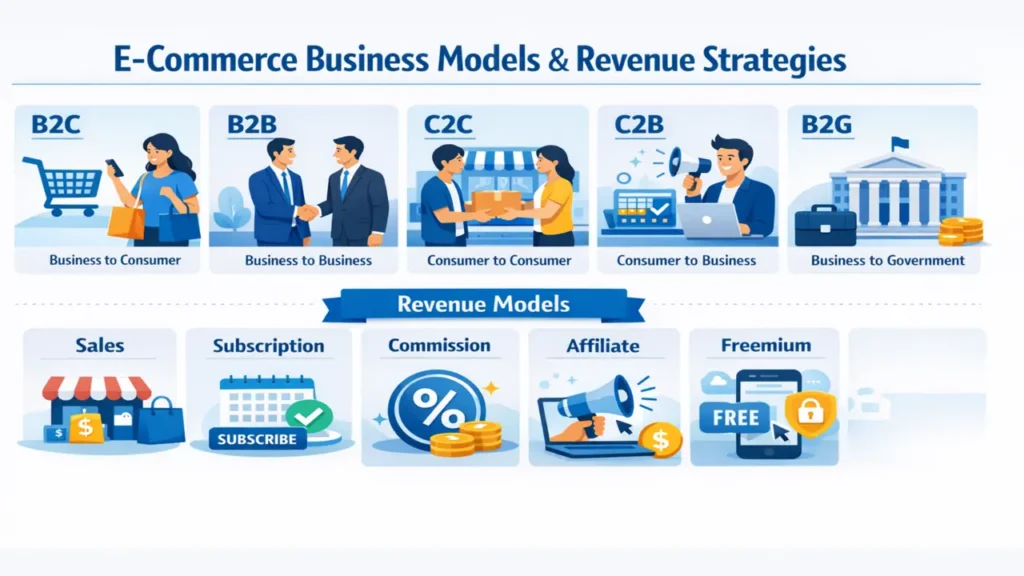
Learn about major e-commerce business models including B2C, B2B, C2C, C2B and key revenue strategies such as subscription, advertising, commission, and affiliate models. Complete BS-level guide.
Introduction to E-Commerce Business Models
An E-Commerce Business Model defines how an online business creates value, delivers products or services, and generates revenue through digital platforms.
Understanding business models is essential because not all e-commerce companies operate in the same way. Some sell directly to customers, some operate as marketplaces, while others earn through subscriptions or advertising.
In this lecture, we will explore:
- Major types of e-commerce business models
- Revenue generation strategies
- Marketplace vs inventory-based models
- Hybrid and emerging models
What is an E-Commerce Business Model?
An E-Commerce Business Model is a structured framework that explains how an online business creates value, delivers that value to customers, and generates revenue through digital platforms.
In simple terms, it answers the fundamental question:
How does an online business work and make money?
A business model is not just about selling products. It includes understanding customers, designing value propositions, managing operations, and ensuring profitability.
Core Components of an E-Commerce Business Model
A strong e-commerce business model explains four key elements:
1. Who Are the Target Customers?
Every e-commerce business must clearly define its target market.
This includes:
- Age group
- Income level
- Geographic location
- Buying behavior
- Business clients or individual consumers
For example:
- Amazon (B2C) targets individual consumers worldwide.
- Alibaba (B2B) targets wholesalers and retailers.
- Upwork (C2B) targets businesses seeking freelancers.
Understanding target customers helps businesses design products, pricing, and marketing strategies effectively.
2. What Value Is Offered? (Value Proposition)
The value proposition explains why customers should choose a particular online platform.
It may include:
- Lower prices
- Faster delivery
- Wide product variety
- Convenience (24/7 access)
- Trust and security
- Personalized recommendations
For example:
- Amazon offers convenience and fast delivery.
- Netflix offers unlimited entertainment through subscription.
- Daraz offers access to multiple sellers in one marketplace.
A strong value proposition differentiates the company from competitors.
3. How Is Revenue Generated?
This part explains how the company earns money.
Common revenue mechanisms in e-commerce include:
- Direct product sales
- Subscription fees
- Commission on transactions
- Advertising revenue
- Affiliate marketing
- Service charges
For example:
- Amazon earns from product sales and Prime subscriptions.
- eBay earns commission on seller transactions.
- Google earns advertising revenue.
Revenue strategy determines business sustainability.
4. What Cost Structure Is Involved?
An e-commerce business also has operational costs, including:
- Website development and maintenance
- Hosting and cloud services
- Marketing and advertising
- Logistics and delivery
- Payment gateway fees
- Employee salaries
Understanding cost structure helps in pricing decisions and profit calculation.
For example:
- An inventory-based company has warehousing costs.
- A marketplace platform may have lower inventory costs but higher marketing expenses.
How the Business Model Determines Operational Structure
In e-commerce, the business model also defines how the company operates.
1. Owns Inventory
Some companies purchase and store products before selling them.
This is known as an inventory-based model.
Example:
- Early Amazon model
- Online grocery stores
Advantages:
- Better quality control
- Higher profit margins
Disadvantages:
- High storage costs
- Inventory risk
2. Acts as an Intermediary (Marketplace Model)
The company connects buyers and sellers but does not own products.
Example:
- Daraz
- eBay
- Alibaba
Advantages:
- Low inventory risk
- Scalable
Disadvantages:
- Less control over product quality
The platform earns commission or listing fees.
3. Provides Services
Some e-commerce businesses provide digital services instead of physical goods.
Examples:
- Upwork (freelancing services)
- Netflix (streaming services)
- Cloud computing platforms
Revenue comes from service fees or subscriptions.
4. Operates Digitally Only
Some companies operate entirely online without physical stores.
Examples:
- SaaS companies
- Online education platforms
These businesses rely heavily on digital infrastructure and cloud services.
Why Understanding the Business Model Is Important
Understanding an e-commerce business model helps:
- Entrepreneurs choose the right strategy
- Investors evaluate profitability
- Managers design operations efficiently
- Students analyze digital market structures
A weak business model may lead to financial losses even if the website is attractive.
Summary
An E-Commerce Business Model explains:
- Target customers
- Value proposition
- Revenue generation
- Cost structure
It also determines whether the company:
- Owns inventory
- Acts as a marketplace intermediary
- Provides services
- Operates fully digitally
A clear and sustainable business model is essential for long-term success in the digital economy.
Major Types of E-Commerce Business Models
E-commerce business models are classified based on the parties involved in the transaction. Each model has its own operational structure, revenue mechanism, and strategic focus. Understanding these models helps businesses choose the right approach and helps students analyze digital markets effectively.
1. Business-to-Consumer (B2C)
Definition
Business-to-Consumer (B2C) refers to e-commerce transactions where businesses sell products or services directly to individual consumers through online platforms.
It is the most common and widely recognized form of e-commerce.
Examples
- Amazon
- Daraz
- Walmart Online
- Nike Online Store
How It Works
- Businesses display products on websites or apps.
- Customers browse products and add them to cart.
- Payment is completed digitally.
- Products are delivered to customers’ addresses.
Key Characteristics
Retail-Based Transactions
Products are sold in small quantities directly to end users.
Large Customer Base
Companies target millions of individual customers.
Focus on Marketing and Branding
Strong emphasis on:
- Digital advertising
- Social media marketing
- Customer loyalty programs
Fast Checkout and Delivery
Efficient logistics and quick payment systems are essential.
Revenue Sources
- Direct product sales
- Subscription services (e.g., Amazon Prime)
- Delivery charges
- Add-on services
Advantages
- High scalability
- Direct customer interaction
- Global market reach
Challenges
- High competition
- Customer acquisition cost
- Managing returns and refunds
2. Business-to-Business (B2B)
Definition
Business-to-Business (B2B) refers to online transactions between two businesses rather than between a business and individual consumers.
Examples
- Alibaba Wholesale
- Amazon Business
- SAP Ariba
How It Works
- Manufacturers sell products to wholesalers.
- Wholesalers sell to retailers.
- Businesses purchase raw materials or services from suppliers.
Key Characteristics
Bulk Purchasing
Orders are large and often repeated.
Negotiated Pricing
Prices are often customized based on order size.
Long-Term Contracts
Business relationships are usually ongoing.
Professional Relationships
Transactions are formal and documented.
Revenue Sources
- Wholesale profit margins
- Long-term service agreements
- Licensing fees
Advantages
- High revenue per transaction
- Stable demand
- Predictable income
Challenges
- Complex negotiation
- Longer sales cycles
- Dependence on business clients
3. Consumer-to-Consumer (C2C)
Definition
Consumer-to-Consumer (C2C) is a model where individuals sell products or services directly to other individuals using an online marketplace platform.
Examples
- eBay
- OLX
- Facebook Marketplace
How It Works
- Individuals list products on a platform.
- Buyers contact sellers.
- The platform may handle payments.
Revenue Sources (for the Platform)
- Commission per transaction
- Listing fees
- Featured product fees
Key Characteristics
- Peer-to-peer transactions
- Often used goods
- Platform acts as intermediary
Advantages
- Easy entry for individuals
- Monetization of unused goods
- Large audience reach
Challenges
- Trust and fraud risks
- Quality inconsistency
- Limited quality control
4. Consumer-to-Business (C2B)
Definition
Consumer-to-Business (C2B) is a model where individuals offer products or services to businesses.
This model reverses the traditional selling structure.
Examples
- Freelancers on Upwork
- Fiverr
- Influencer marketing
- Photographers selling stock images
How It Works
- Individuals provide skills or content.
- Businesses hire them for specific projects.
- Payment is made per task or contract.
Revenue Sources
- Service fees
- Project payments
- Platform commission (if using a marketplace)
Key Characteristics
- Skill-based economy
- Flexible pricing
- Project-based contracts
Advantages
- Global opportunities
- Low entry barriers
- Flexible working environment
Challenges
- Income instability
- High competition
- Platform dependency
5. Business-to-Government (B2G)
Definition
Business-to-Government (B2G) refers to transactions where companies provide goods or services to government agencies through digital procurement platforms.
Examples
- E-procurement portals
- Online government tender systems
- IT companies providing software to government departments
How It Works
- Government publishes tenders online.
- Companies submit bids electronically.
- Contracts are awarded digitally.
Revenue Sources
- Contract payments
- Long-term service agreements
- Maintenance contracts
Key Characteristics
- Formal bidding process
- Legal compliance required
- High-value contracts
Advantages
- Stable income
- Long-term contracts
- Large-scale projects
Challenges
- Complex documentation
- Strict regulations
- Competitive bidding
Comparative Overview
| Model | Seller | Buyer | Transaction Size | Revenue Source |
|---|---|---|---|---|
| B2C | Business | Consumer | Small/Medium | Product sales |
| B2B | Business | Business | Large/Bulk | Wholesale margin |
| C2C | Consumer | Consumer | Small | Commission |
| C2B | Consumer | Business | Service-based | Service fee |
| B2G | Business | Government | Large | Contracts |
Conclusion
Each e-commerce business model serves a specific market structure and operates differently in terms of transaction size, revenue strategy, and customer relationship.
- B2C dominates retail e-commerce.
- B2B supports supply chain and wholesale trade.
- C2C empowers individuals.
- C2B strengthens the digital services economy.
- B2G connects businesses with government institutions.
Understanding these models helps businesses select appropriate strategies and helps students analyze digital commerce ecosystems effectively.
E-Commerce Revenue Models
A revenue model explains how an e-commerce business generates income from its products, services, or digital platform. While a business model describes the overall structure of operations, the revenue model specifically focuses on how money is earned.
Different e-commerce companies use different revenue models depending on their target market, services offered, and operational structure. Some companies even combine multiple revenue models to increase profitability.
1. Sales Revenue Model
Definition
In the Sales Revenue Model, a company earns money by directly selling products or services to customers online.
This is the most traditional and straightforward revenue model.
How It Works
- The business purchases or manufactures products.
- Products are listed on the website.
- Customers place orders and pay online.
- The company earns profit from the difference between selling price and cost price.
Example
- Amazon retail sales
- Online clothing stores
- Electronics e-commerce websites
Advantages
- Simple and easy to understand
- Direct profit generation
- Scalable with increased sales
Limitations
- Requires inventory management
- Competition may reduce profit margins
- High logistics and warehousing costs
2. Subscription Model
Definition
In the Subscription Revenue Model, customers pay a recurring fee (monthly, quarterly, or yearly) to access a product or service.
Examples
- Netflix
- Amazon Prime
- Spotify
- SaaS platforms (e.g., Microsoft 365)
How It Works
- Users subscribe to a service.
- Payment is made regularly.
- Access continues as long as subscription is active.
Advantages
Predictable income
Stable cash flow
High customer retention
Long-term customer relationships
Challenges
- Requires continuous value delivery
- Risk of subscription cancellation
- Competitive pricing pressure
3. Advertising Revenue Model
Definition
In this model, the platform earns revenue by displaying advertisements to users.
Instead of charging users directly, businesses earn from advertisers.
Examples
- YouTube
How It Works
- Businesses pay to display ads.
- The platform earns revenue based on:
- Cost-per-click (CPC)
- Cost-per-impression (CPM)
- Cost-per-action (CPA)
Advantages
- Free services attract large user base
- High profitability with massive traffic
- Scalable globally
Limitations
- Requires large audience
- User privacy concerns
- Ad blockers reduce revenue
4. Commission-Based Model
Definition
In the Commission-Based Model, the platform charges a percentage fee for each transaction completed through its system.
The platform usually acts as an intermediary between buyers and sellers.
Examples
- Daraz
- eBay
- Uber
- Airbnb
How It Works
- Sellers list products or services.
- Buyers make purchases.
- The platform deducts a commission from each sale.
Advantages
- No need to own inventory
- Low operational risk
- Revenue increases with transaction volume
Challenges
- Must maintain trust between users
- Platform competition
- Dependence on seller performance
5. Affiliate Model
Definition
In the Affiliate Revenue Model, a business earns commission by promoting another company’s products.
Affiliates act as marketing partners.
Example
- Bloggers promoting Amazon products
- Influencers sharing referral links
How It Works
- Affiliate shares product link.
- Customer clicks and makes purchase.
- Affiliate earns a commission percentage.
Advantages
- Low startup cost
- No inventory management
- Passive income potential
Limitations
- Dependent on external companies
- Commission rates may vary
- Requires marketing skills
6. Freemium Model
Definition
In the Freemium Model, basic services are offered for free, while advanced features require payment.
The goal is to attract a large user base and convert some users into paying customers.
Examples
- Dropbox
- Zoom
How It Works
- Users sign up for free.
- Premium features are locked.
- Users upgrade for additional benefits.
Advantages
- Rapid user growth
- Easy market penetration
- High scalability
Challenges
- Low conversion rate from free to paid users
- High maintenance cost for free users
- Need for strong value differentiation
Comparison of Revenue Models
| Revenue Model | Main Income Source | Example | Risk Level |
|---|---|---|---|
| Sales | Product sales | Amazon | Medium |
| Subscription | Recurring fees | Netflix | Low |
| Advertising | Ad placements | Medium | |
| Commission | Transaction fee | eBay | Low |
| Affiliate | Referral commission | Bloggers | Low |
| Freemium | Premium upgrades | Medium |
Conclusion
E-commerce revenue models define how digital platforms generate income. Companies may use one model or combine multiple models to maximize profitability.
For example:
- Amazon uses sales + subscription.
- Google uses advertising.
- LinkedIn uses freemium + subscription.
Understanding revenue models helps businesses build sustainable strategies and helps students analyze digital market dynamics effectively.
Marketplace vs Inventory-Based Model
In e-commerce, companies adopt different operational structures depending on how they manage products and transactions. Two major operational models are:
- Marketplace Model
- Inventory-Based Model
The key difference lies in who owns and manages the inventory.
1. Marketplace Model
Definition
In the Marketplace Model, the e-commerce company acts as an intermediary between buyers and sellers. The platform does not own the products; instead, third-party sellers list and sell their products through the platform.
The company provides digital infrastructure such as:
- Website/app
- Payment processing
- Customer support
- Logistics coordination (sometimes)
Examples
- Daraz
- eBay
- Alibaba
- Etsy
How It Works
- Sellers register on the platform.
- They list their products.
- Customers browse and place orders.
- The platform processes payments.
- Sellers ship products (sometimes via platform logistics).
The platform earns commission or service fees per transaction.
Advantages
Low Inventory Risk
The platform does not invest money in purchasing or storing products.
Highly Scalable
Since it does not manage stock, it can expand quickly by onboarding more sellers.
Wide Product Variety
Multiple sellers offer diverse products.
Lower Capital Requirement
No need for warehouses or bulk purchasing.
Disadvantages
- Limited quality control
- Dependence on seller performance
- Customer complaints may affect brand reputation
- High competition among sellers
Revenue Source
- Commission on sales
- Listing fees
- Advertising fees from sellers
2. Inventory-Based Model
Definition
In the Inventory-Based Model, the company purchases products from manufacturers or suppliers and stores them in warehouses before selling them to customers.
The company owns and controls the inventory.
Examples
- Early Amazon model
- Online grocery stores
- Brand-owned online stores (e.g., Nike.com)
How It Works
- The company purchases products in bulk.
- Products are stored in warehouses.
- Customers place orders online.
- The company ships directly to customers.
Profit is earned from the difference between cost price and selling price.
Advantages
Better Quality Control
Since the company owns the products, it can ensure quality standards.
Higher Profit Margins
Bulk purchasing allows better pricing control.
Strong Brand Control
The company controls packaging, delivery, and customer service.
Better Customer Trust
Customers deal directly with the brand.
Disadvantages
- High initial investment
- Warehousing costs
- Risk of unsold inventory
- Complex supply chain management
Key Differences Between Marketplace and Inventory-Based Model
| Feature | Marketplace Model | Inventory-Based Model |
|---|---|---|
| Inventory Ownership | No | Yes |
| Risk Level | Low | High |
| Capital Requirement | Low | High |
| Quality Control | Limited | Strong |
| Revenue Source | Commission | Product margin |
| Scalability | High | Moderate |
Which Model Is Better?
The choice depends on:
- Capital availability
- Risk tolerance
- Business goals
- Operational capacity
Many modern companies adopt a hybrid model, combining both approaches.
Example:
Amazon operates as:
- A marketplace (third-party sellers)
- An inventory-based retailer (Amazon-owned products)
This hybrid approach allows risk diversification and revenue expansion.
Conclusion
The Marketplace Model focuses on connecting buyers and sellers with minimal inventory risk, while the Inventory-Based Model focuses on owning products and maintaining quality control.
Both models have advantages and challenges, and the choice depends on strategic goals and available resources.
Emerging Hybrid Models
Modern e-commerce companies often combine multiple models:
- Amazon: Retail + Marketplace + Subscription
- Alibaba: B2B + Marketplace + Cloud services
Hybrid models increase flexibility and revenue diversification.
Comparison Table
| Model | Seller | Buyer | Revenue Source |
|---|---|---|---|
| B2C | Business | Consumer | Direct sales |
| B2B | Business | Business | Bulk sales |
| C2C | Consumer | Consumer | Commission |
| C2B | Consumer | Business | Service fees |
| B2G | Business | Government | Contracts |
Importance of Choosing the Right Business Model
Selecting the correct model helps:
- Reduce operational risk
- Increase profitability
- Target the right customer segment
- Ensure long-term sustainability
A poorly chosen model may lead to financial losses and business failure.
Conclusion
E-commerce business models define how digital companies operate and generate revenue. From B2C retailing to subscription and commission-based marketplaces, each model serves different customer needs and market structures.
Understanding these models enables students and entrepreneurs to analyze online businesses strategically and select appropriate revenue strategies for success.
Multiple Choice Questions (MCQs)
1. An E-Commerce business model primarily explains:
A) Website color scheme
B) How a business earns money
C) Office location
D) Internet speed
Answer: B
2. In B2C model, transactions occur between:
A) Business and Government
B) Consumer and Consumer
C) Business and Consumer
D) Business and Business
Answer: C
3. Alibaba wholesale mainly operates under:
A) B2C
B) B2B
C) C2C
D) C2B
Answer: B
4. Which revenue model provides recurring income?
A) Sales
B) Affiliate
C) Subscription
D) Commission
Answer: C
5. The Marketplace Model primarily earns through:
A) Manufacturing
B) Commission
C) Donation
D) Inventory resale
Answer: B
6. In C2C model, the platform acts as:
A) Manufacturer
B) Government authority
C) Intermediary
D) Supplier
Answer: C
7. Uber follows which revenue model?
A) Affiliate
B) Commission-based
C) Sales only
D) Subscription only
Answer: B
8. Inventory-based model requires:
A) No storage
B) Low capital
C) Warehouse management
D) No risk
Answer: C
9. LinkedIn Premium follows:
A) Sales model
B) Freemium model
C) B2G model
D) C2C model
Answer: B
10. B2B transactions are usually:
A) Small-scale retail
B) Bulk purchases
C) Personal services
D) Informal trades
Answer: B
11. Affiliate marketing generates revenue through:
A) Direct product ownership
B) Referral commission
C) Government grants
D) Advertising only
Answer: B
12. Which model has lower inventory risk?
A) Inventory-based
B) Marketplace
C) B2B
D) Subscription
Answer: B
13. Netflix primarily uses:
A) Commission
B) Subscription
C) Sales
D) Inventory
Answer: B
14. The Freemium model offers:
A) Only paid services
B) Only free services
C) Free basic + paid premium
D) No service
Answer: C
15. B2G stands for:
A) Business to Group
B) Business to Government
C) Buyer to Government
D) Business to Global
Answer: B
Short Questions Answers
1. Define an E-Commerce Business Model.
An E-Commerce Business Model defines the way an online business generates revenue and how it operates. It describes the interactions between a business and its customers and the methods used to deliver value. The business model includes:
- Who the target customers are
- What value is offered to those customers
- How revenue is generated
- What cost structure is involved
For example, the B2C model (Business-to-Consumer) involves a business selling products directly to consumers online, such as Amazon, while the B2B model (Business-to-Business) involves transactions between businesses, such as Alibaba.
2. Differentiate between Marketplace and Inventory-Based Models.
Marketplace Model:
- The platform does not own inventory.
- It connects buyers and sellers.
- Examples: eBay, Daraz.
- Revenue is generated through commissions, listing fees, or advertisements.
- Advantages: Low inventory risk, scalable, and less capital-intensive.
- Disadvantages: Limited control over product quality and customer service.
Inventory-Based Model:
- The business owns inventory and sells it directly to customers.
- The company purchases products in bulk and stores them before selling.
- Examples: Early Amazon, Nike Store Online.
- Revenue comes from product margins.
- Advantages: Better quality control and higher profit margins.
- Disadvantages: High storage and logistics costs, risk of unsold inventory.
3. Explain the Subscription Revenue Model with examples.
The Subscription Revenue Model involves customers paying a recurring fee (either monthly or yearly) to access a service or product. This model provides predictable, steady revenue.
Examples:
- Netflix (monthly subscription for streaming movies and TV shows).
- Amazon Prime (annual subscription for faster shipping and exclusive content).
Advantages:
- Predictable income streams.
- Higher customer retention.
- Opportunities for upselling additional services or features.
4. What is the Commission-Based Model?
The Commission-Based Model involves platforms or businesses earning a percentage or fee for facilitating a transaction between buyers and sellers. The platform does not own inventory but earns by connecting users and processing payments.
Examples:
- Daraz, eBay, Uber.
- The platform charges a commission on each transaction.
Advantages:
- No need for inventory management.
- Scalable and flexible.
- Revenue is tied directly to transaction volume.
5. Discuss the advantages of B2B E-Commerce.
Business-to-Business (B2B) e-commerce refers to transactions between businesses, such as wholesalers and retailers.
Advantages:
- Bulk transactions: B2B transactions usually involve larger volumes and higher transaction values.
- Long-term relationships: B2B transactions often result in long-term partnerships and repeat business.
- Higher profitability: Because of the volume and negotiation, businesses can secure better pricing and profit margins.
- Streamlined operations: E-commerce platforms automate order management, inventory, and payment systems, improving efficiency.
6. Explain the Freemium Model.
The Freemium Model provides basic services for free but charges for premium features or content. This model attracts a large user base by offering something of value without requiring payment initially, then converts some of those users to paying customers.
Examples:
- LinkedIn (free basic profile; premium features for job seekers and recruiters).
- Dropbox (free storage up to a limit; paid upgrades for more space and features).
Advantages:
- Fast user base growth.
- Potential for passive income as a percentage of users upgrade.
- Flexible entry for users.
Challenges:
- Conversion from free to paid users can be slow.
- The cost of providing free services may outweigh income from premium users.
7. What are the key features of B2C model?
The Business-to-Consumer (B2C) model involves businesses selling products or services directly to individual consumers through an online platform.
Key Features:
- Retail-based transactions: Products are sold in small quantities directly to customers.
- Large customer base: Focuses on individual consumers rather than businesses.
- Emphasis on marketing and branding: B2C companies invest heavily in advertising, customer experience, and loyalty programs.
- Fast checkout and delivery: B2C e-commerce prioritizes quick and convenient purchase processes.
- Revenue: Comes from product sales, subscriptions, or additional services.
Examples:
- Amazon, Walmart Online, Nike Store.
8. Define Affiliate Marketing.
Affiliate Marketing is a performance-based revenue model where a business earns a commission by promoting another company’s products or services.
How It Works:
- Affiliates (individuals or businesses) promote products through links or advertisements on their platform (e.g., websites, blogs, social media).
- If a customer purchases the product through the affiliate link, the affiliate earns a commission.
Example:
- Bloggers promoting products on Amazon or Shopify and earning a commission on sales.
Advantages:
- Low cost for businesses (only paying when sales occur).
- Affiliates do the marketing and promotion.
- Passive income for affiliates.
9. Write short notes on B2G model.
Business-to-Government (B2G) e-commerce involves businesses providing goods or services to government agencies through digital platforms. This model often involves formal procurement systems, where businesses bid for contracts or submit proposals for projects.
Example:
- E-procurement platforms where suppliers bid for government projects.
Revenue Source:
- Contract payments
- Service agreements
- Licensing or software provisions
Advantages:
- Stable income due to long-term government contracts.
- Larger contract sizes.
- Clear regulatory and compliance requirements.
10. Explain how revenue models impact profitability.
Revenue models directly affect a business’s profitability by determining how income is generated.
Sales Model:
The traditional sales model relies on one-time purchases, making profitability dependent on consistent sales and customer retention. It’s straightforward but may require constant marketing to drive sales.
Subscription Model:
Predictable income streams from recurring payments ensure stable revenue, improve cash flow, and increase customer lifetime value (CLTV). Long-term customer relationships are built, which often result in higher profitability.
Commission Model:
Earnings depend on transaction volume. The more transactions, the higher the revenue. Profit margins may vary depending on commission rates.
Freemium Model:
This model allows companies to generate large user bases for free and convert a fraction of them into paying customers. While initial profitability may be low, scalability and conversion can lead to high profitability in the long term.
Long Questions Answers
Q1. Explain in detail the major types of E-Commerce business models with examples.
Answer:
E-commerce business models are categorized based on the parties involved in the transaction. These models describe the structure of business operations and how value is exchanged between buyers and sellers.
Here are the major types of e-commerce business models:
1. Business-to-Consumer (B2C)
Definition:
In the B2C model, businesses sell products or services directly to individual consumers through an online platform. This is the most common form of e-commerce.
Operational Structure:
- Businesses set up online stores or websites.
- Consumers browse products, make purchases, and the company delivers products directly to them.
Revenue Source:
- Product sales
- Subscription services (e.g., Amazon Prime)
- Delivery charges or add-ons
Examples:
- Amazon (retail product sales)
- Daraz (online marketplace)
- Nike (direct-to-consumer sales)
Advantages:
- Direct connection with the customer
- Large market reach
- Flexibility in product offerings
2. Business-to-Business (B2B)
Definition:
In the B2B model, transactions occur between businesses, typically involving bulk buying and selling.
Operational Structure:
- A business sells raw materials, goods, or services to another business.
- Payment is usually negotiated, and the business relationship is long-term.
Revenue Source:
- Wholesale profit margins
- Service contracts and agreements
- Licensing fees for digital solutions
Examples:
- Alibaba (wholesale marketplace for businesses)
- Amazon Business (providing business-related products to companies)
Advantages:
- Larger transaction volumes
- Predictable long-term contracts
- Lower marketing costs per transaction
3. Consumer-to-Consumer (C2C)
Definition:
In the C2C model, consumers sell products or services directly to other consumers, typically through a platform or marketplace.
Operational Structure:
- The platform provides a marketplace where individuals list products for sale.
- Buyers contact the seller, make payments, and the product is shipped by the seller.
Revenue Source:
- Platform commission on transactions
- Listing fees
- Transaction processing fees
Examples:
- eBay (auction-style marketplace)
- OLX (classified ads platform)
- Facebook Marketplace (peer-to-peer selling)
Advantages:
- Low operational costs
- Large variety of products
- Wide audience reach
4. Consumer-to-Business (C2B)
Definition:
In the C2B model, individuals offer products or services to businesses, reversing the traditional B2C model.
Operational Structure:
- Consumers provide products, services, or content to businesses.
- Businesses may hire individuals for freelance work or use user-generated content.
Revenue Source:
- Service fees paid by businesses for the provided services
- Project-based payments for freelance work
- Commissions for leads or referrals
Examples:
- Freelancers on Upwork (offering services like writing, design, etc.)
- Influencers marketing on Instagram (promoting products for businesses)
Advantages:
- Low barriers to entry for individuals
- Businesses access specialized services at lower costs
- High flexibility for consumers
5. Business-to-Government (B2G)
Definition:
In the B2G model, businesses provide goods or services to government agencies.
Operational Structure:
- The government publishes tenders or requests for proposals (RFPs).
- Businesses bid to win contracts to provide goods or services to the government.
Revenue Source:
- Contract payments for the goods or services provided
- Service agreements and long-term contracts
Examples:
- IT firms providing software solutions to government departments
- Consulting companies offering services to public sector organizations
Advantages:
- Stable and predictable income
- Larger, long-term contracts
- Government tends to offer substantial contracts
Summary Table of Major E-Commerce Models
| Model | Seller | Buyer | Revenue Source | Example |
|---|---|---|---|---|
| B2C | Business | Consumer | Product sales, subscriptions | Amazon |
| B2B | Business | Business | Wholesale, service contracts | Alibaba |
| C2C | Consumer | Consumer | Commission, listing fees | eBay |
| C2B | Consumer | Business | Service fees, project payments | Upwork |
| B2G | Business | Government | Contract payments | IT firms, Consultants |
Q2. Compare Marketplace Model and Inventory-Based Model with advantages and disadvantages.
Answer:
Both Marketplace and Inventory-Based Models are widely used in e-commerce, but they differ in operational structure, inventory management, and risk levels.
Marketplace Model
Definition:
In the Marketplace Model, the e-commerce platform acts as an intermediary, connecting buyers and sellers without owning inventory. The platform facilitates transactions but does not directly handle products.
Advantages:
- Low Inventory Risk: The platform does not own products, so it avoids the financial risk of unsold inventory.
- Scalability: The business model is highly scalable because it can onboard multiple sellers without major infrastructure changes.
- Diverse Product Offering: A marketplace offers a wide range of products without investing in inventory management.
- Low Capital Requirement: No need to invest in warehousing or purchasing products upfront.
Disadvantages:
- Limited Control Over Quality: Since sellers manage their own inventory, the platform has less control over product quality and customer experience.
- Seller Dependence: Platform revenue depends on seller performance, including timely delivery and customer satisfaction.
- Higher Competition: Multiple sellers often offer similar products, leading to competitive pressure on pricing and services.
Inventory-Based Model
Definition:
In the Inventory-Based Model, the business owns and manages inventory, purchasing products in bulk and storing them before selling to consumers.
Advantages:
- Better Quality Control: The business owns the products and controls their quality before selling.
- Higher Profit Margins: Buying in bulk allows for price negotiation, leading to better margins.
- Stronger Brand Control: The company can manage packaging, branding, and customer service.
- Customer Trust: Since the business directly handles products, it builds trust with customers regarding product authenticity and service reliability.
Disadvantages:
- High Inventory Risk: The business is responsible for unsold inventory, leading to potential losses if products do not sell.
- Capital-Intensive: Requires investment in inventory, storage, and warehousing.
- Logistical Costs: The company must handle shipping, warehousing, and returns.
- Slower Scalability: Growth may be hindered by the need for more inventory, storage space, and workforce.
| Feature | Marketplace Model | Inventory-Based Model |
|---|---|---|
| Inventory Ownership | No | Yes |
| Risk Level | Low | High |
| Capital Requirement | Low | High |
| Scalability | High | Moderate |
| Quality Control | Limited | Strong |
| Revenue Source | Commission | Product margin |
Q3. Discuss different E-Commerce revenue models and evaluate which model ensures long-term sustainability.
Answer:
E-commerce businesses can generate revenue in various ways, with each model offering different financial sustainability options. Below are the key revenue models in e-commerce:
1. Sales Revenue Model
Definition:
The business generates income by directly selling products to consumers.
Example:
- Amazon (selling physical products)
Sustainability Evaluation:
While easy to understand and implement, it is dependent on consistent sales and customer acquisition costs. It can be unstable due to price competition and changing customer preferences.
2. Subscription Model
Definition:
Customers pay a recurring fee to access a product or service over a period.
Example:
- Netflix, Amazon Prime
Sustainability Evaluation:
Highly sustainable, as it provides predictable and recurring income. Customer retention and value delivery are key for long-term success. However, businesses need to keep improving offerings to reduce churn.
3. Commission-Based Model
Definition:
The platform charges a percentage of each transaction made on the platform.
Example:
- eBay, Uber
Sustainability Evaluation:
The model is scalable, and revenue increases with transaction volume. However, it depends on third-party sellers or providers, and the platform’s success relies on maintaining user trust and transaction volume.
4. Advertising Revenue Model
Definition:
The platform earns revenue by displaying ads to users.
Example:
- Google, Facebook
Sustainability Evaluation:
Very profitable with large audiences but is highly dependent on ad volume, user engagement, and privacy regulations. The risk comes from changes in digital advertising trends and user preferences.
5. Affiliate Revenue Model
Definition:
The business earns commission by promoting products of other companies.
Example:
- Bloggers promoting Amazon products
Sustainability Evaluation:
Low risk and low investment, but dependent on the effectiveness of marketing efforts and affiliate relationships. It’s scalable, but earnings can be inconsistent.
6. Freemium Model
Definition:
Basic services are offered for free, and users pay for premium features.
Example:
- LinkedIn, Dropbox
Sustainability Evaluation:
The model can lead to large user bases, but the conversion rate from free to paid users is often low. Long-term sustainability depends on providing continuous value and incentivizing users to upgrade.
Evaluation of Long-Term Sustainability:
The Subscription Model and Advertising Revenue Model tend to be the most sustainable long-term, as they ensure recurring income. The Commission-Based Model is also highly scalable and reliable. However, models like Sales and Affiliate Marketing may have fluctuating income due to market volatility or reliance on external factors.