Lecture 3: Knowledge Representation and Reasoning
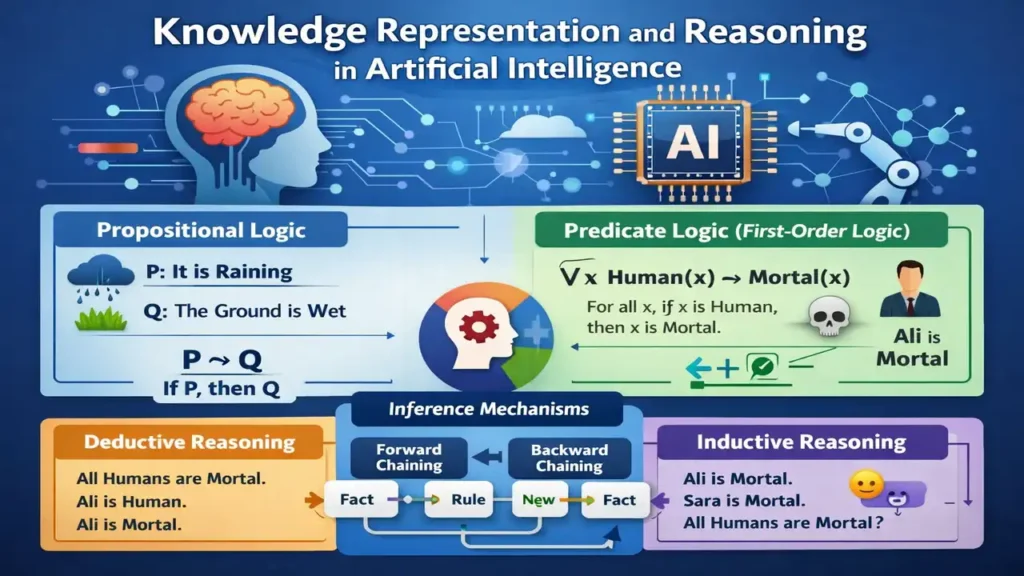
Explore Knowledge Representation and Reasoning in Artificial Intelligence, including Propositional Logic, Predicate Logic, deductive reasoning, and inference mechanisms.
Knowledge Representation & Reasoning in Artificial Intelligence
Artificial Intelligence (AI) systems are designed to simulate intelligent behavior. However, for a machine to behave intelligently, it must first possess knowledge and then be able to reason using that knowledge. This is where Knowledge Representation (KR) and Reasoning become fundamental components of AI.
Knowledge Representation and Reasoning form the intellectual backbone of Artificial Intelligence. They allow machines not only to store information but also to draw logical conclusions, solve problems, and make decisions.
1. What is Knowledge Representation?
Knowledge Representation (KR) is the method used to encode information about the world into a format that an AI system can understand and use.
In simple terms:
Knowledge Representation is how we teach machines to “know” things.
Humans naturally store knowledge in structured ways through language and concepts. AI systems must do the same, but in a formal and mathematical manner.
Example
Human knowledge:
- “All humans are mortal.”
- “Ali is a human.”
An AI system must represent this information formally so it can conclude:
- “Ali is mortal.”
Without structured knowledge representation, AI systems cannot perform logical reasoning.
2. Why Knowledge Representation is Important
Knowledge Representation is critical because:
- AI systems require structured information to function.
- It enables reasoning and inference.
- It helps machines understand relationships between objects.
- It allows intelligent decision-making.
- It supports problem-solving in complex domains.
An AI system without proper knowledge representation is like a student without organized notes — it may have data, but it cannot use it effectively.
3. Characteristics of Good Knowledge Representation
A good knowledge representation system must have:
1. Representational Adequacy
It must be capable of representing all necessary knowledge.
2. Inferential Adequacy
It should allow new knowledge to be derived from existing knowledge.
3. Inferential Efficiency
It should enable reasoning efficiently.
4. Acquisitional Efficiency
It should allow easy addition of new knowledge.
4. Logic-Based Representation
One of the most powerful approaches to knowledge representation is logic-based representation.
Logic provides:
- Formal structure
- Mathematical precision
- Clear syntax
- Systematic reasoning rules
Logic-based systems avoid ambiguity and allow AI to reason in a structured way.
There are two primary types of logical representation:
- Propositional Logic
- Predicate Logic (First-Order Logic)
5. Propositional Logic
Propositional Logic is the simplest form of logic used in AI.
It deals with propositions statements that are either true or false.
5.1 Propositions
A proposition is a declarative statement that has a truth value.
Examples:
- “It is raining.”
- “Ali is a student.”
- “2 + 2 = 4.”
Each statement is either True or False.
5.2 Logical Connectives
Propositional logic uses logical operators:
| Operator | Symbol | Meaning |
|---|---|---|
| AND | ∧ | Both true |
| OR | ∨ | At least one true |
| NOT | ¬ | Negation |
| IMPLIES | → | If–Then |
| BICONDITIONAL | ↔ | If and only if |
Example
Let:
P = “It is raining.”
Q = “The ground is wet.”
Rule:
P → Q
Meaning:
If it is raining, then the ground is wet.
5.3 Limitations of Propositional Logic
Although simple, it has limitations:
- Cannot represent relationships
- Cannot handle objects or variables
- Cannot express general statements like “All humans are mortal”
Because of these limitations, a more powerful logic system is needed.
6. Predicate Logic (First-Order Logic)
Predicate Logic is more expressive than propositional logic.
It allows representation of:
- Objects
- Properties
- Relationships
- Quantifiers
- Variables
6.1 Components of Predicate Logic
1. Constants
Specific objects (Ali, 5, Car1)
2. Variables
Symbols representing objects (x, y)
3. Predicates
Functions describing properties or relationships
Example:
Human(x)
Mortal(x)
Father(Ali, Ahmed)
4. Quantifiers
Universal Quantifier ( ∀ )
Means “for all”
Existential Quantifier ( ∃ )
Means “there exists”
6.2 Example in Predicate Logic
Statement:
“All humans are mortal.”
Representation:
∀x (Human(x) → Mortal(x))
If:
Human(Ali)
Then:
Mortal(Ali)
This representation allows systematic logical reasoning.
7. Reasoning in Artificial Intelligence
Reasoning is the process of deriving new conclusions from known facts.
AI systems use reasoning to:
- Answer queries
- Solve logical problems
- Make decisions
- Predict outcomes
There are two primary types of reasoning:
- Deductive Reasoning
- Inductive Reasoning
8. Deductive Reasoning
Deductive reasoning moves from general rules to specific conclusions.
Structure:
General Rule + Specific Fact → Conclusion
Example:
All humans are mortal.
Ali is human.
Therefore, Ali is mortal.
Deductive reasoning:
- Guarantees correctness (if premises are true)
- Used heavily in rule-based systems
- Provides logically certain conclusions
9. Inductive Reasoning
Inductive reasoning moves from specific observations to general conclusions.
Example:
Ali is mortal.
Sara is mortal.
Ahmed is mortal.
Conclusion:
All humans are mortal.
Inductive reasoning:
- Is probabilistic
- Not guaranteed
- Common in Machine Learning
- Forms hypotheses from data
10. Inference Mechanisms
Inference mechanisms are procedures that apply reasoning rules to derive new information.
10.1 Modus Ponens
If:
P → Q
P is true
Then:
Q is true
Example:
If it rains, the ground is wet.
It is raining.
Therefore, the ground is wet.
10.2 Forward Chaining
- Starts with known facts
- Applies rules repeatedly
- Generates new conclusions
Used in:
- Expert systems
- Diagnostic systems
10.3 Backward Chaining
- Starts with goal
- Works backward to verify conditions
Used in:
- Prolog
- Medical diagnosis systems
11. Applications of Knowledge Representation & Reasoning
KR and reasoning are used in:
- Expert systems
- Medical diagnosis
- Legal reasoning systems
- Robotics
- Game-playing AI
- Automated planning
- Theorem proving
They form the intellectual engine of AI systems.
Lecture 2: Intelligent Agents and Knowledge-Based Systems in Artificial Intelligence
12. Challenges in Knowledge Representation
Some major challenges include:
- Handling uncertainty
- Representing incomplete knowledge
- Managing large knowledge bases
- Computational complexity
- Ambiguity in natural language
Modern AI combines logic-based reasoning with probabilistic and machine learning approaches.
13. Conclusion
Knowledge Representation and Reasoning are fundamental components of Artificial Intelligence. Without structured knowledge and logical reasoning, AI systems cannot behave intelligently.
Propositional Logic provides basic truth-based reasoning, while Predicate Logic enables representation of relationships and structured knowledge. Deductive and inductive reasoning allow AI to draw conclusions, and inference mechanisms automate this reasoning process.
Understanding Knowledge Representation & Reasoning is essential for building intelligent systems that can think, decide, and solve problems logically.
Multiple Choice Questions (MCQs) – Knowledge Representation and Reasoning
1. Knowledge Representation in AI is used to:
A) Increase memory size
B) Store structured information for reasoning
C) Improve hardware speed
D) Design software interfaces
Answer: B
2. A proposition is a statement that is:
A) Always true
B) Always false
C) Either true or false
D) Partially true
Answer: C
3. Which logic deals with simple true/false statements?
A) Predicate Logic
B) Propositional Logic
C) Fuzzy Logic
D) Modal Logic
Answer: B
4. The symbol ∧ represents:
A) OR
B) NOT
C) AND
D) IF
Answer: C
5. Predicate Logic is also called:
A) Boolean Logic
B) First-Order Logic
C) Digital Logic
D) Binary Logic
Answer: B
6. The universal quantifier is represented by:
A) ∃
B) ∀
C) →
D) ¬
Answer: B
7. Deductive reasoning moves from:
A) Specific to general
B) General to specific
C) Random to logical
D) Complex to simple
Answer: B
8. Inductive reasoning is:
A) Always certain
B) Probabilistic
C) Invalid
D) Mathematical only
Answer: B
9. Forward chaining starts with:
A) Goal
B) Assumption
C) Known facts
D) Hypothesis
Answer: C
10. Backward chaining starts with:
A) Known facts
B) Goal
C) Variables
D) Constants
Answer: B
11. Which of the following is NOT a component of predicate logic?
A) Variables
B) Quantifiers
C) Predicates
D) Compiler
Answer: D
12. In logic, P → Q means:
A) P and Q
B) P or Q
C) If P then Q
D) Not P
Answer: C
13. Which reasoning guarantees logical correctness?
A) Inductive
B) Deductive
C) Random
D) Probabilistic
Answer: B
14. The existential quantifier (∃) means:
A) For all
B) If then
C) There exists
D) And
Answer: C
15. Modus Ponens is an example of:
A) Search algorithm
B) Inference rule
C) Data structure
D) Sorting method
Answer: B
16. Knowledge representation must support:
A) Graphics design
B) Inference
C) Encryption
D) Hardware installation
Answer: B
17. Predicate Logic is more powerful because it:
A) Uses numbers only
B) Represents relationships
C) Removes variables
D) Is simpler
Answer: B
18. Which reasoning is used mainly in Machine Learning?
A) Deductive
B) Inductive
C) Symbolic
D) Boolean
Answer: B
19. Forward chaining is commonly used in:
A) Expert systems
B) Antivirus
C) Networking
D) Sorting
Answer: A
20. In AI, inference is used to:
A) Delete data
B) Generate new knowledge
C) Install programs
D) Format memory
Answer: B
21. The main limitation of Propositional Logic is that it cannot:
A) Use AND
B) Represent relationships
C) Use NOT
D) Express truth values
Answer: B
22. ∀x (Human(x) → Mortal(x)) is an example of:
A) Propositional Logic
B) Predicate Logic
C) Fuzzy Logic
D) Binary Logic
Answer: B
23. If all cats are animals and Tom is a cat, then Tom is an animal. This is:
A) Inductive reasoning
B) Deductive reasoning
C) Random reasoning
D) Fuzzy reasoning
Answer: B
24. Backward chaining is best suited for:
A) Fact generation
B) Goal verification
C) Sorting
D) Encryption
Answer: B
25. Which of the following supports structured reasoning in AI?
A) Knowledge representation
B) Antivirus
C) Compiler
D) Router
Answer: A
26. Which reasoning is not guaranteed to be logically certain?
A) Deductive
B) Inductive
C) Modus Ponens
D) Forward chaining
Answer: B
27. The main purpose of inference mechanisms is to:
A) Store knowledge
B) Draw conclusions
C) Increase RAM
D) Compress files
Answer: B
28. Logical representation improves:
A) Internet speed
B) Clarity and reasoning
C) File size
D) Graphics
Answer: B
29. A predicate expresses:
A) Boolean value only
B) Property or relationship
C) Memory size
D) Sorting order
Answer: B
30. Knowledge Representation must provide:
A) Entertainment
B) Logical structure
C) Internet access
D) Hardware drivers
Answer: B
SHORT QUESTIONS ANSWERS
1. Define Knowledge Representation in AI.
Knowledge Representation (KR) in Artificial Intelligence is the method of organizing and storing information in a structured and formal way so that machines can understand, process, and use it for reasoning and decision-making. It allows AI systems to represent facts, relationships, and rules about the world using logical models. Proper knowledge representation enables intelligent systems to solve problems, answer queries, and draw new conclusions from existing knowledge.
2. What is Propositional Logic?
Propositional Logic is a branch of logic that deals with simple statements called propositions, which are either true or false. It uses logical operators such as AND (∧), OR (∨), NOT (¬), and IMPLIES (→) to combine statements and form logical expressions. However, it cannot represent relationships between objects or use variables, which limits its expressive power. It is mainly used for simple logical reasoning in AI systems.
4. What is Predicate Logic?
Predicate Logic, also known as First-Order Logic (FOL), is a more advanced form of logic that represents objects, properties, relationships, and quantifiers. Unlike propositional logic, it uses predicates, variables, constants, and quantifiers (∀, ∃) to express more complex statements. It allows AI systems to represent general rules and relationships between entities. Due to its expressiveness, Predicate Logic is widely used in knowledge representation and reasoning systems.
4. Differentiate between ∀ and ∃ quantifiers.
The universal quantifier (∀) means “for all” and is used to indicate that a statement applies to every element in a domain. For example, ∀x (Human(x) → Mortal(x)) means all humans are mortal.
The existential quantifier (∃) means “there exists” and indicates that at least one element satisfies a condition. For example, ∃x (Student(x)) means there exists at least one student.
Thus, ∀ applies to all elements, while ∃ applies to at least one element.
5. What is Deductive Reasoning?
Deductive reasoning is a logical process that moves from a general rule to a specific conclusion. If the premises are true, the conclusion must also be true. For example:
All humans are mortal.
Ali is a human.
Therefore, Ali is mortal.
Deductive reasoning guarantees logically certain conclusions and is commonly used in rule-based AI systems.
6. What is Inductive Reasoning?
Inductive reasoning is the process of drawing general conclusions from specific observations. Unlike deductive reasoning, its conclusions are not guaranteed but are probable. For example, if several observed humans are mortal, one may conclude that all humans are mortal. Inductive reasoning is widely used in Machine Learning where systems learn patterns from data and make predictions.
7. Define Inference Mechanism.
An inference mechanism is a reasoning process used by AI systems to derive new knowledge from existing facts and rules. It applies logical rules systematically to generate conclusions. Inference mechanisms enable AI systems to answer questions, solve problems, and make intelligent decisions. Examples include Modus Ponens, Forward Chaining, and Backward Chaining.
8. What is Forward Chaining?
Forward Chaining is an inference technique that starts with known facts and applies logical rules to derive new facts until a goal is reached. It moves step-by-step from data toward conclusions. This method is commonly used in expert systems and rule-based systems. It is also known as a data-driven approach because it begins with available information.
9. What is Backward Chaining?
Backward Chaining is an inference technique that starts with a goal and works backward to determine whether known facts support that goal. It checks rules that could produce the desired conclusion and verifies their conditions. It is called a goal-driven approach and is commonly used in diagnostic systems and logic programming languages like Prolog.
10. Why is Knowledge Representation Important in AI?
Knowledge Representation is important because it provides the foundation for reasoning and intelligent behavior in AI systems. Without structured representation, machines cannot understand facts, relationships, or rules. It enables problem-solving, logical reasoning, and decision-making. Effective knowledge representation improves accuracy, efficiency, and reliability of AI systems in real-world applications.
LONG QUESTIONS ANSWERS
1. Explain Knowledge Representation in Artificial Intelligence in detail. Discuss Propositional Logic and Predicate Logic with examples.
Introduction
Knowledge Representation (KR) is a fundamental area of Artificial Intelligence that focuses on how information about the world can be represented in a structured form so that a machine can process and use it for reasoning and decision-making. In simple terms, knowledge representation is the method through which we encode knowledge into a form that an AI system can understand.
AI systems must store facts, rules, relationships, and general principles in a structured format. Without proper knowledge representation, an AI system cannot reason logically or solve problems effectively.
Importance of Knowledge Representation
Knowledge Representation is important because:
- It enables logical reasoning.
- It supports problem-solving.
- It allows decision-making.
- It helps AI systems draw new conclusions.
- It organizes information in a meaningful structure.
For example, if an AI system knows:
- All humans are mortal.
- Ali is a human.
It should conclude:
- Ali is mortal.
This ability is only possible through proper knowledge representation.
Characteristics of Good Knowledge Representation
A good knowledge representation system should have:
- Representational adequacy (ability to represent necessary knowledge)
- Inferential adequacy (ability to derive new knowledge)
- Inferential efficiency (efficient reasoning)
- Acquisitional efficiency (easy to add new knowledge)
Logic-Based Representation
One of the most common methods of knowledge representation is logic-based representation. Logic provides a formal and mathematical structure for representing facts and reasoning.
The two main types of logical representation are:
- Propositional Logic
- Predicate Logic (First-Order Logic)
Propositional Logic
Propositional Logic is the simplest form of logic used in AI. It deals with propositions — statements that are either true or false.
Example of Propositions:
- “It is raining.”
- “Ali is a student.”
Each statement has a truth value (True or False).
Logical Operators
Propositional Logic uses logical connectives:
- AND ( ∧ )
- OR ( ∨ )
- NOT ( ¬ )
- IMPLIES ( → )
Example:
Let:
P = “It is raining”
Q = “The ground is wet”
Rule:
P → Q
Meaning:
If it is raining, then the ground is wet.
Limitation of Propositional Logic
Although simple, it has limitations:
- Cannot express relationships
- Cannot use variables
- Cannot represent general statements like “All humans are mortal”
Because of these limitations, a more powerful logic is needed.
Predicate Logic (First-Order Logic)
Predicate Logic is more expressive than Propositional Logic. It allows representation of:
- Objects
- Properties
- Relationships
- Variables
- Quantifiers
Components of Predicate Logic
- Constants (Ali, 5, Car1)
- Variables (x, y)
- Predicates (Human(x), Mortal(x))
- Quantifiers:
- Universal (∀) → “for all”
- Existential (∃) → “there exists”
Example
Statement:
“All humans are mortal.”
Representation:
∀x (Human(x) → Mortal(x))
If:
Human(Ali)
Then:
Mortal(Ali)
Predicate Logic allows AI systems to represent structured knowledge and relationships clearly.
Comparison of Propositional and Predicate Logic
| Feature | Propositional Logic | Predicate Logic |
|---|---|---|
| Expressiveness | Limited | More powerful |
| Variables | Not allowed | Allowed |
| Relationships | Cannot represent | Can represent |
| Complexity | Simple | More complex |
Conclusion
Knowledge Representation is a core component of Artificial Intelligence. It enables machines to store structured knowledge and apply logical reasoning. Propositional Logic provides simple true/false reasoning, while Predicate Logic offers a more powerful framework for representing objects and relationships. Together, they form the foundation of reasoning systems in AI.
2. Compare Deductive and Inductive reasoning in AI. Also explain inference mechanisms including Forward Chaining and Backward Chaining with examples.
Introduction
Reasoning is the process by which AI systems derive conclusions from known facts and rules. It allows machines to think logically and solve problems. There are two main types of reasoning in AI:
- Deductive Reasoning
- Inductive Reasoning
AI systems also use inference mechanisms such as Forward Chaining and Backward Chaining to apply reasoning rules systematically.
Deductive Reasoning
Deductive reasoning moves from general rules to specific conclusions.
Structure:
General Rule + Specific Fact → Conclusion
Example:
Rule:
All humans are mortal.
Fact:
Ali is a human.
Conclusion:
Ali is mortal.
Deductive reasoning guarantees correctness if the premises are true. It is commonly used in rule-based expert systems.
Inductive Reasoning
Inductive reasoning moves from specific observations to general conclusions.
Example:
Ali is mortal.
Sara is mortal.
Ahmed is mortal.
Conclusion:
All humans are mortal.
Inductive reasoning is probabilistic. The conclusion may be true but is not guaranteed. It is widely used in Machine Learning where systems learn patterns from data.
Comparison of Deductive and Inductive Reasoning
| Feature | Deductive Reasoning | Inductive Reasoning |
|---|---|---|
| Direction | General → Specific | Specific → General |
| Certainty | Guaranteed | Probable |
| Usage | Rule-based systems | Machine Learning |
| Example | Logical proof | Pattern recognition |
Inference Mechanisms
Inference mechanisms are procedures that apply reasoning rules to derive new knowledge from existing facts.
They help AI systems:
- Answer queries
- Solve logical problems
- Make decisions
Forward Chaining
Forward Chaining is a data-driven inference method.
It:
- Starts with known facts
- Applies rules repeatedly
- Generates new facts
- Continues until goal is reached
Example:
Facts:
It is raining.
Rule:
If it rains, the ground is wet.
Conclusion:
The ground is wet.
Forward chaining moves from data to conclusion.
It is commonly used in:
- Expert systems
- Diagnostic systems
Backward Chaining
Backward Chaining is a goal-driven inference method.
It:
- Starts with a goal
- Works backward to verify if facts support it
- Checks required conditions
Example:
Goal:
Is the ground wet?
Rule:
If it rains, the ground is wet.
Check:
Is it raining?
If yes → Goal is true.
Backward chaining moves from goal to data.
It is used in:
- Prolog programming
- Medical diagnosis systems
Conclusion
Reasoning is essential in Artificial Intelligence for intelligent decision-making. Deductive reasoning guarantees logical certainty, while inductive reasoning forms general conclusions from data. Inference mechanisms such as Forward Chaining and Backward Chaining allow AI systems to systematically apply reasoning rules. Together, they enable AI systems to think logically and solve real-world problems.