
Cell wall structure and composition primary vs secondary wall, cellulose hemicellulose pectin, lignin, pits, plasmodesmata, and key lab staining tests.
Learning Outcomes
By the end of Week 9, students will be able to:
- Differentiate between primary and secondary cell walls.
- Explain the role of cellulose, hemicellulose, pectin, lignin, and matrix polysaccharides.
- Describe the structure and function of pits and plasmodesmata.
- Understand the biosynthesis of cell wall components.
- Interpret staining reactions for lignin and wall components.
- Draw a layered model of a plant cell wall with microfibril orientation.
Understanding the Plant Cell Wall
The cell wall is a rigid yet dynamic layer that surrounds plant cells, providing structure, protection, and controlled permeability.
Primary Cell Wall
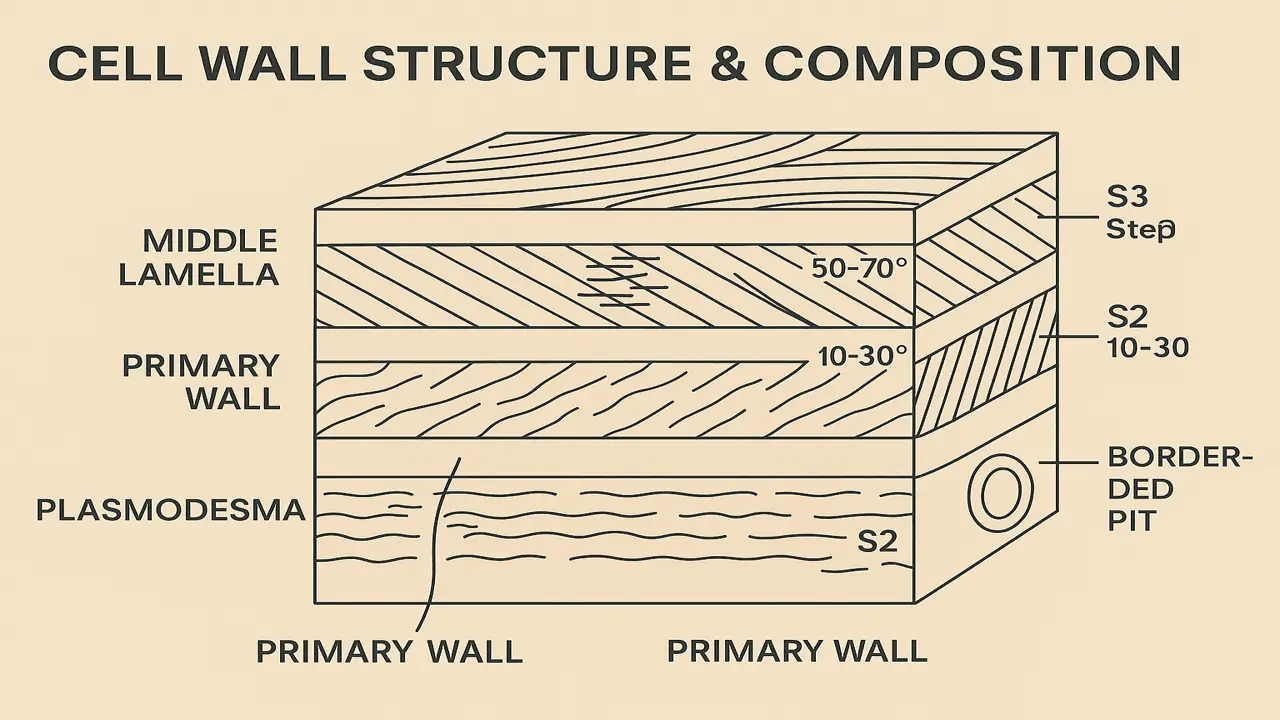
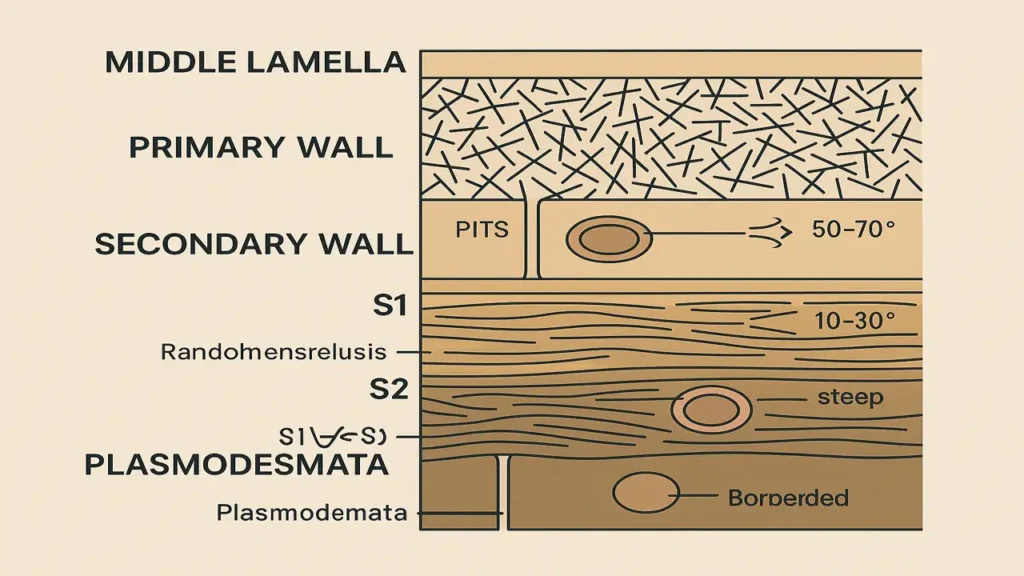
The primary wall is thin, flexible, and formed while the cell is still growing.
Composition:
- Cellulose microfibrils (25–30%): arranged randomly for extensibility.
- Hemicellulose (25–30%): cross-links cellulose.
- Pectin (30–35%): hydrophilic, gives wall plasticity.
- Proteins & enzymes: expansins, peroxidases.
Features:
- Capable of stretching during growth.
- Rich in pectin, especially in middle lamella.
- Connections via plasmodesmata allow communication and transport.
Secondary Cell Wall
Formed after cell enlargement stops—thick, rigid, multilayered.
Layers:
- S1, S2, S3 layers with distinct microfibril orientations.
- High lignin content (20–35%) for rigidity and waterproofing.
Functions:
- Provides strength (xylem vessels, fibers).
- Enables long-distance water transport.
- Makes structure resistant to pathogens.
Chemical Composition Overview
| Component | Role |
|---|---|
| Cellulose | Structural scaffold; tensile strength |
| Hemicellulose | Cross-linking polymer; wall stability |
| Pectin | Adhesion & flexibility; high in primary wall |
| Lignin | Hydrophobic polymer for rigidity; key in secondary wall |
| Cutin/Suberin | Wax-like components in protective layers |
| Proteins | Enzymes for wall loosening or hardening |
Pits & Plasmodesmata
Pits
- Thin areas in secondary wall.
- In pairs: pit-pairs, with pit membrane.
- Types: bordered pits (gymnosperms), simple pits.
Plasmodesmata
- Cytoplasmic channels connecting adjacent cells.
- Enable symplastic transport of water, ions, and signals.
- Important for coordination of growth.
Week 8 – Diagnostic Families II: Rosaceae, Cucurbitaceae, Asteraceae & Poaceae
Cell Wall Biosynthesis
Occurs at the plasma membrane (cellulose) and Golgi bodies (pectin, hemicellulose).
Steps:
- Cellulose synthase complexes deposit microfibrils.
- Golgi vesicles deliver matrix polysaccharides.
- Wall expands via acid growth and expansins.
- Lignification happens during maturation.
The approach followed at E Lectures reflects both academic depth and easy-to-understand explanations.
People also ask:
Cellulose molecules form tightly packed microfibrils through hydrogen bonding, giving high tensile strength.
Its high lignin content and layered microfibril arrangement provide compressive strength.
Plasmodesmata are cytoplasmic channels, while pits are structural wall thinnings that allow water passage.
It exhibits metachromasia, meaning it stains different chemical groups in distinct colors.
Yes, in some tissues primary walls deposit lignin, especially during maturation (e.g., collenchyma older parts).