
Brassicaceae and Fabaceae family morphology diagnostic characters, economic importance, floral diagrams, and dichotomous key lab practice.
Learning Outcomes
By the end of this week, students will be able to:
- Recognize diagnostic morphological and floral characters of Brassicaceae and Fabaceae.
- Interpret family-level features using dichotomous keys.
- Prepare and label floral diagrams for mustard and legume flowers.
- Evaluate the economic significance and global distribution of both families.
- Summarize key traits for field identification in “Family Fact Cards.”
Brassicaceae (Cruciferae)
Key Characteristics:
- Habit: Mostly annual or biennial herbs.
- Leaves: Alternate, simple, exstipulate; often form rosettes.
- Inflorescence: Raceme or corymb.
- Flower: Actinomorphic, bisexual, complete.
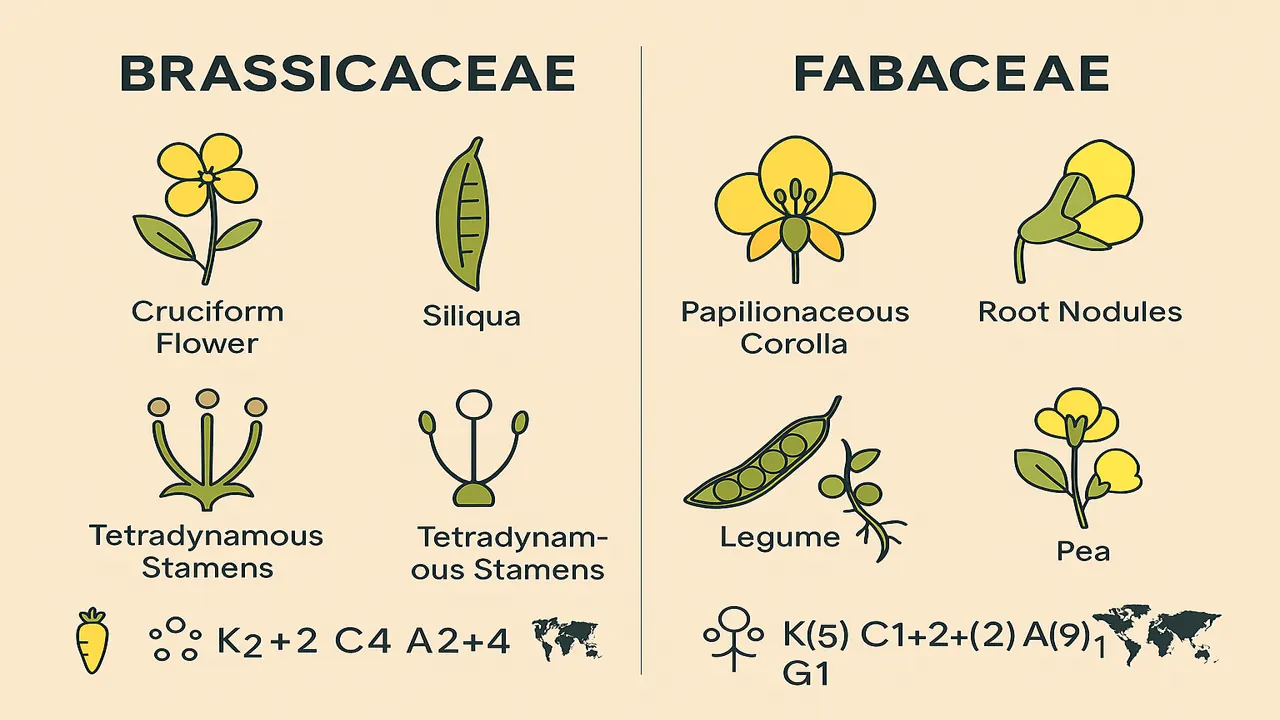
- Calyx: 4 sepals (2 outer + 2 inner).
- Corolla: 4 petals arranged in a cross (cruciform).
- Androecium: Tetradynamous (4 long + 2 short stamens).
- Gynoecium: Bicarpellary, syncarpous; ovary superior, placentation parietal.
- Fruit: Siliqua or silicule.
Floral Formula:⚥ K2+2 C4 A2+4 G(2)
Examples: Brassica campestris (mustard), Raphanus sativus (radish).
Economic Importance: Vegetables (cabbage, cauliflower), oilseeds (mustard), condiments (radish), and ornamental (Alyssum).
Distribution: Cosmopolitan, most diverse in temperate regions.
Fabaceae (Leguminosae)
Key Characteristics:
- Habit: Herbs, shrubs, or trees; root nodules with nitrogen-fixing bacteria.
- Leaves: Alternate, pinnate compound, stipulate.
- Inflorescence: Raceme, head, or solitary axillary.
- Flower: Zygomorphic, bisexual, papilionaceous corolla (standard, wings, keel).
- Calyx: 5 sepals, united.
- Corolla: 5 petals vexillary aestivation.
- Androecium: Diadelphous (9 fused + 1 free).
- Gynoecium: Monocarpellary; ovary superior, marginal placentation.
- Fruit: Legume or pod.
- Seed: Non-endospermic, rich in protein.
Floral Formula:⚥ K(5) C1+2+(2) A(9)+1 G1
Examples: Pisum sativum (pea), Cajanus cajan (pigeon pea), Trifolium (clover).
Economic Importance: Pulses, fodder, timber, green manure, gum, and medicinal plants.
Distribution: Widespread in tropical and subtropical regions.
Week 6 – Morphology II: Inflorescence, Flower, Placentation & Fruit
Economic Snapshot
| Family | Major Products | Economic Uses |
|---|---|---|
| Brassicaceae | Mustard, Cabbage, Cauliflower | Oil, Vegetables, Spices |
| Fabaceae | Pea, Beans, Clover, Acacia | Food, Fodder, Timber, Soil Enrichment |
The approach followed at E Lectures reflects both academic depth and easy-to-understand explanations.
People also ask:
Because its petals form a cross-shaped (cruciform) arrangement, hence “Cruciferae” meaning “cross-bearing.
Fabaceae” is the modern name under APG; “Leguminosae” was its older name based on characteristic fruit type the legume.
It helps distinguish members easily by their 6 stamens (4 long, 2 short), a diagnostic feature.
A unique petal arrangement with a large standard (vexillum), two wings, and two fused keel petals typical of peas and beans.
Through root nodules housing Rhizobium bacteria that fix atmospheric nitrogen.