
Diagnostic Families II Rosaceae, Cucurbitaceae, Asteraceae & Poaceae. Study floral characters, keying practice, grass florets, and composite heads.
Learning Outcomes
By the end of this week, students will be able to:
- Identify diagnostic floral and vegetative traits of Rosaceae, Cucurbitaceae, Asteraceae, and Poaceae.
- Differentiate between dicot and monocot family structures through comparative analysis.
- Practice keying out species using dichotomous keys and floral characters.
- Describe composite and grass flower morphology under hand lens/microscope.
- Recognize economically important plants from each family.
Rosaceae (Rose Family)
Habit: Trees, shrubs, or herbs with thorns and stipulate leaves.
Inflorescence: Corymb, raceme, or solitary.
Flower: Actinomorphic, bisexual, perigynous to epigynous.
Calyx: 5 sepals, often with epicalyx.
Corolla: 5 petals, free.
Androecium: Numerous stamens.
Gynoecium: Varies apocarpous (e.g., Fragaria), syncarpous (Pyrus).
Fruit: Drupe, pome, or achene (aggregate).
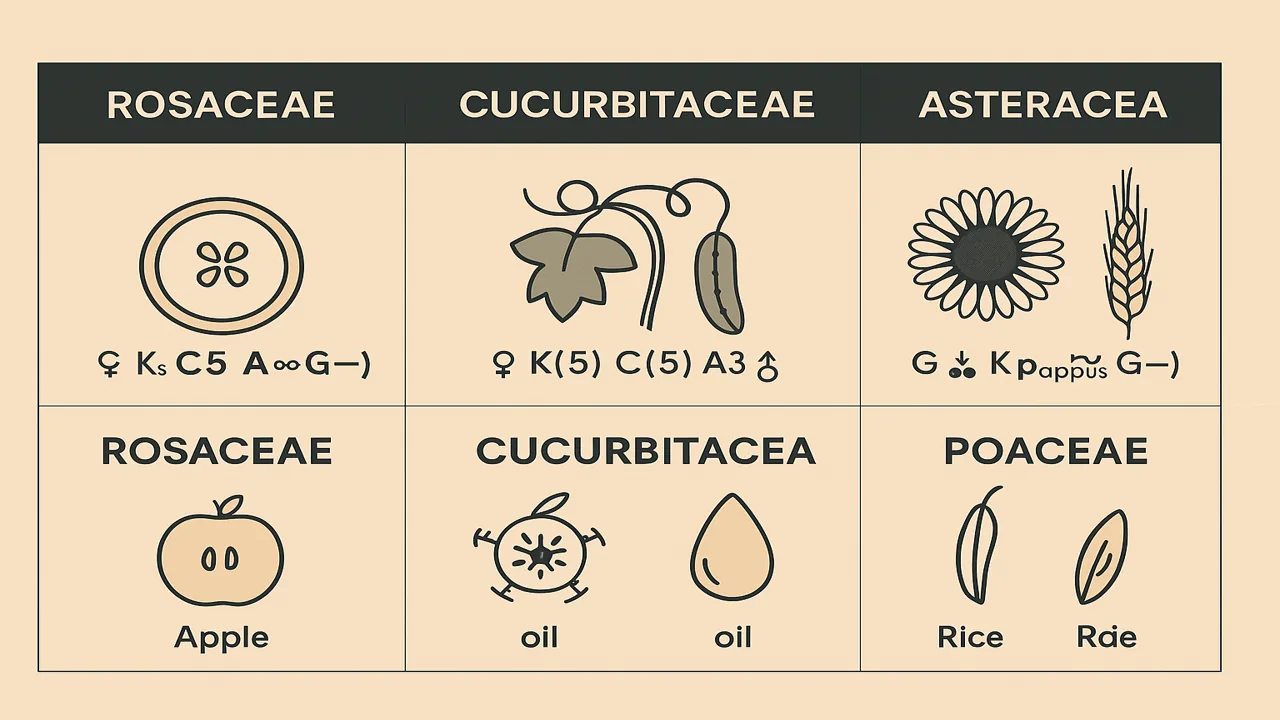
Floral Formula: ⚥ K5 C5 A∞ G(1–∞)
Examples: Rosa, Prunus, Pyrus, Fragaria.
Economic Uses: Fruits (apple, peach, plum), ornamentals (roses), essential oils.
Cucurbitaceae (Gourd Family)
Habit: Climbing or trailing herbs with tendrils.
Leaves: Alternate, palmately lobed.
Inflorescence: Unisexual flowers in axillary clusters.
Flower: Unisexual, epigynous, often yellow.
Calyx: 5 sepals.
Corolla: 5 petals, united (gamopetalous).
Androecium: 5 stamens, variously fused.
Gynoecium: Tricarpellary, syncarpous, inferior ovary.
Fruit: Pepo (fleshy, many-seeded berry-like fruit).
Floral Formula (Male): ♂ K(5) C(5) A(3)
Floral Formula (Female): ♀ K(5) C(5) G(3)
Examples: Cucurbita, Luffa, Momordica, Citrullus.
Economic Uses: Vegetables (gourds, melons, cucumbers), sponges (Luffa).
Asteraceae (Composite Family)
Habit: Mostly herbs; rarely shrubs.
Inflorescence: Capitulum or head with ray and disc florets.
Flower: Epigynous, zygomorphic (ray) or actinomorphic (disc).
Calyx: Modified into pappus (scales or hairs).
Corolla: 5 fused petals.
Androecium: 5 syngenesious stamens (fused anthers).
Gynoecium: Bicarpellary, syncarpous; inferior ovary.
Fruit: Cypsela with pappus for dispersal.
Floral Formula (Disc): ⚥ Kpappus C(5) A(5) G(2)
Examples: Helianthus, Tagetes, Ageratum.
Economic Uses: Oil (sunflower), ornamental (marigold), medicinal (chamomile).
Week 7 – Diagnostic Families I: Brassicaceae & Fabaceae Key Characters & Economic Value
Poaceae (Grass Family)
Habit: Annual or perennial herbs with hollow nodes and sheathing leaves.
Inflorescence: Spikelet (florets arranged on rachilla).
Flower: Minute, unisexual, or bisexual, enclosed by lemma and palea.
Calyx: Represented by lodicules (2–3).
Corolla: Absent or represented by bracts.
Androecium: 3 stamens.
Gynoecium: Unicarpellary, superior ovary.
Fruit: Caryopsis (grain).
Floral Formula: ⚥ ⊕ Lod2 A3 G(1)
Examples: Triticum (wheat), Oryza (rice), Zea mays (maize), Saccharum (sugarcane).
Economic Uses: Staple cereals, fodder, sugar, paper, and biofuel crops.
The approach followed at E Lectures reflects both academic depth and easy-to-understand explanations.
People also ask:
The capitulum inflorescence many florets (disc & ray) on a common receptacle with an involucre of bracts.
They are adapted for wind pollination (anemophily) reduced perianth, feathery stigmas, and exposed stamens aid pollen dispersal.
Rosaceae often produce drupes or pomes, while Asteraceae develop cypselae with pappus.
To promote cross-pollination and genetic variability through insect vectors.
It includes the world’s most important food and industrial crops—rice, wheat, maize, sugarcane, and bamboo.